English spelling can feel tricky, especially when two similar-looking words appear to mean the same thing.
One common confusion people face is flys vs flies. If you have ever wondered which spelling is correct, you are definitely not alone.
The good news is that the difference is simple once you understand the grammar rule behind it. In this guide, you’ll learn the correct spelling, meanings, grammar usage, examples, common mistakes, and how to remember the difference easily. We’ll also cover whether American and British English treat these words differently.
Quick Answer
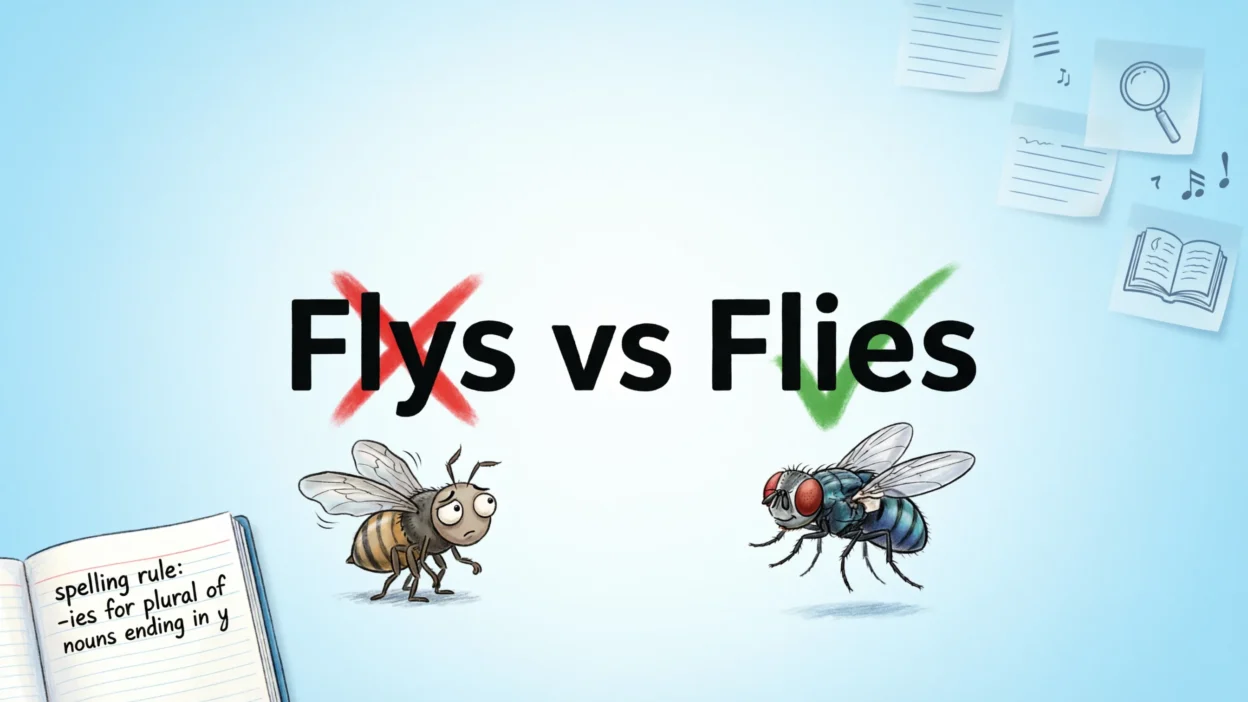
“Flies” is the correct plural and verb form of “fly.”
“Flys” is usually considered incorrect in standard English, except in a few specialized uses or proper names.
- ✅ Correct: Flies
- ❌ Usually Incorrect: Flys
Examples:
- The bird flies across the lake.
- Several flies were buzzing near the window.
What Does “Flies” Mean?
The word flies is the standard English form used in two major ways:
1. Plural Noun Form of “Fly”
A fly is a small flying insect. When referring to more than one, the correct plural becomes flies.
Examples:
- The kitchen was full of flies.
- Fruit flies are common in summer.
2. Third-Person Singular Verb Form
“Flies” is also the present tense verb form used with singular subjects.
Examples:
- She flies to New York every month.
- The airplane flies above the clouds.
This spelling follows a standard English grammar rule for nouns and verbs ending in consonant + “y.”
Why Is “Flies” Correct Instead of “Flys”?
In English grammar, when a word ends with:
consonant + y
you usually change the y to ies when making it plural or changing the verb form.
Examples
| Singular | Correct Form |
|---|---|
| Fly | Flies |
| Baby | Babies |
| City | Cities |
| Lady | Ladies |
| Cry | Cries |
Because fly ends with a consonant (“l”) followed by “y,” the correct spelling becomes:
fly → flies
What About “Flys”?
The spelling flys is generally considered incorrect in standard writing.
However, there are a few rare exceptions.
Specialized or Proper Name Usage
“Flys” may appear in:
- Brand names
- Surnames
- Technical terminology
- Old or nonstandard spellings
For example:
- A company name might intentionally use “Flys.”
- Some fishing terminology uses “flys” informally.
Still, in everyday grammar and professional writing, you should use flies.
Flys vs Flies: Side-by-Side Comparison
| Feature | Flies | Flys |
|---|---|---|
| Standard English spelling | ✅ Yes | ❌ No |
| Plural of fly | ✅ Yes | ❌ Incorrect |
| Verb form of fly | ✅ Yes | ❌ Incorrect |
| Commonly accepted | ✅ Yes | Rarely |
| Professional writing | ✅ Recommended | ❌ Avoid |
| Dictionary approval | ✅ Fully accepted | Limited/nonstandard |
Examples of “Flies” in Sentences
Here are common examples showing the correct usage.
As a Noun
- The room was filled with buzzing flies.
- House flies spread germs quickly.
- We used spray to keep the flies away.
As a Verb
- He flies internationally for work.
- Time flies when you are having fun.
- The superhero flies across the city.
Common Mistakes People Make
1. Writing “Flys” as a Plural
Incorrect:
- Two flys landed on the table.
Correct:
- Two flies landed on the table.
2. Forgetting the “Y to IES” Rule
Many learners simply add “s” automatically. But English spelling changes for words ending in consonant + y.
3. Mixing Verb and Noun Forms
Incorrect:
- She flys every weekend.
Correct:
- She flies every weekend.
Easy Grammar Rule to Remember
A simple memory trick is:
If a word ends in consonant + y, change “y” to “ies.”
Examples:
- Fly → Flies
- Cry → Cries
- Party → Parties
This rule works for many English words and helps prevent spelling mistakes.
Pronunciation of Flies
The word flies is pronounced:
“flize”
Phonetically:
/flaɪz/
Even though the spelling changes, the pronunciation remains smooth and natural in spoken English.
American vs British English Differences
There is no major difference between American and British English for this word.
Both forms of English use:
- ✅ Flies
And both generally reject:
- ❌ Flys
So whether you are writing for a US, UK, Canadian, or Australian audience, flies is the correct spelling.
Why Correct Spelling Matters
Using proper spelling improves:
- Readability
- Professionalism
- Grammar accuracy
- SEO trust signals
- User experience
Misspellings like flys can make content appear unedited or less authoritative. That matters especially in:
- Blog writing
- Academic papers
- Business communication
- Website content
- Marketing copy
Search engines also favor high-quality, accurate content, which is why proper spelling helps with SEO performance.
Synonyms and Related Words
Depending on context, here are related words you can use.
If Referring to Insects
- Bugs
- Gnats
- Mosquitoes
- Pests
- Insects
If Referring to Flying
- Soars
- Glides
- Travels
- Hovers
- Airborne movement
Using related terms naturally improves readability and keyword variety.
Idioms and Popular Expressions Using “Flies”
English includes many common expressions with the word “flies.”
Time Flies
Meaning:
- Time passes quickly.
Example:
- Time flies during vacations.
Fly on the Wall
Meaning:
- Someone quietly observing a situation.
Example:
- I wish I could be a fly on the wall during that meeting.
Flies in the Ointment
Meaning:
- Small problems ruining something good.
Example:
- The delay was the only fly in the ointment.
Frequently Asked Questions
Is “flys” ever correct?
Rarely. It may appear in names or specialized contexts, but standard English uses flies.
Which is correct: flys or flies?
Flies is the correct spelling in normal grammar.
Why does fly become flies?
Because English changes words ending in consonant + y into “ies.”
Is flies singular or plural?
“Flies” can be:
- A plural noun
- A singular verb form
Examples:
- The flies are annoying. (plural noun)
- She flies often. (singular verb)
How do you spell the plural of fly?
The correct plural spelling is:
Flies
Do British and American English spell it differently?
No. Both use flies.
What is the rule for words ending in y?
If a word ends in consonant + y, replace the y with “ies.”
Can “flies” be a verb?
Yes. Example:
- The bird flies south in winter.
Final Thoughts on Flys vs Flies
The confusion between flys vs flies usually happens because English spelling rules are not always obvious at first glance. However, once you learn the consonant + y rule, the answer becomes easy to remember.
In standard English, flies is the correct spelling for both the plural noun and verb form of fly. The spelling flys is generally considered incorrect and should be avoided in professional or academic writing.
Actionable Takeaway
Whenever you see a word ending in consonant + “y,” remember this simple rule:
Change “y” to “ies.”
So:
- Fly → Flies
- Baby → Babies
- City → Cities
Using the correct spelling instantly improves your grammar, writing quality, and credibility.

Shan Waston is a skilled writer at Symboliy.com, producing clear, engaging content on language, communication, and everyday expressions to help readers understand meaning and usage confidently in modern digital contexts.