Have you ever typed miniscule and wondered if autocorrect was being too picky? You are not alone.
The debate around minuscule vs miniscule confuses writers, students, bloggers, and even experienced professionals because both spellings appear online so frequently.
The truth is simple, but the explanation behind it is surprisingly interesting. In this guide, you will learn the correct spelling, the meaning of the word, why people commonly misspell it, and how to remember the difference forever.
We’ll also explore pronunciation, grammar usage, examples, and whether American or British English changes the rule.
Quick Answer
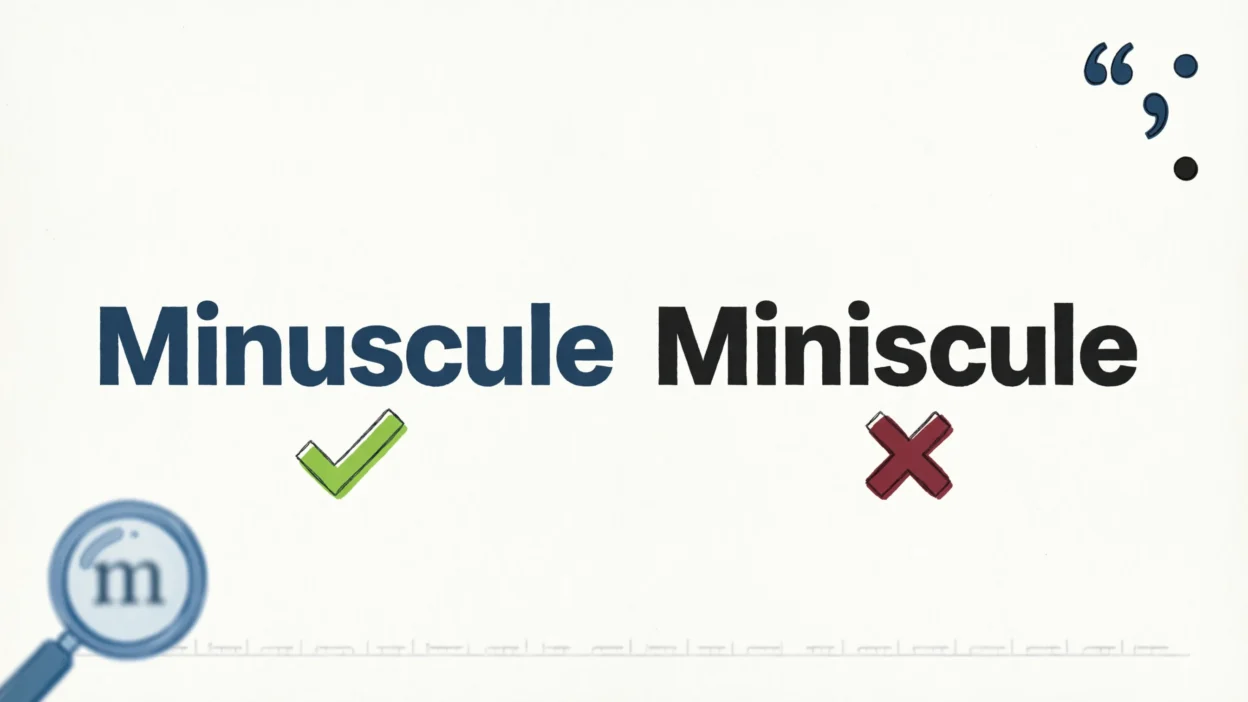
“Minuscule” is the correct spelling.
“Miniscule” is considered a misspelling, although it is commonly used because people pronounce the word incorrectly.
- ✅ Correct: Minuscule
- ❌ Incorrect: Miniscule
The word minuscule means extremely small or tiny.
Example:
- The insect was so minuscule that I could barely see it.
What Does “Minuscule” Mean?
The word minuscule describes something very small in size, amount, importance, or detail. It is often used as a synonym for:
- Tiny
- Minute
- Microscopic
- Petite
- Miniature
- Insignificant
- Negligible
In everyday English, people use it to describe physical objects, numbers, differences, or even risks.
Examples of “Minuscule” in Sentences
- The scientist observed a minuscule organism under the microscope.
- We noticed only a minuscule difference between the two designs.
- Her chances of winning were minuscule.
- The crack in the wall was almost minuscule.
Because the word sounds sophisticated and descriptive, it appears often in academic writing, journalism, blogs, and professional communication.
Why Do People Write “Miniscule”?
The confusion mainly comes from pronunciation.
Many English speakers pronounce minuscule as:
“mini-skule”
Because it sounds similar to the word mini, people naturally assume the spelling should be miniscule.
However, the correct spelling has nothing to do with the prefix “mini.”
The actual origin comes from the Latin word:
minusculus — meaning “somewhat smaller”
Over time, the spelling evolved into minuscule, which is why the “u” appears after the “n.”
Minuscule vs Miniscule: Side-by-Side Comparison
| Feature | Minuscule | Miniscule |
|---|---|---|
| Correct spelling | ✅ Yes | ❌ No |
| Dictionary accepted | ✅ Yes | Rarely listed as variant |
| Common usage | Very common | Common typo |
| Meaning | Extremely small | Intended to mean the same |
| Professional writing | Recommended | Avoid |
| Academic acceptance | Fully accepted | Considered incorrect |
Is “Miniscule” Ever Correct?
Technically, most major dictionaries still label miniscule as a nonstandard spelling or spelling variant caused by widespread misuse.
Some modern dictionaries acknowledge it because so many people use it online. However, that does not make it the preferred spelling in formal writing.
If you are writing:
- Blog articles
- Academic papers
- Business emails
- Website copy
- SEO content
- Professional documents
You should always use minuscule.
American vs British English Differences
Unlike many English spelling debates, there is no major difference between American English and British English here.
Both forms of English prefer:
- ✅ Minuscule
And both generally reject:
- ❌ Miniscule
So whether you write for a US audience or a UK audience, the correct spelling remains the same.
Pronunciation of Minuscule
Phonetically:
/ˈmɪnəˌskjuːl/
Because many people say “mini-skule,” the incorrect spelling became popular through speech habits rather than grammar rules.
Common Mistakes Related to Minuscule
Here are several mistakes people frequently make.
1. Using “Miniscule” in Formal Writing
Incorrect:
- The error was miniscule.
Correct:
- The error was minuscule.
2. Confusing It with “Mini”
Many assume the word relates to “miniature,” but it does not come from the same spelling pattern.
3. Overusing the Word
Because minuscule sounds elegant, writers sometimes overuse it. Simpler alternatives like “tiny” or “small” may improve readability in casual writing.
Easy Trick to Remember the Correct Spelling
Another helpful reminder:
Think of “minus” meaning smaller.
Since minuscule relates to smallness, the “minus” connection helps reinforce the correct spelling.
Synonyms of Minuscule
Using related words improves readability and SEO diversity. Here are useful synonyms:
- Tiny
- Minute
- Microscopic
- Small-scale
- Miniature
- Slight
- Trivial
- Negligible
- Compact
- Little
Example Variations
Instead of:
- A minuscule amount
You could write:
- A negligible amount
- A tiny amount
- A microscopic amount
Antonyms of Minuscule
Understanding opposites also helps with vocabulary learning.
Common antonyms include:
- Huge
- Massive
- Enormous
- Significant
- Large
- Gigantic
- Immense
When Should You Use “Minuscule”?
The word works best when describing:
Physical Size
- A minuscule scratch
- A minuscule insect
Amounts or Quantities
- A minuscule budget increase
- A minuscule percentage
Importance or Impact
- A minuscule risk
- A minuscule chance of failure
Scientific or Technical Contexts
- Minuscule particles
- Minuscule organisms
Is “Miniscule” Bad for SEO or Professional Credibility?
Yes, it can hurt credibility.
Search engines increasingly value content quality and accuracy. Using common misspellings in headlines or professional copy may:
- Reduce reader trust
- Make content appear unedited
- Affect perceived authority
- Lower editorial quality
However, including the misspelled variation naturally inside your article can still help capture search intent because many users search for:
- “miniscule or minuscule”
- “how to spell minuscule”
- “miniscule meaning”
That is why SEO writers often mention both spellings while clarifying which one is correct.
Historical Background of the Word
The word minuscule entered English through medieval Latin and French influences. Interestingly, it was also used to describe a style of small handwriting in ancient manuscripts.
In typography and paleography, minuscule letters refer to lowercase letters.
Example:
- “a, b, c” are minuscule letters.
- “A, B, C” are majuscule letters.
This historical meaning still exists in typography, publishing, and linguistics.
Examples in Everyday Conversation
Here are natural examples of the word used correctly.
- The phone defect was so minuscule that customers barely noticed it.
- Our improvement in sales was minuscule this quarter.
- She wore a necklace with minuscule diamonds.
- The chances of rain today are minuscule.
- A minuscule error in coding caused the system crash.
Frequently Asked Questions
Is miniscule a real word?
It is considered a misspelling or nonstandard variant of minuscule. Most professional writers avoid it.
Which is correct: minuscule or miniscule?
Minuscule is the correct spelling.
Why do people spell it “miniscule”?
Because many people pronounce the word incorrectly as “mini-skule.”
Is miniscule accepted in dictionaries?
Some dictionaries mention it as a common variant, but it is still not recommended in formal writing.
How do you pronounce minuscule?
It is pronounced:
MIN-uh-skyool
Does British English use “miniscule”?
No. British English also prefers minuscule.
What does minuscule mean?
It means extremely small, tiny, or insignificant.
Can I use “miniscule” in casual writing?
You can, but it may still appear incorrect to readers. Using minuscule is safer and more professional.
Final Thoughts on Minuscule vs Miniscule
The confusion between minuscule vs miniscule is one of the most common spelling mistakes in English. While both versions appear online, only minuscule is widely accepted as correct in formal and professional writing. The error usually happens because pronunciation influences spelling habits.
If you want your writing to look polished, credible, and grammatically accurate, always choose minuscule. Whether you are writing blog posts, academic essays, marketing copy, or emails, using the correct spelling improves clarity and professionalism.
Actionable Takeaway
Whenever you feel tempted to write miniscule, remember this quick rule:
The “usc” spelling is the standard form in both American and British English. Save this rule, practice it in sentences, and your spelling mistake will disappear permanently.

Here is a professional 30-word author biography including your site name Symboliy.com:
Martin Hood is a professional writer at Symboliy.com, creating clear, informative content focused on language, communication, and meaningful expressions for everyday and professional use.