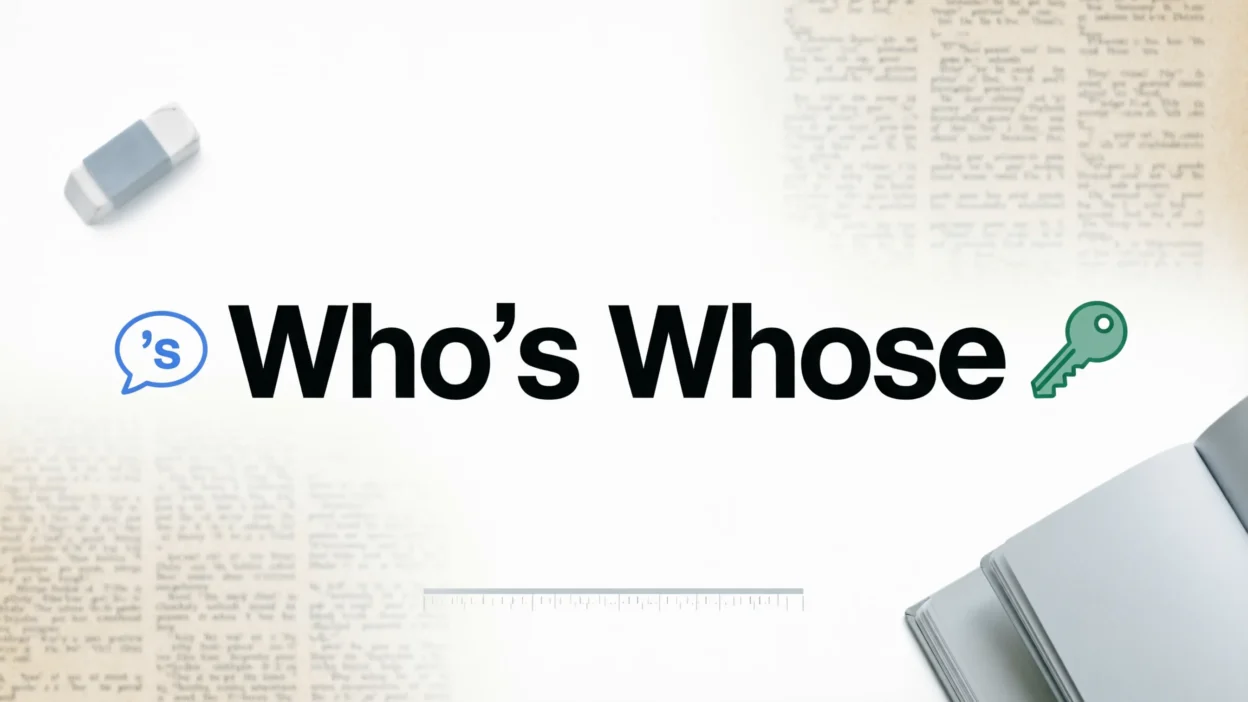
The confusion between who’s vs whose is one of the most common grammar mistakes in English writing. Even experienced writers occasionally pause before using these words because they sound exactly the same when spoken.
However, their meanings are completely different, and using the wrong one can make a sentence look grammatically incorrect.
If you’ve ever wondered whether to write who’s coming today or whose book is this, you’re in the right place.
This guide explains the difference between who’s and whose in simple language, with examples, grammar tips, common mistakes, and easy memory tricks to help you use them confidently every time.
Quick Answer
- Who’s = contraction of who is or who has
- Whose = possessive form of who
Examples
- ✅ Who’s calling me right now?
(Who is calling me right now?) - ✅ Whose jacket is on the chair?
(The jacket belongs to someone.)
A simple trick:
- If you can replace it with who is or who has, use who’s.
- If it shows ownership, use whose.
What Does “Who’s” Mean?
The word who’s is a contraction. It combines:
- who + is
or - who + has
The apostrophe replaces missing letters.
Examples of “Who’s”
- Who’s coming to dinner tonight?
→ Who is coming to dinner tonight? - Who’s finished the assignment?
→ Who has finished the assignment? - Do you know who’s at the door?
In each sentence, who’s can be expanded into who is or who has.
What Does “Whose” Mean?
The word whose is a possessive pronoun. It shows ownership or connection.
Examples of “Whose”
- Whose phone is ringing?
- Do you know whose keys these are?
- She’s the person whose idea won the competition.
Here, whose asks or describes who owns or possesses something.
Who’s vs Whose: Key Difference
The main difference is simple:
| Word | Meaning | Function |
|---|---|---|
| who’s | who is / who has | contraction |
| whose | belonging to whom | possessive pronoun |
Quick Test
Try replacing the word with:
- who is
or - who has
If the sentence still makes sense, use who’s.
If not, use whose.
Example
- Who’s ready for the trip?
→ Who is ready for the trip? ✔ - Whose bag is this?
→ Who is bag is this? ✘
Common Mistakes People Make
Because the two words sound identical, many people mix them up in writing.
Mistake #1: Using “who’s” for possession
❌ Who’s car is parked outside?
✅ Whose car is parked outside?
Mistake #2: Forgetting “who’s” means “who is”
❌ Whose going to the party?
✅ Who’s going to the party?
Mistake #3: Ignoring the apostrophe rule
Apostrophes usually indicate:
- contractions
or - possession
But whose is an exception. Even without an apostrophe, it already shows possession.
Easy Trick to Remember the Difference
A simple memory trick makes this easy.
Use This Rule
- Who’s → expand it to who is or who has
- Whose → think of ownership
Helpful Reminder
Apostrophe = missing letters, not ownership in this case.
This is similar to:
- it’s = it is
- whose = possessive
Examples in Everyday Sentences
Using “Who’s”
- Who’s your favorite author?
- Who’s been using my laptop?
- Who’s available for the meeting?
Using “Whose”
- Whose shoes are by the door?
- I met a writer whose novels became famous.
- Whose turn is it now?
Practicing with real sentences helps the grammar feel natural.
Grammar Explanation Made Simple
“Who’s” as a Contraction
Contractions shorten two words into one:
- who is → who’s
- who has → who’s
“Whose” as a Possessive Pronoun
Possessive pronouns show ownership:
- my
- your
- their
- whose
Example:
- Whose notebook is missing?
American vs British English Differences
There is no spelling difference between American and British English for these words.
Both forms are identical in:
- American English
- British English
- Canadian English
- Australian English
Correct usage stays the same worldwide.
Why Correct Usage Matters
Using who’s and whose correctly improves:
Writing Clarity
Correct grammar helps readers understand your meaning immediately.
Professionalism
Grammar mistakes in emails, blogs, or resumes can appear careless.
Academic Accuracy
Teachers and editors often notice homophone errors quickly.
SEO and Content Quality
Clear, grammatically correct writing improves readability and user trust.
Similar Grammar Confusions
People often confuse who’s vs whose with other English homophones like:
| Incorrect Pair | Correct Usage |
|---|---|
| its vs it’s | possession vs contraction |
| your vs you’re | possession vs contraction |
| there vs their | location vs possession |
| affect vs effect | verb vs noun |
Learning these patterns strengthens overall grammar skills.
Frequently Asked Questions
Is “who’s” short for “who is”?
Yes. It can also mean “who has.”
Is “whose” possessive?
Yes. It shows ownership or relationship.
Can “whose” refer to things?
Yes. Modern English allows whose for people, animals, and things.
Example:
- A company whose products are popular worldwide.
Which is correct: “Who’s book is this?” or “Whose book is this?”
✅ Correct: Whose book is this?
How do I test which word to use?
Replace the word with:
- who is
or - who has
If it works, use who’s.
Why is “whose” spelled without an apostrophe?
Because it is a possessive pronoun, similar to:
- his
- hers
- theirs
Is “who’s” formal English?
Yes, but in very formal writing, some people prefer writing the full phrase who is.
Final Thoughts on Who’s vs Whose
Understanding who’s vs whose becomes much easier once you remember one key rule: who’s is a contraction, while whose shows possession. Even though they sound identical, they serve completely different purposes in English grammar.
Whenever you feel unsure, do the quick replacement test. If you can substitute who is or who has, choose who’s. If the sentence talks about ownership or belonging, use whose. With a little practice, the difference becomes automatic and your writing instantly looks more polished and professional.
The best takeaway is simple:
Who’s = who is. Whose = ownership.
Keep that rule in mind, and you’ll rarely make this grammar mistake again.

Shan Waston is a skilled writer at Symboliy.com, producing clear, engaging content on language, communication, and everyday expressions to help readers understand meaning and usage confidently in modern digital contexts.