
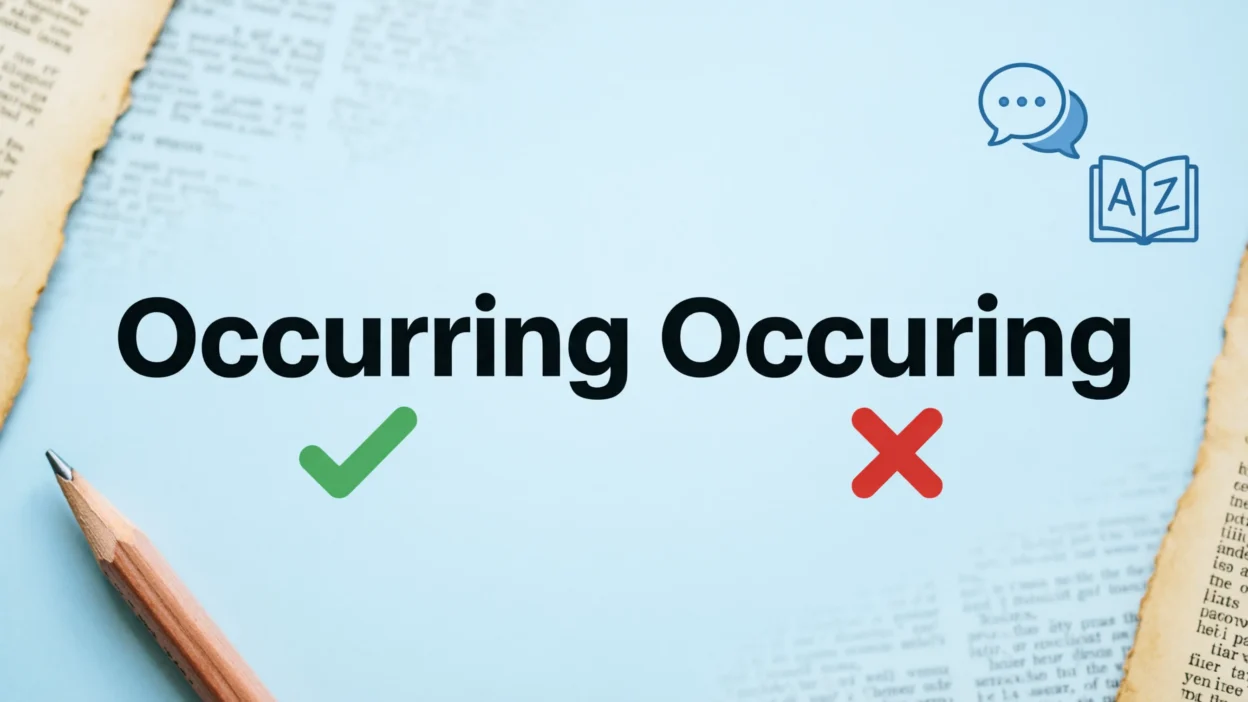
If you’ve ever paused while typing occurring and wondered whether it should have one “r” or two, you’re not alone. The confusion between occurring vs occuring is incredibly common, especially because English spelling rules can feel inconsistent at times.
Whether you’re writing an email, blog post, academic paper, or social media caption, using the correct spelling helps your writing appear polished and professional.
The good news is simple: “occurring” is correct, while “occuring” is incorrect. The extra “r” follows a standard English spelling rule that applies to many verbs ending in a vowel plus consonant.
In this guide, you’ll learn the meaning of the word, why the spelling changes, common mistakes to avoid, and easy memory tricks to help you remember the correct form every time.
Quick Answer
- ✅ Correct spelling: occurring
- ❌ Incorrect spelling: occuring
The word occurring comes from the verb occur. When adding -ing, the final “r” is doubled because the word ends in a stressed vowel-consonant pattern.
Example:
- A strange noise is occurring every night.
- Several changes are occurring in the industry.
What Does “Occurring” Mean?
The word occurring is the present participle form of the verb occur. It means:
- Happening
- Taking place
- Existing or appearing
- Coming to mind
Examples in Sentences
- Heavy rainfall is occurring across the region today.
- A major event is occurring downtown this weekend.
- The same issue keeps occurring during testing.
- An interesting idea is occurring to me now.
In everyday English, occurring is commonly used in conversations, news articles, academic writing, and professional communication.
Why “Occurring” Has Two Rs
Many English learners and even native speakers accidentally write occuring because they assume adding “-ing” only requires attaching the suffix. However, English spelling follows a doubling rule.
When a verb:
- Ends in a single consonant,
- Has a vowel before the consonant,
- And the final syllable is stressed,
the final consonant is usually doubled before adding -ing or -ed.
The verb occur fits this pattern perfectly.
Correct Formation
- occur → occurring
- occur → occurred
Similar Examples
- run → running
- begin → beginning
- admit → admitting
- refer → referring
This rule helps maintain proper pronunciation and readability.
Occurring vs Occuring: Comparison Table
| Word | Correct? | Meaning | Notes |
|---|---|---|---|
| occurring | ✅ Yes | Happening or taking place | Standard English spelling |
| occuring | ❌ No | Incorrect spelling | Missing the second “r” |
This spelling mistake appears frequently in informal writing, but dictionaries and grammar guides recognize only occurring as correct.
Common Mistakes People Make
Confusion around occurring vs occuring often happens because English contains many irregular spelling patterns. Here are the most common errors.
Forgetting the Double “R”
Many writers type:
- ❌ “The meeting is occuring tomorrow.”
Correct version:
- ✅ “The meeting is occurring tomorrow.”
Mixing Up Verb Rules
Some verbs do not double the final consonant:
- open → opening
- listen → listening
Because of this inconsistency, people mistakenly assume occur follows the same pattern.
Fast Typing Errors
Autocorrect sometimes misses uncommon mistakes, especially in informal writing or online content. Proofreading helps catch spelling issues before publishing.
Easy Trick to Remember the Correct Spelling
A simple memory trick can help.
Think of it this way:
“An event is occurring repeatedly, so the ‘r’ repeats too.”
Since occur already ends with “r,” adding -ing doubles it:
- occur + ring = occurring
Another easy approach:
- If the word sounds stronger at the end, double the consonant.
Is There an American vs British English Difference?
No. Both American English and British English use the spelling occurring.
Unlike words such as:
- color vs colour
- traveling vs travelling
the spelling of occurring stays the same across both language styles.
Correct in Both Variants
- American English: occurring
- British English: occurring
So no matter where you write English, the correct spelling remains unchanged.
Examples of “Occurring” in Different Contexts
Understanding how the word appears in real-life situations makes it easier to remember.
Academic Writing
- Climate changes are occurring more rapidly than expected.
- Several reactions are occurring simultaneously in the experiment.
Workplace Communication
- A technical issue is occurring in the software dashboard.
- Unexpected delays are occurring during production.
Everyday Conversation
- What’s occurring here?
- Something unusual is occurring outside.
News and Media
- Flooding is currently occurring in low-lying areas.
- Significant changes are occurring in global markets.
Synonyms for “Occurring”
Using related words can improve writing variety and SEO relevance.
Common Synonyms
- happening
- taking place
- unfolding
- arising
- transpiring
- developing
- emerging
Example
Instead of:
- “Problems are occurring frequently.”
You could write:
- “Problems are happening frequently.”
- “Issues are arising frequently.”
These alternatives help improve readability while maintaining meaning.
Grammar Notes About “Occurring”
The word occurring functions as:
- A present participle
- A gerund in some cases
- Part of continuous verb tenses
Present Continuous
- Changes are occurring rapidly.
Gerund Usage
- Occurring unexpectedly caused confusion.
Understanding grammar usage can make your writing smoother and more natural.
Why Correct Spelling Matters
Correct spelling affects more than grammar. It also impacts:
Professionalism
Misspelled words can make writing seem rushed or careless.
SEO and Search Rankings
Search engines understand spelling variations, but correctly spelled keywords improve clarity and trustworthiness.
Reader Trust
Readers are more likely to trust content that is polished and error-free.
Academic Accuracy
Proper spelling is especially important in essays, reports, and research papers.
Frequently Asked Questions
Is “occuring” ever correct?
No. Occuring is always considered a misspelling in standard English.
Why does “occurring” have two Rs?
Because the verb occur follows the consonant doubling rule before adding “-ing.”
How do you spell “occurred”?
The correct spelling is:
- ✅ occurred
- ❌ occured
The “r” is doubled here as well.
Is “occurring” used in formal writing?
Yes. It is commonly used in academic, business, scientific, and professional writing.
Do British and American English spell it differently?
No. Both use the spelling occurring.
What part of speech is “occurring”?
It is primarily a present participle form of the verb occur.
Can “occurring” be used as an adjective?
Yes, in some contexts:
- naturally occurring minerals
- commonly occurring issues
Why do people confuse occurring and occuring?
Because English spelling rules are inconsistent, and many writers forget the consonant doubling rule.
Final Thoughts on Occurring vs Occuring
The difference between occurring vs occuring is straightforward once you understand the spelling rule. The correct form is always occurring, with two “r” letters. The incorrect version, occuring, appears often online but is not accepted in standard English grammar.
Whenever you add -ing to the verb occur, remember to double the final consonant. This small detail makes your writing clearer, more professional, and grammatically correct. Whether you’re writing an email, article, essay, or report, using the correct spelling helps build credibility and confidence.
The easiest takeaway is this:
If it comes from “occur,” keep the double “r” before adding “-ing.” Proofread carefully, rely on spell-check tools when needed, and practice using the word in sentences to make the spelling feel natural over time.

Mike Poop is a dedicated writer at Symboliy.com, creating clear, practical content about language, communication, and everyday expressions to help readers understand meaning and usage confidently in professional contexts worldwide.