
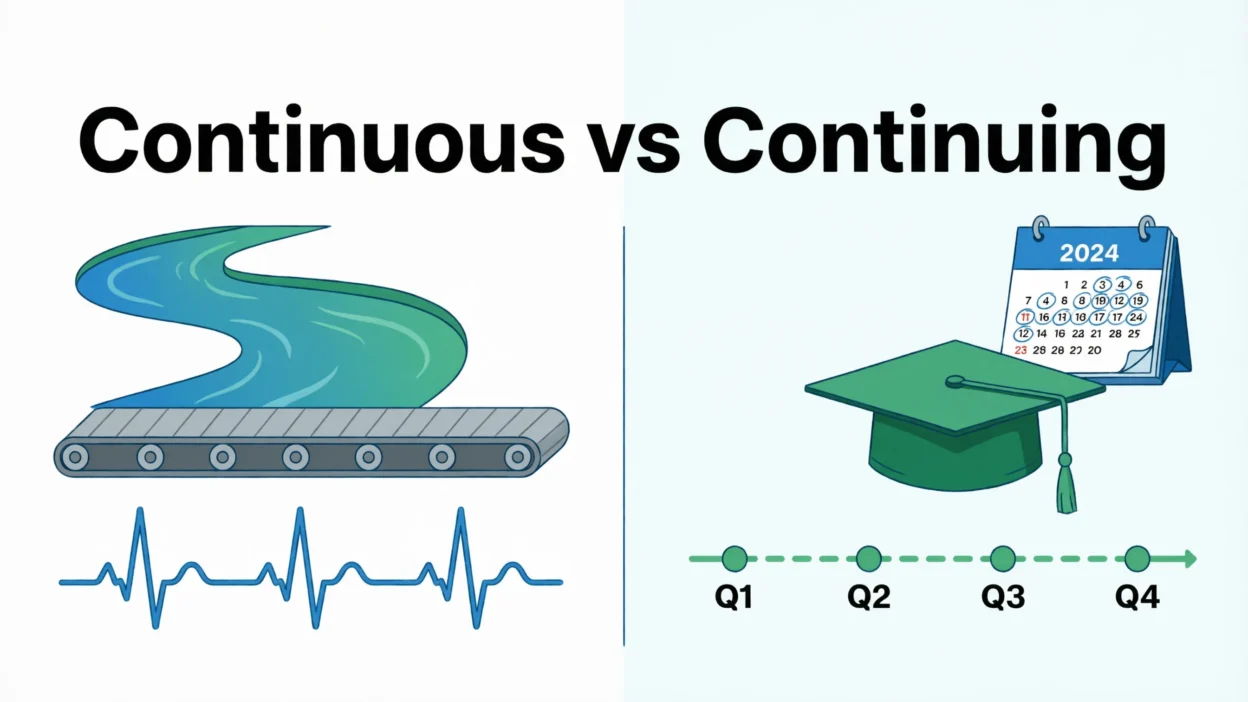
The words continuous and continuing are closely related, which is why they’re often confused. Both describe something that keeps going, but they aren’t always interchangeable.
Choosing the correct word can make your writing more accurate, whether you’re writing for school, work, or everyday communication.
If you’ve ever wondered about the difference between continuous vs continuing, you’re in the right place.
This guide explains each word in simple American English, provides real-life examples, highlights common mistakes, and offers easy memory tricks so you’ll always know which one to use.
Quick Answer
The difference between continuous and continuing is straightforward:
- Continuous means without interruption or stopping.
- Continuing means still happening, ongoing, or carried on over time, but it may include pauses or interruptions.
Examples:
- The machine operated continuously for 24 hours. (No interruptions.)
- She is receiving continuing education to improve her skills. (Ongoing over time.)
The key distinction is that continuous emphasizes unbroken action, while continuing emphasizes ongoing duration, even if there are breaks.
What Does “Continuous” Mean?
Continuous is an adjective that describes something happening without any interruption, pause, or break.
It is commonly used when discussing processes, movement, sounds, or actions that never stop during a given period.
Examples of Continuous
- The rain was continuous throughout the night.
- The factory runs on a continuous production line.
- We heard a continuous buzzing noise.
- The patient required continuous monitoring.
- The internet connection provided continuous service.
Common Uses of Continuous
- Continuous improvement
- Continuous monitoring
- Continuous operation
- Continuous flow
- Continuous process
- Continuous learning
- Continuous production
What Does “Continuing” Mean?
Continuing is an adjective (and the present participle of continue) that describes something that continues over time or is still in progress. Unlike continuous, it does not necessarily mean the action happens without interruption.
Examples of Continuing
- She enrolled in a continuing education program.
- The company faces continuing challenges.
- There is continuing interest in the project.
- The investigation remains continuing.
- We appreciate your continuing support.
Common Uses of Continuing
- Continuing education
- Continuing support
- Continuing efforts
- Continuing concern
- Continuing discussion
- Continuing development
- Continuing partnership
Continuous vs Continuing Comparison Table
| Feature | Continuous | Continuing |
|---|---|---|
| Meaning | Happening without interruption | Ongoing over time, possibly with breaks |
| Part of Speech | Adjective | Adjective (also present participle of continue) |
| Focus | Unbroken action | Ongoing duration |
| Can It Include Pauses? | No | Yes |
| Example | Continuous rainfall | Continuing negotiations |
Why People Confuse Continuous and Continuing
These words are often confused because both come from the verb continue and describe something that lasts over time.
The confusion happens because:
- They share the same root word.
- Both describe ongoing actions.
- They sometimes appear in similar contexts.
- Both relate to time and duration.
The important difference is this:
Continuous means never stopping.
Continuing means still happening, even if it pauses occasionally.
Easy Memory Trick
Here’s a simple way to remember the difference.
Continuous = Constant
Both words begin with C and describe something that happens without stopping.
Continuing = Carrying On
Think of continuing as something that carries on over time, even if it stops and starts again.
If there are no breaks, choose continuous.
If something is still happening over a period of time, choose continuing.
Example Sentences
Continuous
- The alarm produced a continuous sound.
- The hospital provides continuous patient monitoring.
- The road experienced continuous traffic all day.
- Engineers ensured continuous power during the outage.
- The river maintained a continuous flow.
Continuing
- The organization appreciates your continuing generosity.
- They discussed the continuing effects of climate change.
- Her continuing education improved her career prospects.
- The team made continuing efforts to solve the issue.
- We expect continuing growth next year.
Common Mistakes
Although these words are related, they shouldn’t always replace one another.
Incorrect
- She enrolled in a continuous education program.
Correct
- She enrolled in a continuing education program.
Incorrect
- The machine requires continuing operation without stopping.
Correct
- The machine requires continuous operation without stopping.
Incorrect
- The patient needed continuing monitoring every second.
Correct
- The patient needed continuous monitoring every second.
Before choosing a word, ask yourself whether the action is uninterrupted or simply ongoing.
American vs. British English
There is no spelling difference between American English and British English for continuous and continuing.
Both varieties use:
- Continuous
- Continuously
- Continuing
- Continue
The meanings are also the same. However, the phrase continuing education is especially common in American English, while British English may also use further education, professional development, or continuing professional development (CPD) in certain contexts.
When Should You Use Continuous?
Use continuous when talking about:
- Sounds
- Movement
- Monitoring
- Production
- Flow
- Power supply
- Processes with no interruptions
When Should You Use Continuing?
Use continuing when referring to:
- Education
- Support
- Discussions
- Efforts
- Challenges
- Relationships
- Projects that continue over time
Related Words and Synonyms
Synonyms for Continuous
- Constant
- Uninterrupted
- Unbroken
- Nonstop
- Steady
- Persistent
- Ongoing (in some contexts)
Synonyms for Continuing
- Ongoing
- Lasting
- Sustained
- Existing
- Enduring
- Remaining
- Persisting
Frequently Asked Questions
1. What is the difference between continuous and continuing?
Continuous means happening without interruption, while continuing means ongoing over time and may include pauses.
2. Is continuing education the same as continuous education?
No. Continuing education is the correct expression because learning happens over time through separate courses or programs, not without interruption.
3. Can continuous mean ongoing?
Yes, but it specifically emphasizes that there are no breaks in the action.
4. Which word is correct for patient monitoring?
If monitoring occurs without interruption, continuous monitoring is the correct term.
5. Can negotiations be continuous?
Usually, negotiations are described as continuing, since meetings often pause and resume over days or weeks.
6. Is there a difference between continuous improvement and continuing improvement?
Yes. Continuous improvement is the standard business and quality management term because it refers to an ongoing process of making improvements in a consistent, uninterrupted cycle.
7. Are continuous and continuing interchangeable?
Not always. They overlap in some contexts, but continuous focuses on unbroken action, while continuing focuses on ongoing duration.
8. Is the spelling different in American and British English?
No. Both American and British English use the same spelling and meanings for continuous and continuing.
Summary
Understanding continuous vs continuing becomes much easier when you focus on the type of action being described. Continuous refers to something happening without interruption or stopping, while continuing refers to something that remains in progress over time, even if there are breaks. Although both words describe duration, they emphasize different aspects of it.
Whenever you’re unsure which word to use, think about whether the action is completely unbroken or simply still ongoing. If there are no pauses, choose continuous. If the activity extends over time but may stop and resume, choose continuing. Using the correct word will make your writing clearer, more natural, and more precise.
Actionable Takeaway
Remember this simple rule:
- Continuous = No interruptions
- Continuing = Still going over time
Keeping this distinction in mind will help you choose the right word in academic writing, professional communication, and everyday English.

Here is a professional 30-word author biography including your site name Symboliy.com:
Martin Hood is a professional writer at Symboliy.com, creating clear, informative content focused on language, communication, and meaningful expressions for everyday and professional use.