
If you’ve ever paused while writing to wonder whether you should use any time or anytime, you’re not alone. These two expressions look almost identical, but they have different meanings and grammatical functions.
Using the wrong one can make your writing seem less polished, especially in academic, professional, or business settings.
In this complete grammar guide, you’ll learn the difference between any time vs anytime, when to use each one, grammar rules, real-life examples, common mistakes, American vs British English differences, and simple memory tricks. By the end, you’ll know exactly which form fits every situation.
Quick Answer
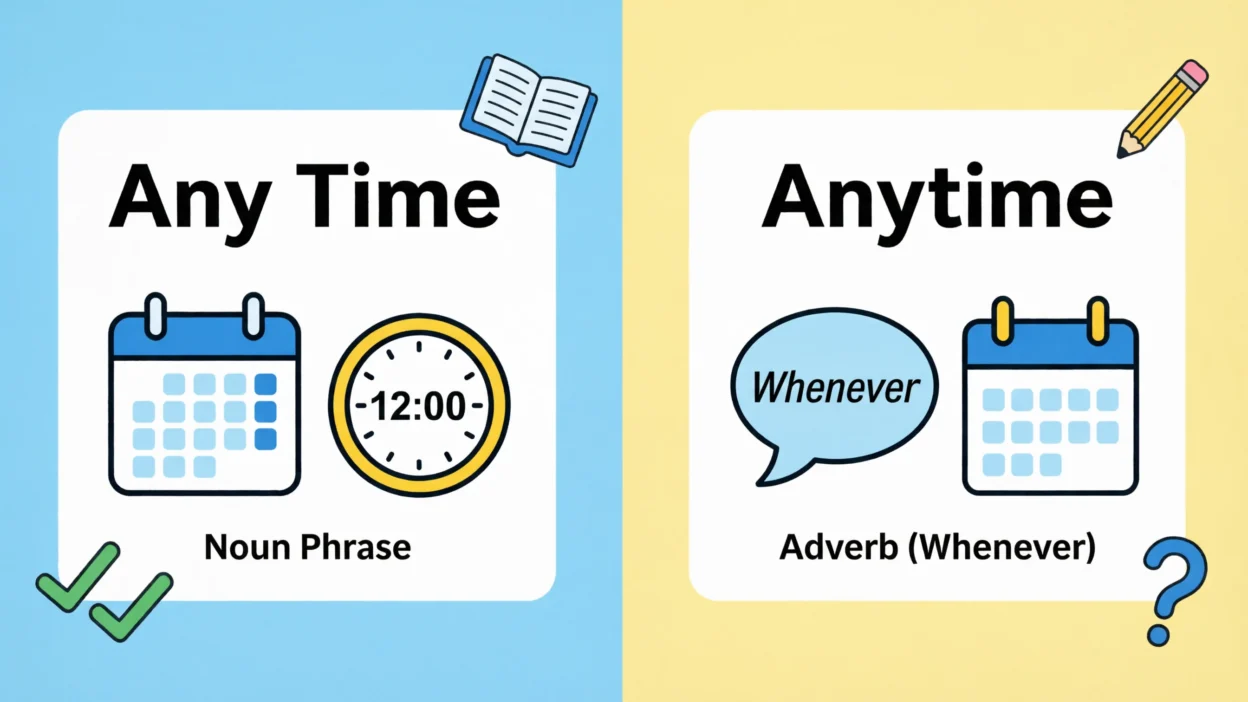
Any time (two words) is a noun phrase that means “at any point in time.”
Anytime (one word) is an adverb that means “whenever” or “at any time.”
Correct Examples:
- You can call me any time during the day. ✅
- You can visit anytime. ✅
Both forms are correct—but only when used in the right context.
What Do “Any Time” and “Anytime” Mean?
Although they sound the same, any time and anytime serve different grammatical purposes.
Any Time Meaning
Any time is a noun phrase.
It refers to an unspecified amount of time or any point in time.
Examples
- Do you have any time to talk today?
- I don’t have any time for distractions.
- Call me at any time if you need help.
Notice that time functions as a noun in these examples.
Anytime Meaning
Anytime is an adverb.
It means:
- Whenever
- At any moment
- At any point
Examples
- You can visit anytime.
- Feel free to call anytime.
- I’m available anytime this week.
Here, anytime modifies the verb and tells when something can happen.
Any Time vs Anytime: Comparison Table
| Feature | Any Time | Anytime |
|---|---|---|
| Part of speech | Noun phrase | Adverb |
| Meaning | Any amount or point of time | Whenever; at any moment |
| Formal writing | Preferred in many contexts | Accepted in modern English |
| Can follow “at” | Yes | Usually no |
| Example | At any time | Visit anytime |
When to Use “Any Time”
Use any time when time is functioning as a noun.
It’s especially common after prepositions like:
- At
- Have
- Need
- Spend
Examples
- You may call at any time.
- I don’t have any time to finish the report.
- She rarely has any time for herself.
- Is there any time available tomorrow?
A useful test is this:
If you can insert another adjective before time, then any time is likely correct.
Example:
- I don’t have any free time.
- I don’t have any time.
When to Use “Anytime”
Use anytime as an adverb meaning whenever.
It modifies a verb rather than naming a period of time.
Examples
- Come over anytime.
- You can email me anytime.
- Visit us anytime this weekend.
- I’ll help you anytime you need me.
In these examples, anytime answers the question when?
Key Difference Between Any Time and Anytime
The easiest way to remember the difference is this:
- Any time = a thing (noun phrase).
- Anytime = describes when something happens (adverb).
For example:
- I don’t have any time today.
- Stop by anytime.
The first refers to available time.
The second tells when someone may stop by.
Examples in Everyday English
Talking About Work
- I don’t have any time for another meeting.
- You can call me anytime after lunch.
Talking About School
- Do you have any time to study tonight?
- Visit the library anytime during opening hours.
Talking About Friends
- We haven’t spent any time together lately.
- You’re welcome anytime.
Talking About Travel
- Flights may leave at any time.
- Feel free to visit us anytime you’re in town.
Common Mistakes to Avoid
These two expressions are easy to confuse because they sound identical.
Mistake 1: Writing “Anytime” After “At”
❌ Call me at anytime.
✅ Call me at any time.
After the preposition at, use the two-word form.
Mistake 2: Using “Any Time” as an Adverb
❌ Come any time.
Although this is accepted by many style guides, come anytime is generally smoother when anytime functions as an adverb.
Mistake 3: Assuming They Are Always Interchangeable
While both forms often appear in similar sentences, they are not always interchangeable.
Pay attention to whether you’re using a noun phrase or an adverb.
Easy Memory Trick
Here’s a simple way to remember:
- If you can replace it with whenever, use anytime.
- If you’re talking about time itself, use any time.
Examples:
- Visit anytime. → Visit whenever. ✔
- I don’t have any time. → I don’t have whenever. ✘
This quick test works in most situations.
American vs British English
Both American English and British English recognize any time and anytime.
However, there is a slight difference in preference.
American English
Modern American English frequently uses anytime as one word when it functions as an adverb.
British English
British English tends to favor any time in more situations, especially in formal writing.
Even so, anytime is increasingly accepted in contemporary British English, particularly in informal contexts.
Related Words and Phrases
Expanding your vocabulary can help you understand these expressions more naturally.
- Whenever
- At any moment
- At any point
- Free time
- Spare time
- Available
- Anytime soon
- Any day
- At all times
- Whenever you like
These related phrases commonly appear in everyday English and professional writing.
Why Using “Any Time” and “Anytime” Correctly Matters
Choosing the correct form improves both grammar and readability.
Using any time and anytime correctly helps you:
- Write more professionally.
- Avoid common grammar mistakes.
- Improve clarity.
- Build credibility with readers.
- Produce polished academic and business writing.
Understanding the distinction also helps you communicate more naturally in everyday English.
Frequently Asked Questions
Is “anytime” one word or two?
Both forms are correct, but they have different uses. Anytime is an adverb, while any time is a noun phrase.
Which is grammatically correct?
Both are grammatically correct when used appropriately.
Is “call me anytime” correct?
Yes. Call me anytime is correct because anytime functions as an adverb meaning whenever.
Is “at anytime” correct?
Generally, no.
The preferred form is:
At any time.
Which is more formal?
Any time is generally considered the safer choice in formal and academic writing, especially after prepositions like at.
Is “anytime” accepted in American English?
Yes. It is widely accepted and commonly used as an adverb in American English.
Can I use “anytime” in professional writing?
Yes, when it’s used correctly as an adverb. However, many editors still prefer any time in especially formal contexts.
Summary
The difference between any time vs anytime comes down to grammar and usage. Any time is a noun phrase that refers to an amount or point of time, while anytime is an adverb meaning whenever or at any moment. Although they sound the same, choosing the correct form depends on how the word functions in your sentence. A simple rule to remember is that any time names time, whereas anytime describes when an action happens.
Using the correct form makes your writing clearer and more professional. In everyday conversations, many people use both naturally, but in formal writing it’s important to understand the distinction. Whenever you’re unsure, check whether you’re referring to time as a noun or using the word to describe when something happens. This small habit will help you avoid one of the most common English grammar mistakes.
Actionable Takeaway
The next time you’re writing, try this quick test: if you can replace the word with “whenever,” use anytime. If you’re referring to time itself or writing after “at,” choose any time. Following this simple rule will help you write with greater confidence and accuracy.

Here is a professional 30-word author biography including your site name Symboliy.com:
Martin Hood is a professional writer at Symboliy.com, creating clear, informative content focused on language, communication, and meaningful expressions for everyday and professional use.