
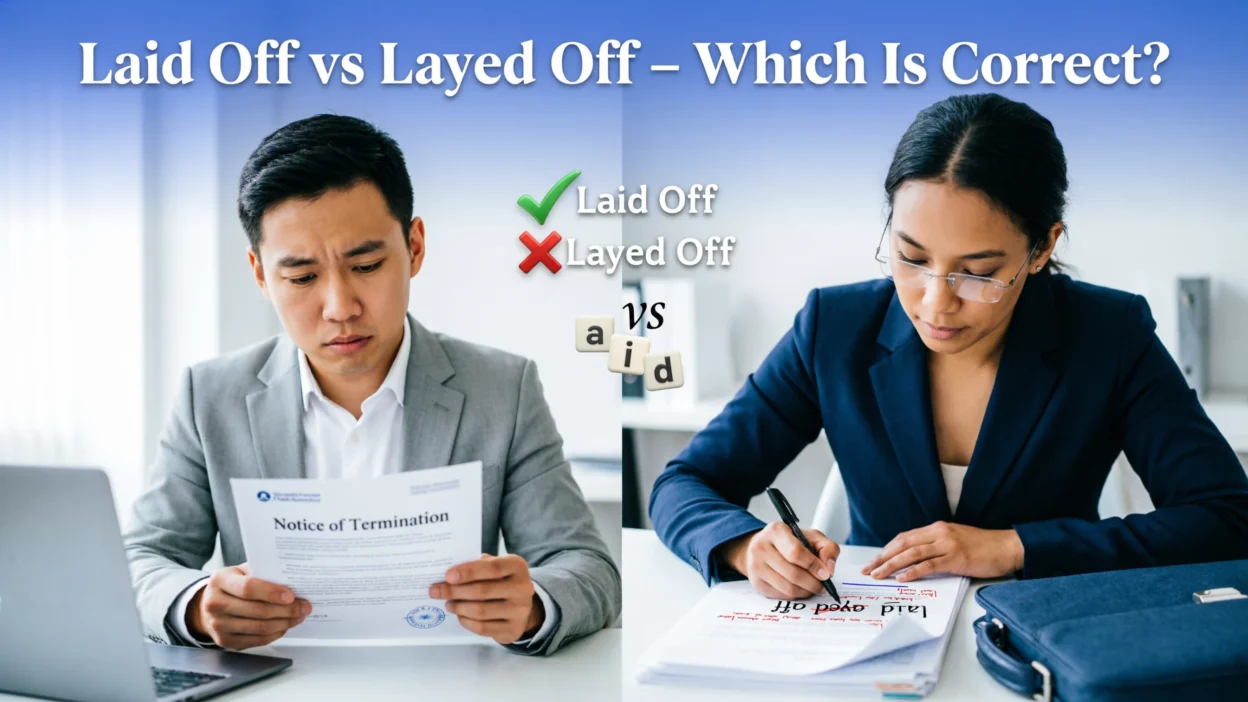
If you’ve ever searched for laid off vs layed off, you’re not alone. Many people get confused about which spelling is correct, especially when discussing job loss or employment status. The two phrases look similar, but only one is grammatically correct in standard English.
Whether you’re writing a resume, updating your LinkedIn profile, sending an email, or simply improving your English, understanding the difference between laid off and layed off will help you communicate more confidently.
This guide explains everything in simple language with examples, common mistakes, and practical tips.
Quick Answer
“Laid off” is the correct phrase.
“Layed off” is incorrect and should not be used in standard English.
- ✅ Correct: I was laid off from my job last month.
- ❌ Incorrect: I was layed off from my job last month.
The confusion happens because many people assume the past tense of lay is layed, but the correct past tense and past participle of lay is laid.
What Does “Laid Off” Mean?
Laid off means an employee loses their job because of business reasons rather than personal performance. A layoff usually happens due to:
- Company restructuring
- Budget cuts
- Economic downturn
- Department closures
- Automation
- Reduced workload
- Business mergers
Being laid off does not automatically mean an employee did anything wrong. In many cases, companies reduce staff because of financial or organizational challenges.
Example Sentences
- I was laid off after the company reduced its workforce.
- Hundreds of workers were laid off during the recession.
- She was laid off, but she quickly found another opportunity.
- Many employees fear being laid off during economic uncertainty.
Why Is “Layed Off” Incorrect?
The mistake comes from misunderstanding English verb forms.
The verb lay follows an irregular pattern:
- Present: Lay
- Past: Laid
- Past Participle: Laid
There is no standard English word “layed” when referring to the verb lay.
Therefore:
- ✅ laid off
- ❌ layed off
Although you may occasionally see layed off online, it is considered a spelling and grammar mistake.
Understanding the Verb “Lay”
The verb lay means to put or place something down.
Examples:
- Please lay the book on the table.
- Yesterday, she laid the blanket on the bed.
- The hen has laid several eggs.
Notice that every past-tense example uses laid, never layed.
Laid Off vs Layed Off: Comparison Table
| Feature | Laid Off | Layed Off |
|---|---|---|
| Correct English | ✅ Yes | ❌ No |
| Standard Grammar | ✅ Yes | ❌ No |
| Dictionary Accepted | ✅ Yes | ❌ No |
| Professional Writing | ✅ Recommended | ❌ Avoid |
| Resume Safe | ✅ Yes | ❌ No |
| Business Communication | ✅ Yes | ❌ Incorrect |
Common Situations Where “Laid Off” Is Used
The phrase laid off appears frequently in professional and business communication.
Common situations include:
- Job termination because of company downsizing
- Workforce reductions
- Economic recessions
- Company restructuring
- Temporary business closures
- Industry slowdowns
Examples:
- Our entire department was laid off.
- Several workers were laid off after the merger.
- He explained that he was laid off because of budget cuts.
- Thousands of employees were laid off nationwide.
Common Mistakes People Make
Many English learners and even native speakers accidentally write layed off.
Here are some common mistakes:
Mistake 1
❌ I got layed off.
✅ I got laid off.
Mistake 2
❌ She was layed off yesterday.
✅ She was laid off yesterday.
Mistake 3
❌ They have been layed off.
✅ They have been laid off.
Mistake 4
❌ Our manager got layed off.
✅ Our manager got laid off.
Using the correct form improves your credibility in professional writing.
Is Being Laid Off the Same as Being Fired?
No. These terms have different meanings.
Laid Off
A layoff usually happens because of business needs rather than employee performance.
Examples include:
- Company downsizing
- Financial losses
- Organizational restructuring
- Reduced demand
Fired
Being fired usually means employment ends because of:
- Poor performance
- Misconduct
- Policy violations
- Attendance issues
Understanding this distinction is important when discussing employment history.
American vs British English
Both American English and British English use the phrase laid off correctly.
The spelling does not change between the two versions of English.
However, usage differs slightly.
American English
Americans frequently use laid off to describe losing a job because of economic or company-related reasons.
Example:
“I was laid off during the company’s restructuring.”
British English
British speakers also understand laid off, but they may additionally use expressions such as:
- made redundant
- redundancy
- redundant
Example:
“She was made redundant after the business closed.”
Although made redundant is more common in the UK, laid off is still widely understood.
Grammar Tip to Remember
Think of this simple rule:
Lay → Laid
Not:
Lay → Layed
This same pattern appears in many examples:
- Lay the phone down.
- Yesterday I laid the phone down.
- The company laid off 200 employees.
Whenever you are unsure, remember that laid is always the correct past form.
Related Words and Synonyms
Depending on the context, you may also encounter these terms:
- Job loss
- Workforce reduction
- Downsizing
- Company restructuring
- Employee termination
- Redundancy
- Position eliminated
- Staff reduction
- Employment separation
- Job displacement
These phrases often appear in business news, HR documents, and employment discussions.
Tips for Using “Laid Off” Correctly
Follow these simple guidelines:
- Always write laid off, never layed off.
- Proofread resumes and job applications carefully.
- Use the phrase accurately when explaining employment history.
- Learn the irregular verb forms of lay.
- Remember that layoffs usually happen because of business decisions, not employee performance.
Frequently Asked Questions
Is “layed off” ever correct?
No. Layed off is not considered correct in standard English grammar.
Why do so many people write “layed off”?
Many people mistakenly assume that adding “-ed” forms the past tense. However, lay is an irregular verb whose past tense is laid.
Is “laid off” formal English?
Yes. It is appropriate in professional writing, business communication, resumes, news articles, and everyday conversation.
Does “laid off” mean fired?
Not usually. Being laid off generally refers to losing a job because of business reasons, while being fired usually relates to performance or misconduct.
Is “laid off” used in both the US and UK?
Yes. Americans commonly use laid off, while British English also uses made redundant in many situations.
Can I say “I got laid off”?
Yes. This is a natural and grammatically correct sentence.
Is “laid off” the past tense of “lay off”?
Yes. Laid off is the correct past tense and past participle of the phrasal verb lay off.
How can I remember the correct spelling?
Remember this simple pattern:
Lay → Laid
Never Lay → Layed.
Summary
Understanding laid off vs layed off is straightforward once you know the grammar rule. Laid off is the only correct spelling in standard English because laid is the proper past tense and past participle of the verb lay.
Whether you’re writing a resume, discussing employment, or improving your English skills, using the correct phrase helps you sound professional and credible.
The next time you need to describe job loss due to downsizing or company restructuring, confidently use laid off.
Avoid layed off, proofread your writing, and remember the simple rule: Lay becomes laid—not layed. Mastering this small grammar point can make your communication clearer, more accurate, and more polished.

Here is a professional 30-word author biography including your site name Symboliy.com:
Martin Hood is a professional writer at Symboliy.com, creating clear, informative content focused on language, communication, and meaningful expressions for everyday and professional use.