If you’ve seen the phrases layed off and laid off online, you may wonder which one is grammatically correct.
This confusion is common because many English verbs form their past tense by adding -ed, leading some writers to assume that “layed off” is acceptable.
However, when talking about job loss, employment termination, or workforce reductions, only one phrase is considered correct in standard English.
Understanding the difference between layed off vs laid off can help you avoid a common writing mistake and communicate more professionally.
Quick Answer
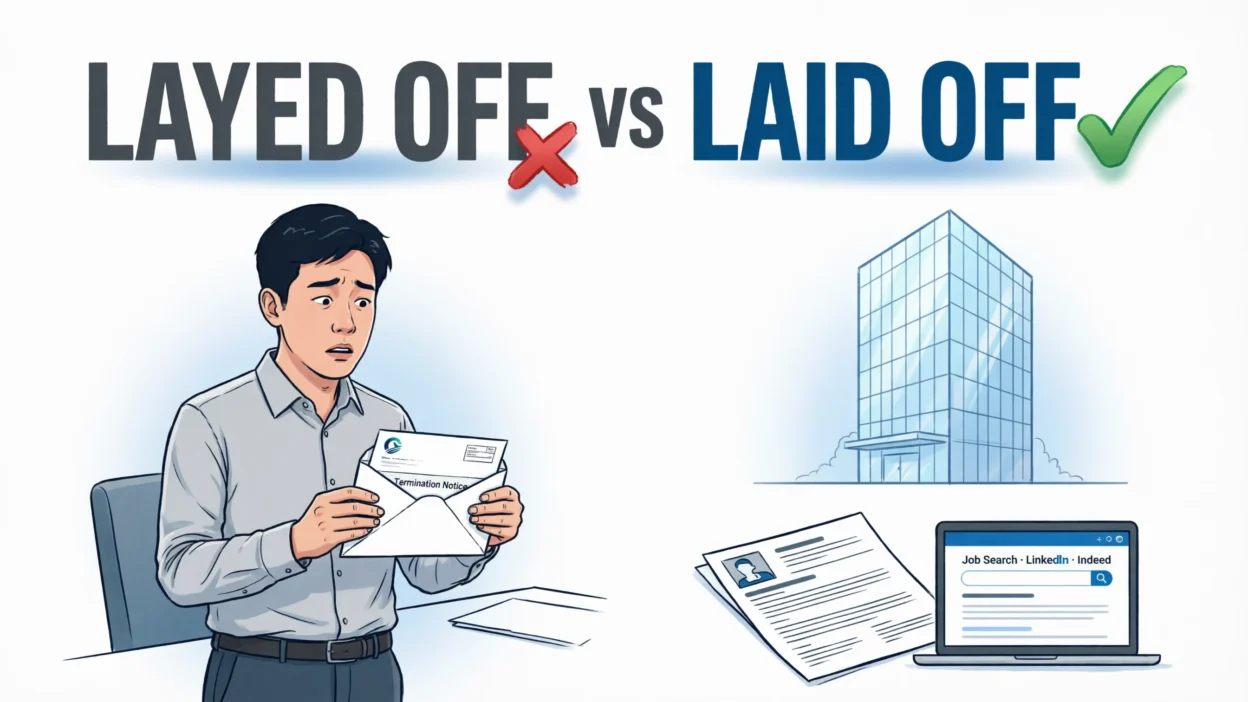
✅ Laid off is the correct phrase.
❌ Layed off is incorrect in standard English.
Examples:
- The company laid off 200 employees last month.
- She was laid off during the restructuring process.
- Thousands of workers have been laid off this year.
Whenever you’re referring to someone losing a job due to business reasons, use laid off, not layed off.
What Does “Laid Off” Mean?
The phrase laid off is the past tense and past participle form of the phrasal verb lay off.
In employment contexts, lay off means:
- To terminate employees because of economic conditions
- To reduce staff due to budget cuts
- To eliminate positions during restructuring
- To temporarily or permanently dismiss workers
Unlike being fired for misconduct, being laid off usually occurs because of business needs rather than employee performance.
Examples of “Laid Off” in Sentences
- The company laid off several workers after sales declined.
- He was laid off during the economic downturn.
- Hundreds of employees were laid off after the merger.
- The factory laid off staff due to reduced demand.
- She found a new job shortly after being laid off.
Why Is “Laid Off” Correct Instead of “Layed Off”?
The confusion comes from the verb lay.
Many English verbs form their past tense by adding -ed:
- Work → Worked
- Open → Opened
- Jump → Jumped
Because of this pattern, some people mistakenly write:
- Lay → Layed
However, lay is an irregular verb.
Correct Verb Forms
| Verb Form | Correct Word |
|---|---|
| Base Form | Lay |
| Present Participle | Laying |
| Past Tense | Laid |
| Past Participle | Laid |
When combined with the word off, the same rule applies:
- Lay off → Laid off ✅
- Lay off → Layed off ❌
This is why professional writers, employers, news organizations, and grammar guides consistently use laid off.
Layed Off vs Laid Off: Side-by-Side Comparison
| Feature | Layed Off | Laid Off |
|---|---|---|
| Grammatically Correct | No | Yes |
| Standard English | No | Yes |
| Professional Writing | No | Yes |
| Business Communication | No | Yes |
| HR Documentation | No | Yes |
| Common Modern Usage | Rare/Error | Very Common |
The correct phrase in virtually every employment-related situation is laid off.
Understanding the Phrasal Verb “Lay Off”
The phrase lay off can have several meanings depending on context.
Employment Meaning
- The company may lay off workers.
- The company laid off workers last year.
To Stop Doing Something
- You should lay off the junk food.
- He needs to lay off unnecessary spending.
To Leave Someone Alone
- Lay off him; he didn’t do anything wrong.
- The reporters finally laid off the celebrity.
In all cases, the past tense remains laid off.
Common Examples of “Laid Off”
Business Restructuring
- The corporation laid off employees during restructuring.
- Several departments were laid off after the merger.
Economic Downturns
- Many workers were laid off during the recession.
- The slowdown caused companies to lay off staff.
Technology Industry
- Several tech firms laid off workers to reduce costs.
- Thousands were laid off across the sector.
Manufacturing Industry
- The factory laid off workers after production declined.
- Employees were laid off because of reduced orders.
Common Mistakes People Make
Mistake 1: Writing “Layed Off”
Incorrect:
- She was layed off last month.
Correct:
- She was laid off last month.
Mistake 2: Treating “Lay” as a Regular Verb
Many writers assume every verb forms its past tense with -ed.
Incorrect:
- The company layed off fifty employees.
Correct:
- The company laid off fifty employees.
Mistake 3: Confusing “Laid Off” with “Fired”
Although both involve losing a job, they are different.
Laid Off:
- Due to business conditions.
- Usually unrelated to performance.
Fired:
- Usually related to employee conduct or performance.
Laid Off vs Fired
| Feature | Laid Off | Fired |
|---|---|---|
| Business Decision | Yes | Sometimes |
| Employee Fault | Usually No | Often Yes |
| Position Eliminated | Often Yes | Rarely |
| Performance Related | Usually No | Often Yes |
| Eligible for Rehire | Often | Depends |
Understanding this distinction helps ensure accurate communication in workplace discussions.
American vs British English
There is no difference between American and British English regarding this phrase.
Both use:
✅ Laid off
Both reject:
❌ Layed off
Whether you’re writing for a U.S., U.K., Canadian, Australian, or international audience, laid off is the correct form.
Is “Layed Off” Ever Correct?
In modern English, layed off is almost always considered incorrect.
You may occasionally encounter it in:
- Social media posts
- Informal writing
- User-generated content
- Spelling mistakes
However, reputable dictionaries, style guides, employers, HR professionals, journalists, and educators use laid off.
Grammar Trick to Remember the Difference
A simple memory trick:
Think of these irregular verbs:
- Pay → Paid
- Say → Said
- Lay → Laid
Notice the pattern:
Lay → Laid
Not:
Lay → Layed
If you remember paid, you’ll easily remember laid.
Real-Life Examples of Correct Usage
- The startup laid off dozens of employees.
- She was laid off after the company downsized.
- Several workers were laid off during the recession.
- The airline laid off staff due to lower demand.
- He found another position after being laid off.
- Thousands have been laid off across the industry.
- The organization laid off employees to reduce expenses.
- Workers feared they would be laid off next quarter.
- The firm laid off contractors first.
- Many professionals recovered quickly after being laid off.
Why Correct Usage Matters
Using laid off correctly helps improve:
- Professional communication
- Business writing accuracy
- Resume and career-related content
- Workplace credibility
- Academic writing quality
- SEO and content authority
Since employment topics are often sensitive and important, using the correct terminology demonstrates professionalism and attention to detail.
Frequently Asked Questions (FAQs)
Is laid off or layed off correct?
Laid off is correct. Layed off is considered incorrect in standard English.
Why do people write layed off?
Many people mistakenly assume that lay follows the regular -ed past tense pattern.
What does laid off mean?
It means an employee loses a job due to business reasons such as restructuring, downsizing, or financial challenges.
Is laid off the past tense of lay off?
Yes. The past tense and past participle of lay off are both laid off.
Is being laid off the same as being fired?
No. Being laid off is usually unrelated to performance, while being fired often involves performance or conduct issues.
Do Americans say laid off?
Yes. Americans use laid off, just as British English speakers do.
Is layed off ever acceptable?
Not in standard English writing. It is generally considered a spelling error.
How do I remember the correct phrase?
Think of the pattern pay → paid and lay → laid. This helps you remember laid off.
Summary
When comparing layed off vs laid off, the correct phrase is laid off. The expression comes from the phrasal verb lay off, and because lay is an irregular verb, its past tense becomes laid, not layed. This rule applies in business communication, workplace discussions, journalism, and everyday writing.
Whether you’re discussing layoffs, workforce reductions, company restructuring, or employment changes, always use laid off. Choosing the correct phrase improves clarity, professionalism, and grammatical accuracy while helping readers understand your message immediately.
Actionable Takeaway
Whenever you’re referring to job loss or workforce reductions, remember this simple formula:
Lay off → Laid off
Avoid writing layed off, even in informal content. If you’re unsure, compare it to pay → paid. The same irregular pattern gives us the correct phrase: laid off.

Shan Waston is a skilled writer at Symboliy.com, producing clear, engaging content on language, communication, and everyday expressions to help readers understand meaning and usage confidently in modern digital contexts.