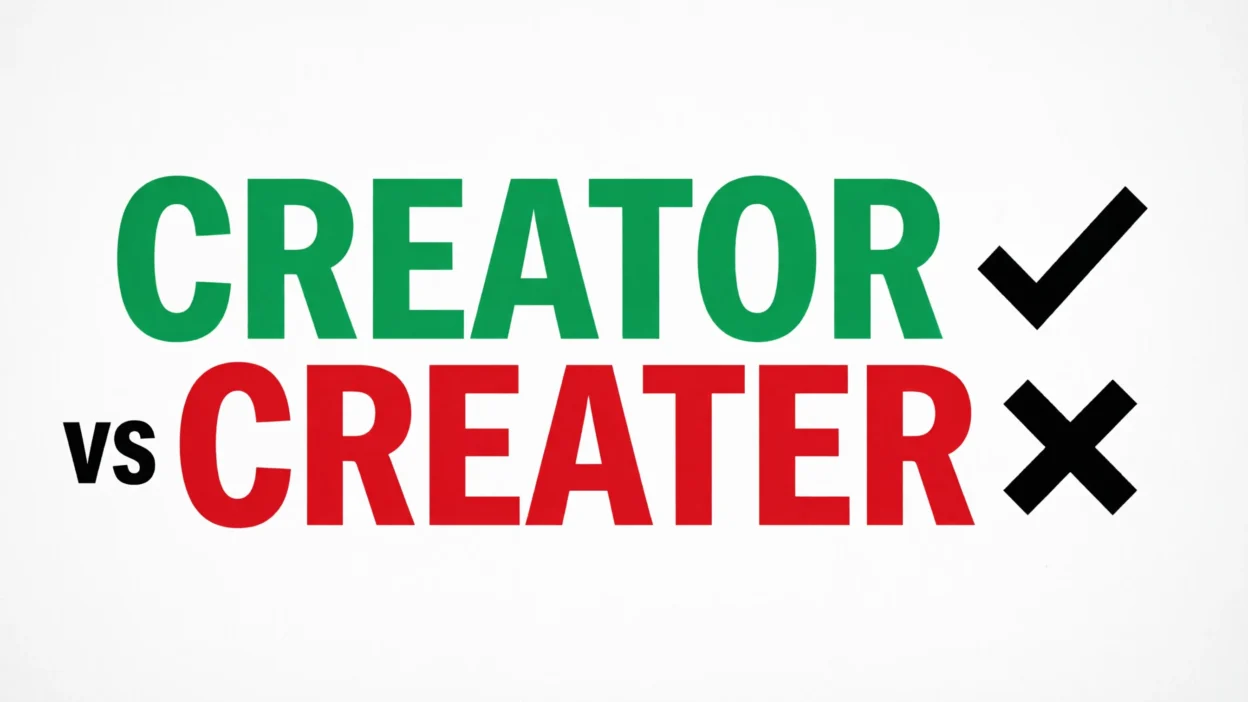
Have you ever typed creater and wondered if it was the correct spelling? You’re not alone. Many English learners, students, writers, and even native speakers occasionally confuse creater and creator because the words sound similar when spoken quickly.
The good news is that the difference is easy to understand. In this guide, you’ll learn the correct spelling, meaning, examples, common mistakes, and practical tips to remember the right word every time.
Whether you’re writing for school, business, social media, or SEO content, knowing the correct form will improve your writing accuracy and professionalism.
Quick Answer
Creator is the correct spelling.
Creater is a misspelling and is not considered a standard English word.
✔ Correct: She is the creator of the website.
✔ Correct: The content creator gained thousands of followers.
✘ Incorrect: She is the creater of the website.
What Does “Creator” Mean?
The word creator refers to a person or entity that makes, invents, designs, produces, or brings something into existence.
A creator can develop anything from artwork and videos to businesses, inventions, books, products, and digital content.
Common Definitions of Creator
- A person who creates something
- An inventor or designer
- A content producer
- An artist or author
- Someone responsible for bringing an idea into reality
Examples
- She is the creator of a popular mobile app.
- The creator of the series won several awards.
- Many content creators earn income online.
- He became the creator of a successful startup.
- The creator developed a unique marketing strategy.
Is “Creater” a Real Word?
No. Creater is not a standard English word.
The mistake usually happens because people assume the noun follows the same pattern as the verb create. However, when forming the noun, English uses creator, not creater.
Why People Write Creater
Common reasons include:
- Spelling based on pronunciation
- Confusion with the verb “create”
- Fast typing
- Lack of proofreading
- Autocorrect not catching the error
Whenever you see creater, it should almost always be corrected to creator.
Creater vs Creator: Key Differences
| Feature | Creator | Creater |
|---|---|---|
| Correct English Word | Yes | No |
| Found in Dictionaries | Yes | No |
| Accepted in Academic Writing | Yes | No |
| Accepted in Professional Writing | Yes | No |
| Standard English Usage | Yes | No |
| Has a Recognized Meaning | Yes | No |
The table clearly shows that creator is the only correct spelling.
Different Uses of the Word “Creator”
The word creator is widely used across many industries and contexts.
1. Content Creator
A content creator produces material for online platforms.
Examples:
- YouTube creator
- TikTok creator
- Instagram creator
- Podcast creator
2. Creator in Business
Entrepreneurs and innovators are often called creators.
Examples:
- Product creator
- Brand creator
- Business creator
- Startup creator
3. Creator in Technology
People who build software, apps, and digital products are creators.
Examples:
- App creator
- Software creator
- Website creator
- Game creator
4. Creator in Arts and Entertainment
Artists and writers are often described as creators.
Examples:
- Film creator
- Music creator
- Book creator
- Graphic creator
5. Religious Usage
In many religions, the term Creator refers to God as the maker of the universe.
Examples:
- Worship of the Creator
- Belief in the Creator
- Creator of all things
Common Mistakes People Make with Creator
Many writers make similar errors when using this word.
Mistake #1: Writing Creater Instead of Creator
Incorrect:
- He is the creater of the application.
Correct:
- He is the creator of the application.
Mistake #2: Assuming the Noun Follows “Create”
Some people think:
Create → Creater
But the correct noun form is:
Create → Creator
Mistake #3: Using the Wrong Word in Professional Writing
Misspellings can reduce credibility.
Incorrect:
- Website creater
Correct:
- Website creator
Mistake #4: Repeating the Error Throughout a Document
One spelling mistake can spread when content is copied and pasted.
Always proofread before publishing.
How to Remember the Correct Spelling
A simple memory trick can help.
Think of these related words:
- Create
- Creation
- Creative
- Creator
Notice that creator shares the same root pattern as creation.
Memory Tip
Remember:
“A creator makes a creation.”
Since both words contain “or” and “ion” patterns, this makes the correct spelling easier to remember.
Synonyms and Related Terms
Depending on the context, several words can be used instead of creator.
For Making Something
- Inventor
- Designer
- Builder
- Developer
- Producer
For Digital Media
- Content creator
- Influencer
- Publisher
- Broadcaster
- Media producer
For Artistic Work
- Artist
- Author
- Composer
- Filmmaker
- Writer
Related Terms
- Create
- Creation
- Creative
- Creativity
- Innovator
Using these related words can improve readability and SEO relevance.
American vs British English Differences
There is no spelling difference between American English and British English.
American English
- Creator
- Content creator
- Website creator
British English
- Creator
- Content creator
- Website creator
Both language varieties use the same spelling and meaning.
Why Understanding the Correct Spelling Matters
Correct spelling is important for several reasons.
Better Professionalism
Proper spelling creates a positive impression.
Improved Communication
Readers understand your meaning instantly.
Stronger SEO Performance
Correct keywords help search engines understand your content.
Enhanced Credibility
Accurate spelling makes content appear more trustworthy.
Better Academic Writing
Schools, colleges, and universities expect correct spelling.
Practical Examples in Sentences
Business
- She is the creator of a successful software company.
- The creator launched a new digital product.
Technology
- The app creator updated the platform.
- Every website creator needs basic design skills.
Social Media
- The content creator gained millions of views.
- Many creators monetize their videos online.
Education
- The creator of the learning program received recognition.
- Students studied the creator of the theory.
Arts and Entertainment
- The creator of the film won an award.
- The creator published a bestselling novel.
FAQs
1. Is creater or creator correct?
Creator is correct. Creater is a spelling mistake.
2. What does creator mean?
A creator is a person who makes, designs, invents, or produces something.
3. Is creater a dictionary word?
No. Standard English dictionaries do not recognize creater as a valid word.
4. Why do people write creater?
People often assume the noun form follows directly from the verb create, leading to the incorrect spelling.
5. What is a content creator?
A content creator produces digital content such as videos, articles, podcasts, or social media posts.
6. Is creator used in business?
Yes. Entrepreneurs, inventors, and product developers are often called creators.
7. Is creator spelled differently in British English?
No. The spelling remains creator in both American and British English.
8. How can I remember the correct spelling?
Remember the phrase: “A creator makes a creation.” This helps reinforce the correct word pattern.
Summary
The confusion between creater and creator is common, but the correct answer is simple. Creator is the accepted English word used to describe a person who makes, designs, invents, or produces something. Creater is a misspelling and should be avoided in professional, academic, and everyday writing.
Whether you’re referring to a content creator, app creator, business creator, artist, or inventor, using the correct spelling improves clarity, credibility, and professionalism. Understanding this small difference can help you communicate more effectively and avoid common writing mistakes.
Actionable Takeaway
Whenever you write this word, remember: Creator is correct, creater is incorrect. Use proofreading tools, review important documents carefully, and connect the word with creation to make the correct spelling easier to remember.

Mike Poop is a dedicated writer at Symboliy.com, creating clear, practical content about language, communication, and everyday expressions to help readers understand meaning and usage confidently in professional contexts worldwide.