
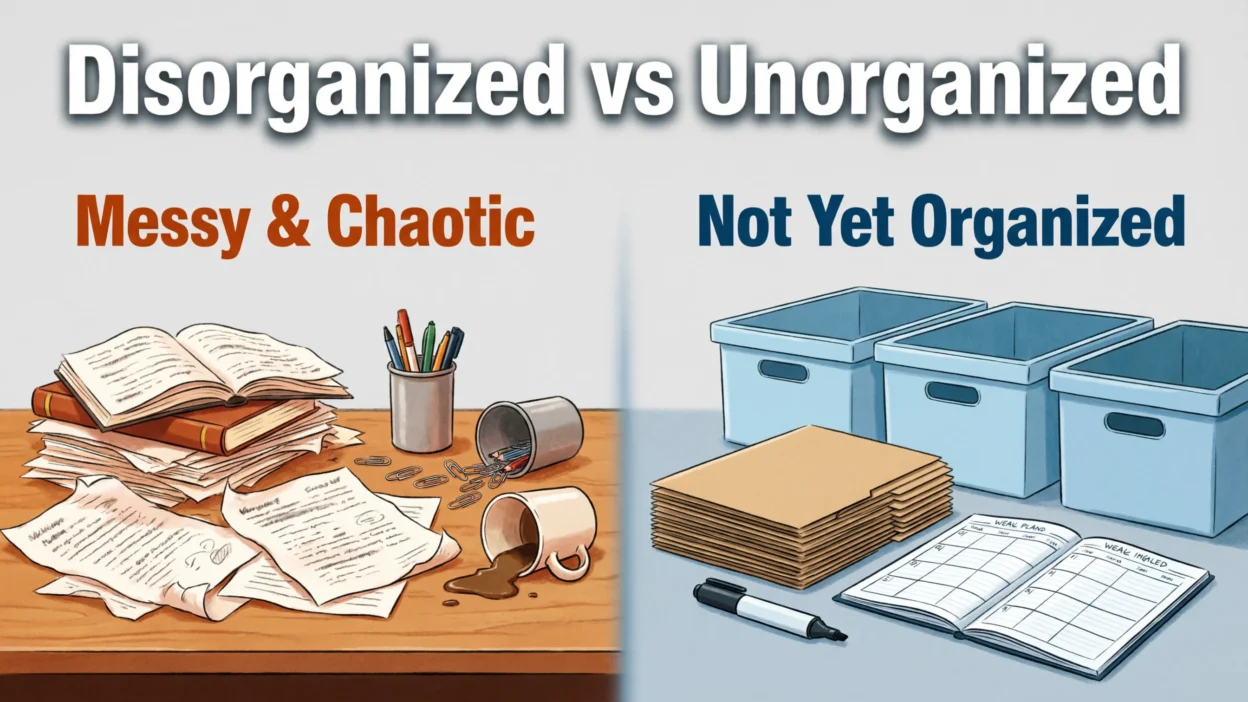
Have you ever wondered whether you should use disorganized or unorganized? Since both words describe a lack of order, many English learners and even native speakers use them interchangeably.
However, they have slightly different meanings and are appropriate in different situations.
In this guide, you’ll learn the difference between disorganized vs unorganized, their meanings, practical examples, common mistakes, and simple memory tricks to help you choose the right word every time.
By the end, you’ll understand when to use each word confidently in both spoken and written English.
Quick Answer
The difference between disorganized and unorganized is subtle but important:
- Disorganized means messy, lacking order, or poorly arranged, often implying that something was once organized or should be organized.
- Unorganized means not yet organized or not formally arranged, without necessarily suggesting disorder or messiness.
Example:
- My desk is disorganized because papers are scattered everywhere.
- The volunteers are still unorganized because the event planning hasn’t started.
If you’re describing clutter or confusion, use disorganized. If you’re describing something that simply hasn’t been organized yet, use unorganized.
What Does Disorganized Mean?
Disorganized is an adjective that means untidy, chaotic, poorly arranged, or lacking proper structure. It often suggests that order has been lost or that someone has difficulty staying organized.
The word is commonly used to describe people, workspaces, plans, businesses, or ideas.
Examples of Disorganized
- His office is extremely disorganized.
- The meeting felt disorganized because there was no agenda.
- She admitted she was too disorganized to meet the deadline.
- A disorganized schedule can reduce productivity.
- The files became disorganized after the office move.
Common Synonyms of Disorganized
- Messy
- Chaotic
- Disorderly
- Cluttered
- Confused
- Untidy
What Does Unorganized Mean?
Unorganized is an adjective that means not organized, not arranged, or not formally established. Unlike disorganized, it doesn’t always imply chaos or mess. Instead, it often describes something that simply hasn’t been structured yet.
The word is frequently used for groups, projects, plans, or activities that are still in the early stages.
Examples of Unorganized
- The volunteers remained unorganized until a leader was chosen.
- The event is still unorganized because planning hasn’t begun.
- The documents are unorganized and need to be sorted.
- The community group is unorganized but eager to help.
- Their ideas were unorganized during the brainstorming session.
Common Synonyms of Unorganized
- Unplanned
- Unstructured
- Unarranged
- Informal
- Unsystematic
- Not coordinated
Disorganized vs Unorganized: Key Differences
| Feature | Disorganized | Unorganized |
|---|---|---|
| Meaning | Messy, chaotic, lacking order | Not yet organized or formally arranged |
| Focus | Disorder or confusion | Absence of organization |
| Implies Previous Order? | Often yes | Usually no |
| Common Context | Rooms, offices, schedules, people | Groups, plans, projects, events |
| Example | Her desk is disorganized. | The committee is still unorganized. |
The easiest way to remember the difference is:
- Disorganized = Disorder
- Unorganized = Not Organized Yet
Disorganized vs Unorganized in Sentences
Here are practical examples to highlight the difference.
Using Disorganized
- The presentation looked disorganized without clear sections.
- My closet became disorganized after moving.
- The company’s records were completely disorganized.
- He is talented but often disorganized.
- The kitchen appeared disorganized after dinner.
Using Unorganized
- The charity remains unorganized until volunteers receive assignments.
- Their travel plans are still unorganized.
- The new club is unorganized but growing quickly.
- The project feels unorganized because no schedule exists yet.
- The team was unorganized before selecting a captain.
Common Mistakes People Make
Since both words involve a lack of organization, they are often confused.
Incorrect
- My room is unorganized because clothes are all over the floor.
Correct
- My room is disorganized because clothes are all over the floor.
Reason: The room is messy and chaotic, making disorganized the better choice.
Incorrect
- The committee is disorganized because it hasn’t been formed yet.
Correct
- The committee is unorganized because it hasn’t been formed yet.
Reason: The group simply hasn’t been organized, not that it’s chaotic.
Incorrect
- The office became unorganized after employees moved everything.
Correct
- The office became disorganized after employees moved everything.
The office lost its order, so disorganized is the more natural word.
Easy Trick to Remember Disorganized vs Unorganized
Here’s a simple memory trick.
Disorganized = Disorder
Think of the prefix dis-, which often suggests something is broken, disturbed, or lacking proper order. A disorganized room or schedule is messy and chaotic.
Unorganized = Not Yet Organized
The prefix un- simply means not. An unorganized project hasn’t been organized yet—it isn’t necessarily messy.
Whenever you’re talking about clutter or confusion, choose disorganized.
Whenever you’re talking about something that hasn’t been arranged yet, choose unorganized.
American vs British English
There is no significant difference between American and British English in the meaning of these words.
In both varieties:
- Disorganized usually describes something messy, chaotic, or lacking proper order.
- Unorganized describes something that has not yet been organized or formally structured.
However, disorganized is much more common in everyday conversation and writing. Unorganized is less frequently used and often appears in formal or specific contexts, such as organizational planning or administration.
Related Words You Should Know
Learning these related words can help you expand your vocabulary.
Organized
Organized means arranged neatly or managed efficiently.
Example:
- She keeps a very organized workspace.
Organization
Organization refers to the process of arranging things or the structure of a group.
Example:
- Good organization saves time and reduces stress.
Disorderly
Disorderly means untidy or lacking order.
Example:
- The classroom became disorderly after recess.
Remember:
- Organized = In order
- Disorganized = Messy or chaotic
- Unorganized = Not yet arranged or structured
Tips for Using Disorganized and Unorganized Correctly
Keep these simple tips in mind.
- Use disorganized when something is messy, chaotic, or poorly arranged.
- Use unorganized when something simply hasn’t been organized yet.
- If you can replace the word with messy, choose disorganized.
- If you can replace it with not yet arranged, choose unorganized.
- In everyday English, disorganized is generally the more natural choice when describing clutter or confusion.
Frequently Asked Questions (FAQs)
Is disorganized the same as unorganized?
No. Disorganized suggests disorder or chaos, while unorganized usually means something has not yet been organized.
Can disorganized and unorganized be used interchangeably?
Sometimes, but not always. Disorganized is preferred when describing messiness, while unorganized is better for something that hasn’t been formally arranged.
Which word is more common?
Disorganized is much more common in everyday English because it naturally describes messy people, places, or situations.
Can a person be unorganized?
Yes, but disorganized is far more common and sounds more natural when describing someone’s habits or behavior.
Is “disorganized desk” correct?
Yes. A disorganized desk is messy and lacks order.
Is “unorganized meeting” correct?
Yes. If the meeting hasn’t been properly planned or arranged yet, unorganized is appropriate. If the meeting itself is chaotic, disorganized is usually a better choice.
What is the opposite of disorganized?
The opposite is organized, meaning neat, orderly, and well-planned.
Summary
Understanding the difference between disorganized vs unorganized helps you communicate more precisely. Disorganized describes something that is messy, chaotic, or lacking proper order, while unorganized refers to something that has not yet been organized or formally arranged. Although both words involve a lack of organization, they are not always interchangeable.
When choosing between these words, think about the context. If you’re describing clutter, confusion, or poor structure, use disorganized. If you’re referring to something that simply hasn’t been planned or arranged yet, use unorganized. Using the correct word will make your writing clearer and more professional.
Actionable Takeaway
Before choosing between these two words, ask yourself one simple question:
“Is it messy, or has it simply not been organized yet?”
- If it’s messy or chaotic, choose disorganized.
- If it hasn’t been arranged or planned yet, choose unorganized.
This simple habit will help you use disorganized and unorganized correctly every time.

Here is a professional 30-word author biography including your site name Symboliy.com:
Martin Hood is a professional writer at Symboliy.com, creating clear, informative content focused on language, communication, and meaningful expressions for everyday and professional use.