Have you ever confused inpatient and impatient while reading or writing? You’re not alone. These two words look almost identical, differing by just one letter, but they have completely different meanings. Mixing them up can lead to misunderstandings, especially in healthcare, education, or everyday conversations.
In this guide, you’ll learn the difference between inpatient vs impatient, their meanings, practical examples, common mistakes, and simple memory tricks to help you use each word correctly. By the end, you’ll know exactly when to use inpatient and when impatient is the right choice.
Quick Answer
The difference between inpatient and impatient is simple:
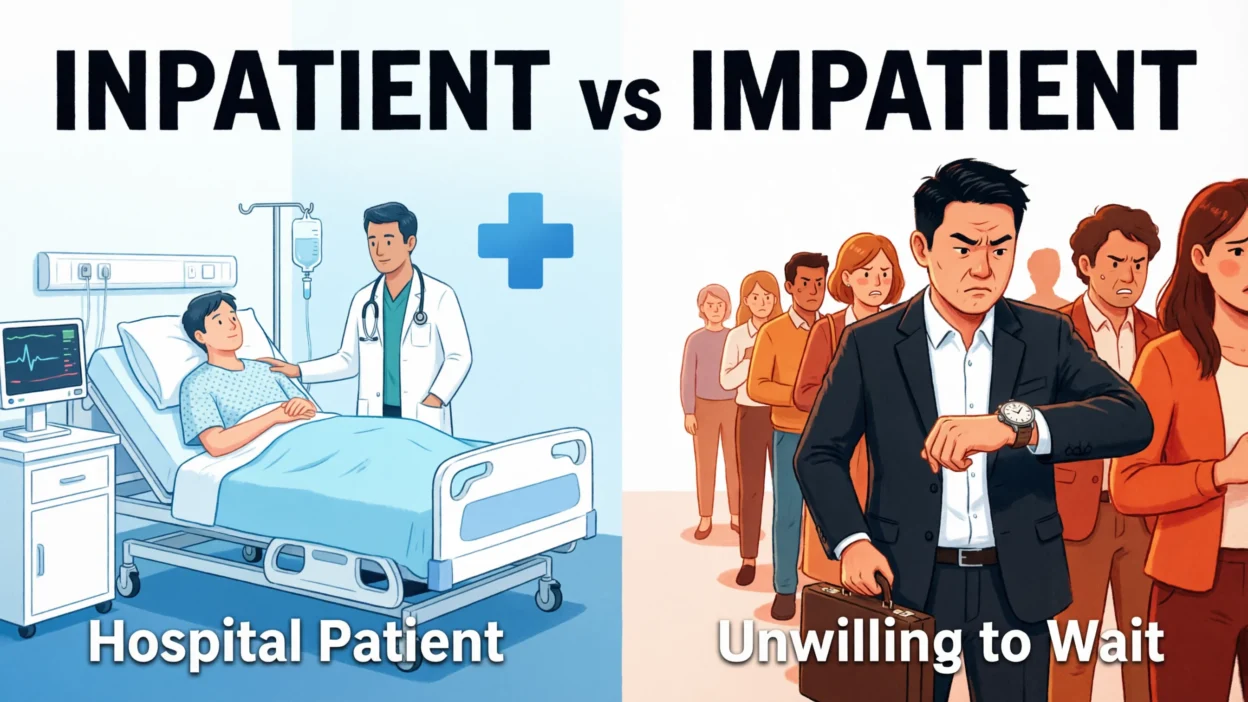
- Inpatient refers to a person who stays in a hospital or medical facility for treatment overnight or longer.
- Impatient describes someone who becomes easily annoyed or restless because they don’t want to wait.
Example:
- The inpatient recovered well after surgery and stayed in the hospital for three days.
- The children became impatient while waiting for the amusement park to open.
If you’re talking about hospital care, use inpatient. If you’re describing a person’s attitude toward waiting, use impatient.
What Does Inpatient Mean?
Inpatient is a noun or adjective used in healthcare. It refers to a patient who is admitted to a hospital or medical facility and stays there for at least one night or longer to receive treatment or observation.
Hospitals provide inpatient care for surgeries, serious illnesses, and conditions that require continuous medical supervision.
Examples of Inpatient
- She remained an inpatient after her knee replacement surgery.
- The hospital has a separate ward for inpatient care.
- He became an inpatient following a heart procedure.
- Doctors monitored the inpatient throughout the night.
- Some treatments require inpatient rehabilitation.
Common Synonyms of Inpatient
- Hospital patient
- Admitted patient
- Resident patient
- Hospitalized patient
What Does Impatient Mean?
Impatient is an adjective that describes someone who becomes restless, frustrated, or annoyed because something is taking too long or not happening quickly enough.
The word is commonly used in everyday conversations, workplaces, schools, and relationships.
Examples of Impatient
- The customers grew impatient while waiting in line.
- She became impatient with the slow internet connection.
- Children often get impatient before birthdays or holidays.
- He looked impatient during the long meeting.
- Try not to be impatient while learning a new skill.
Common Synonyms of Impatient
- Restless
- Frustrated
- Eager
- Agitated
- Irritated
- Anxious to proceed
Inpatient vs Impatient: Key Differences
| Feature | Inpatient | Impatient |
|---|---|---|
| Meaning | A patient admitted to a hospital | A person unwilling to wait calmly |
| Part of Speech | Noun or adjective | Adjective |
| Common Context | Hospitals, healthcare, medical treatment | Emotions, behavior, waiting |
| Focus | Medical care requiring an overnight stay | Lack of patience |
| Example | The inpatient was discharged today. | She became impatient after waiting an hour. |
The easiest way to remember the difference is:
- Inpatient = In the hospital
- Impatient = No patience
Inpatient vs Impatient in Sentences
Here are practical examples showing how each word is used.
Using Inpatient
- The doctor recommended inpatient treatment.
- After surgery, he remained an inpatient for five days.
- The hospital expanded its inpatient services.
- She received excellent inpatient care during recovery.
- Insurance covered most of the inpatient expenses.
Using Impatient
- We became impatient because the flight was delayed.
- The audience grew impatient before the concert started.
- He sounded impatient during the phone call.
- Don’t be impatient with yourself while learning English.
- Drivers often become impatient during heavy traffic.
Common Mistakes People Make
Because these words differ by only one letter, they’re often confused.
Incorrect
- The doctor admitted the impatient after surgery.
Correct
- The doctor admitted the inpatient after surgery.
Reason: The sentence refers to a hospital patient, not someone lacking patience.
Incorrect
- I became inpatient while waiting for my food.
Correct
- I became impatient while waiting for my food.
Reason: The sentence describes frustration while waiting, so impatient is correct.
Incorrect
- The hospital has twenty impatient beds.
Correct
- The hospital has twenty inpatient beds.
Hospital beds are designated for inpatients, not impatient people.
Easy Trick to Remember Inpatient vs Impatient
Here’s a simple memory trick.
Inpatient = In the Hospital
Think of the word in. An inpatient stays in the hospital for treatment.
Impatient = No Patience
The word impatient begins with im-, meaning not. An impatient person does not have patience.
Whenever you think of hospitals, choose inpatient.
Whenever you think of waiting or frustration, choose impatient.
American vs British English
There is no significant difference between American and British English regarding these words.
In both varieties:
- Inpatient refers to a hospital patient who stays overnight or longer.
- Impatient means lacking patience or becoming frustrated while waiting.
The spelling and meanings remain the same in modern English.
Related Words You Should Know
Understanding these related terms can make the distinction even clearer.
Outpatient
An outpatient receives medical treatment without staying overnight in the hospital.
Example:
- She had outpatient surgery and returned home the same day.
Patience
Patience is the ability to remain calm while waiting or dealing with difficulties.
Example:
- Learning a new language requires patience.
Patient
A patient is a person receiving medical care. As an adjective, patient also means calm and willing to wait.
Example:
- The patient thanked the nurses after treatment.
- She remained patient despite the long delay.
Remember:
- Inpatient = Hospital stay
- Outpatient = No overnight stay
- Patient = Calm person or someone receiving medical care
- Impatient = Not willing to wait
Tips for Using Inpatient and Impatient Correctly
Keep these simple tips in mind.
- Use inpatient only in medical or hospital-related contexts.
- Use impatient when describing feelings about waiting.
- If the sentence mentions doctors, hospitals, surgery, or treatment, inpatient is probably correct.
- If the sentence mentions delays, waiting, or frustration, use impatient.
- Think about whether you’re describing healthcare or a person’s behavior before choosing the word.
Frequently Asked Questions (FAQs)
Is inpatient the same as impatient?
No. Inpatient refers to someone admitted to a hospital, while impatient describes someone who is unwilling to wait calmly.
Can inpatient and impatient be used interchangeably?
No. They have completely different meanings and should never replace one another.
What is an inpatient?
An inpatient is a patient who stays in a hospital or healthcare facility overnight or longer for treatment.
What does impatient mean?
Impatient means feeling restless, annoyed, or frustrated because something is taking too long.
What is the opposite of inpatient?
In healthcare, the opposite of inpatient is outpatient, who receives treatment without staying overnight.
What is the opposite of impatient?
The opposite of impatient is patient, meaning calm and willing to wait.
Is “inpatient care” correct?
Yes. Inpatient care refers to medical treatment provided to patients who stay in a hospital.
Is “impatient customer” correct?
Yes. An impatient customer is someone who becomes frustrated because they have to wait.
Summary
Understanding the difference between inpatient vs impatient is essential because these words belong to entirely different contexts. Inpatient is a healthcare term referring to someone admitted to a hospital for overnight care or longer, while impatient describes a person’s inability or unwillingness to wait calmly. Although they look similar, their meanings are completely unrelated.
Before using either word, think about the context. If the sentence is about hospitals, medical treatment, or healthcare, choose inpatient. If it’s about frustration, waiting, or a lack of patience, choose impatient. Using the correct word will make your writing clearer, more accurate, and more professional.
Actionable Takeaway
Before choosing between these words, ask yourself one simple question:
“Am I talking about hospital care or someone’s attitude toward waiting?”
- If it’s about a patient staying in a hospital, choose inpatient.
- If it’s about someone becoming frustrated while waiting, choose impatient.
This quick habit will help you use inpatient and impatient correctly every time.

Mike Poop is a dedicated writer at Symboliy.com, creating clear, practical content about language, communication, and everyday expressions to help readers understand meaning and usage confidently in professional contexts worldwide.