
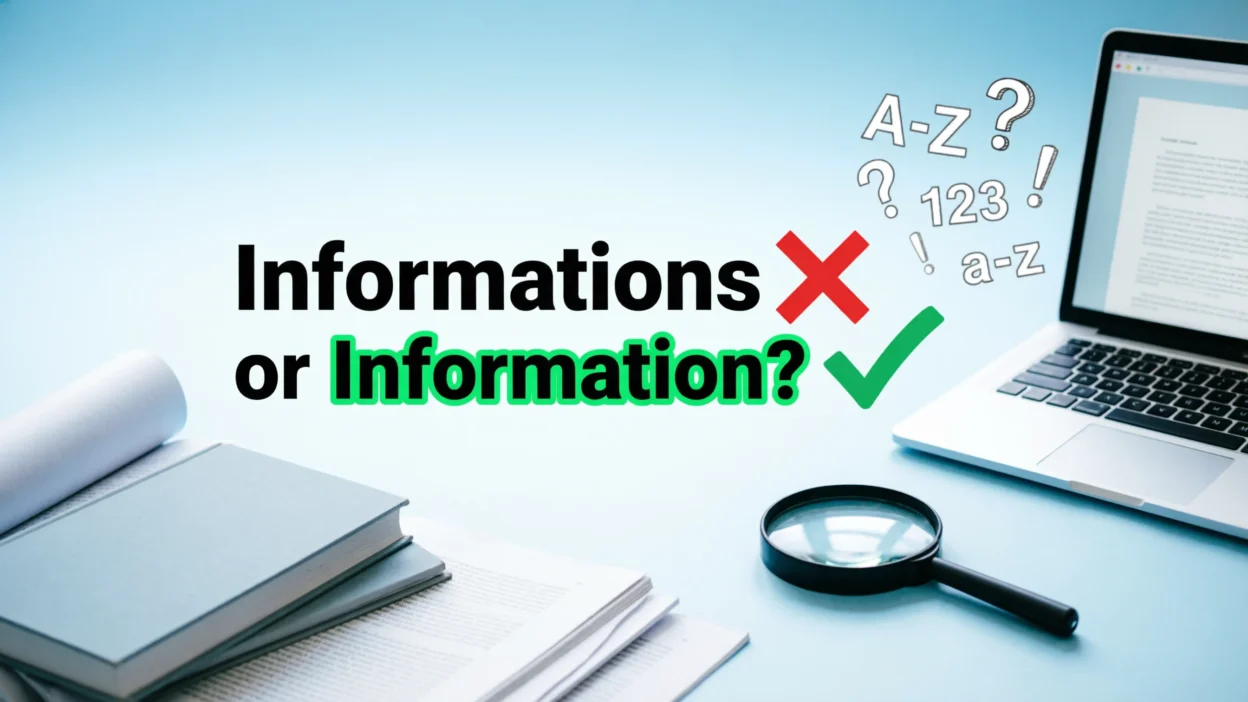
Have you ever seen someone write informations and wondered if it’s correct? This is a common grammar question for English learners because many languages allow the equivalent of “information” to have a plural form. In English, however, the rule is different.
If you’re writing emails, academic papers, blog posts, or business documents, knowing whether to use informations or information will help you sound more natural and professional.
This guide explains the correct usage, provides practical examples, highlights common mistakes, and answers the most frequently asked questions.
Quick Answer
Information is the correct word in standard English.
Informations is not grammatically correct in modern English and should be avoided in almost all situations.
Examples:
- ✅ I need more information.
- ✅ Thank you for the information.
- ✅ The information was helpful.
- ❌ I need more informations.
The word information is an uncountable noun, which means it does not normally have a plural form.
What Does “Information” Mean?
Information refers to facts, knowledge, details, or data about a person, place, event, or topic.
Unlike countable nouns such as book or car, information cannot usually be counted as individual items. Instead, it is treated as a single mass or collection.
Examples:
- The information is accurate.
- We received useful information.
- She shared important information during the meeting.
- I found valuable information online.
In each sentence, information refers to facts or knowledge without counting individual pieces.
What Does “Informations” Mean?
In standard English grammar, informations is considered incorrect.
Because information is an uncountable noun, it does not take a plural -s.
Incorrect examples:
- ❌ Please send me the informations.
- ❌ I collected many informations.
- ❌ These informations are useful.
Correct versions:
- ✅ Please send me the information.
- ✅ I collected a lot of information.
- ✅ This information is useful.
Although you may occasionally see informations in very old texts, legal contexts, or translations from other languages, it is not accepted in modern everyday English.
Information vs Informations Comparison Table
| Feature | Information | Informations |
|---|---|---|
| Grammatically correct | ✅ Yes | ❌ No (Modern English) |
| Type of noun | Uncountable noun | Incorrect plural form |
| Used in formal writing | ✅ Yes | ❌ No |
| Common in everyday English | ✅ Yes | ❌ No |
| Recommended for SEO and blogs | ✅ Yes | ❌ Avoid |
Why Is “Information” Uncountable?
English has many nouns that represent concepts or substances rather than individual items. These are called uncountable nouns.
Examples include:
- Information
- Advice
- Furniture
- Knowledge
- Equipment
- Research
- Traffic
- Homework
These words do not normally become plural.
For example:
- ✅ Some information
- ✅ Much information
- ✅ A little information
- ❌ Many informations
How to Express More Than One Piece of Information
If you want to refer to multiple facts or details, use phrases like these instead of informations.
Examples:
- Pieces of information
- Bits of information
- Items of information
- Sources of information
Examples in sentences:
- She gave me three pieces of information.
- We collected several pieces of information.
- The report contains important pieces of information.
- Each piece of information was carefully verified.
These expressions are grammatically correct and sound natural.
Examples of Correct Usage
Here are some everyday examples.
At Work
- I need more information before making a decision.
- The manager provided useful information.
- Customer information must remain confidential.
At School
- The teacher shared important information about the exam.
- Students received information about the project.
- This information will help you prepare.
Online
- I found reliable information on the website.
- Always verify information before sharing it.
- The article contains updated information.
Common Mistakes
Many English learners make these errors.
Mistake 1
❌ I need more informations.
✅ I need more information.
Mistake 2
❌ These informations are useful.
✅ This information is useful.
Mistake 3
❌ She gave me many informations.
✅ She gave me a lot of information.
Mistake 4
❌ I have several informations.
✅ I have several pieces of information.
Avoid adding -s to information, even when referring to multiple facts.
Information vs Data
People often confuse information with data.
Here’s the difference.
- Data refers to raw facts, figures, or measurements.
- Information is organized or meaningful data that people can understand and use.
Example:
- The survey collected data.
- The report presented useful information.
Although data can sometimes be treated as plural in technical writing, information remains uncountable.
American vs British English
Both American English and British English follow the same rule.
Correct in both:
- Information
- More information
- Useful information
- Piece of information
Incorrect in both:
- Informations
There is no spelling or grammar difference between American and British English for this word.
SEO Perspective: Which Keyword Should You Use?
If you’re creating content for search engines, always use information in your headings, titles, and body text because it is the grammatically correct form.
However, some users search for informations because they are unsure of the correct grammar. Including a natural comparison such as “Informations or Information?” helps your content match search intent while clearly explaining that information is the correct word.
Related Keywords (LSI)
Using related terms naturally strengthens topical relevance.
Useful LSI keywords include:
- information meaning
- information grammar
- uncountable nouns
- countable and uncountable nouns
- English grammar
- pieces of information
- grammar rules
- common grammar mistakes
- information examples
- information usage
- data vs information
- English vocabulary
Frequently Asked Questions
Is “informations” a real English word?
In modern standard English, informations is generally considered incorrect. Use information instead.
Why is “information” uncountable?
Because it refers to knowledge or facts as a whole rather than individual countable objects.
How do I talk about multiple facts?
Use expressions like pieces of information, bits of information, or items of information.
Can I say “many information”?
No. Since information is uncountable, say much information or a lot of information instead.
Is “information” singular or plural?
Grammatically, information is an uncountable noun that takes a singular verb.
Example:
- The information is correct.
Do American and British English use different rules?
No. Both varieties use information and do not normally accept informations.
What are other uncountable nouns like information?
Common examples include advice, knowledge, equipment, research, furniture, luggage, and homework.
Summary
The correct word in modern English is information. It is an uncountable noun, which means it does not have a regular plural form. Although some learners write informations, this form is considered incorrect in standard English and should be avoided in professional, academic, and everyday writing.
Whenever you want to refer to several facts or details, use phrases like pieces of information instead of adding -s to the word. Following this simple rule will make your English sound more natural, accurate, and fluent.
Actionable Takeaway
Whenever you’re unsure, remember this simple rule: Never add an “s” to information. If you need to refer to multiple facts, write pieces of information, bits of information, or a lot of information. This habit will help you avoid one of the most common mistakes in English grammar.

Mike Poop is a dedicated writer at Symboliy.com, creating clear, practical content about language, communication, and everyday expressions to help readers understand meaning and usage confidently in professional contexts worldwide.