
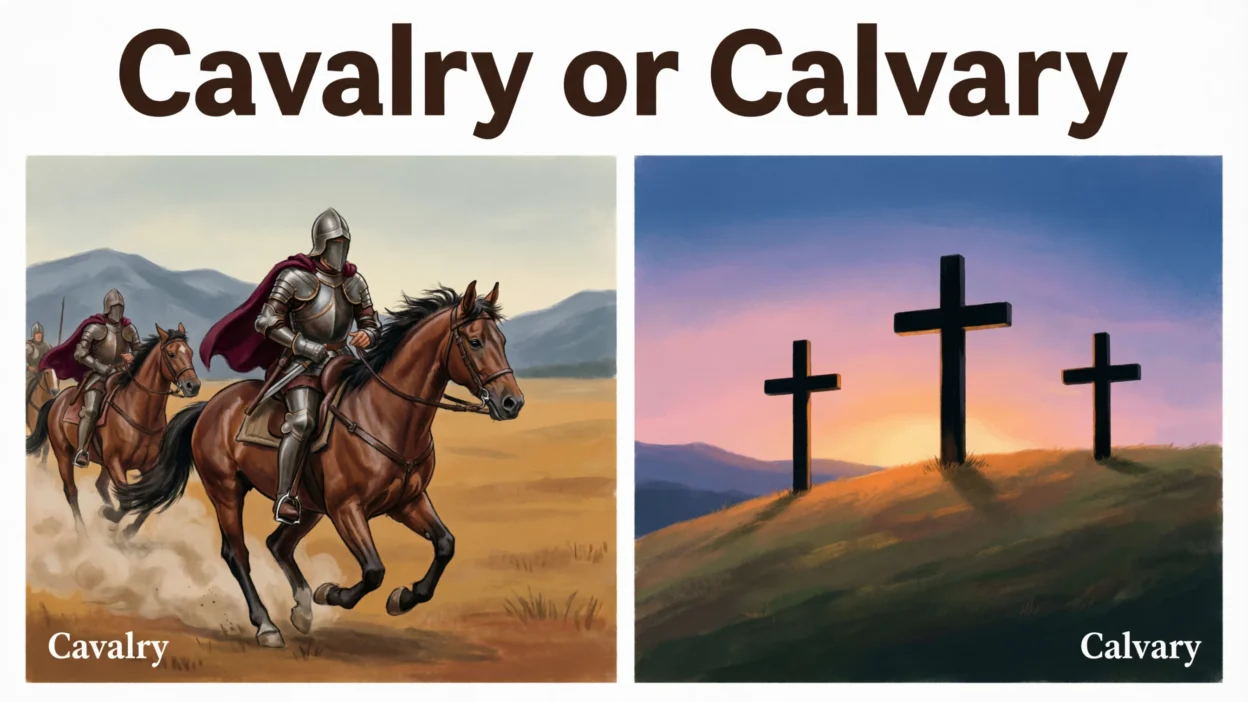
Have you ever seen the words cavalry and Calvary and wondered which one is correct? Since they look and sound somewhat similar, many people accidentally use one in place of the other.
However, these words have entirely different meanings and are used in completely different contexts.
In this guide, you’ll learn the difference between cavalry or Calvary, understand their meanings, explore real-life examples, avoid common mistakes, and discover when to use each word correctly.
Whether you’re writing an essay, an email, or a social media post, this article will help you choose the right word with confidence.
Quick Answer
The difference between cavalry and Calvary is simple:
- Cavalry refers to soldiers who fight on horseback or, in modern usage, armored or mobile military units.
- Calvary refers to the hill outside Jerusalem where Jesus Christ was crucified and is an important term in Christianity.
In short:
- Cavalry = Soldiers
- Calvary = Crucifixion Site
What Does Cavalry Mean?
Cavalry is a military term that originally referred to soldiers who fought while riding horses. In modern armies, cavalry often refers to armored or reconnaissance units that use tanks or other vehicles instead of horses.
The word is also used figuratively to describe help arriving when it’s needed.
Examples of Cavalry
- The cavalry charged across the battlefield.
- Modern cavalry units use armored vehicles.
- Don’t worry—the cavalry is on the way!
- Reinforcements arrived like the cavalry.
Common Uses of Cavalry
- Cavalry regiment
- Cavalry officer
- Cavalry charge
- Modern cavalry
- The cavalry is coming
What Does Calvary Mean?
Calvary is a religious term referring to the hill where Jesus Christ was crucified, according to the New Testament. The name comes from the Latin word Calvaria, meaning “place of the skull.”
Today, Calvary is commonly used in:
- Christianity
- Churches
- Religious literature
- Biblical studies
- Hymns and sermons
It may also be used figuratively to describe a place or experience of great suffering or sacrifice.
Examples of Calvary
- Christians remember the events that took place at Calvary.
- The church held a Good Friday service reflecting on Calvary.
- The sermon focused on Christ’s sacrifice at Calvary.
- His long struggle felt like a personal Calvary.
Cavalry vs Calvary: Key Differences
| Feature | Cavalry | Calvary |
|---|---|---|
| Meaning | Soldiers on horseback or armored military units | The hill where Jesus was crucified |
| Category | Military | Religious |
| Common Context | Army, history, warfare | Christianity, Bible, churches |
| Everyday Usage | Common in history and figurative speech | Common in religious contexts |
| Figurative Meaning | Help arriving | A place or experience of suffering |
Simple Way to Remember the Difference
A quick memory trick can help:
- Cavalry contains “cav,” reminding you of cavalier or cavalry soldiers riding horses.
- Calvary contains “Cal,” helping you remember Calvary, the biblical location associated with Christ’s crucifixion.
Remember:
- Cavalry = Military
- Calvary = Christianity
Real-Life Examples of Cavalry vs Calvary
Example 1: Military History
- The cavalry defended the city during the battle.
Not:
- The Calvary defended the city.
Example 2: Religion
- Pilgrims visited Calvary during their journey.
Not:
- Pilgrims visited cavalry.
Example 3: Everyday Expression
- My friends arrived like the cavalry just when I needed help.
Example 4: Church Service
- The pastor spoke about the meaning of Calvary during Easter.
Common Mistakes People Make
Because the words look similar, writers often confuse them.
Here are the most common mistakes:
- Writing Calvary when referring to soldiers.
- Using cavalry when discussing Jesus’ crucifixion.
- Assuming the words are interchangeable.
- Misspelling cavalry because Calvary is a more familiar religious term.
Incorrect
- The Calvary rescued the village.
Correct
- The cavalry rescued the village.
Incorrect
- Jesus was crucified at cavalry.
Correct
- Jesus was crucified at Calvary.
American vs British English
There is no difference between American English and British English in the meanings of cavalry and Calvary.
Both varieties use:
- Cavalry for military units.
- Calvary for the biblical location associated with Jesus Christ’s crucifixion.
The spelling and pronunciation remain the same in both forms of English.
Related LSI Keywords and Synonyms
Using related terms naturally helps improve understanding and supports SEO.
Relevant keywords include:
- cavalry meaning
- Calvary meaning
- cavalry definition
- Calvary definition
- cavalry vs Calvary
- military vocabulary
- biblical terminology
- Christian vocabulary
- horse soldiers
- armored cavalry
- Mount Calvary
- place of crucifixion
- common English homophones
- confusing English words
- spelling differences
When Should You Use Each Word?
Use cavalry when talking about:
- Military history
- Horse-mounted soldiers
- Armored units
- Reinforcements
- Rescue or help arriving
Use Calvary when talking about:
- Jesus Christ
- Christianity
- The Bible
- Churches
- Good Friday or Easter
- Sacrifice and suffering
Why Are Cavalry and Calvary So Often Confused?
These words are commonly confused because they have similar spellings and are pronounced similarly in many English accents. In fast speech, the difference can be difficult to hear, leading to spelling mistakes in writing.
The easiest way to avoid confusion is to think about the context. If you’re discussing the military or rescue, the correct word is cavalry. If the topic is Christianity, the Bible, or the crucifixion of Jesus, the correct word is Calvary.
Frequently Asked Questions
1. What is the difference between cavalry and Calvary?
Cavalry refers to horse-mounted or armored military units, while Calvary is the hill where Jesus Christ was crucified.
2. Is “the cavalry is coming” correct?
Yes. This expression means that help or reinforcements are on the way.
3. What does Calvary mean in Christianity?
Calvary is the traditional name for the place where Jesus Christ was crucified.
4. Are cavalry and Calvary pronounced the same?
They are pronounced very similarly in many English accents, which is why they are often confused.
5. Can cavalry be used figuratively?
Yes. People often say “the cavalry has arrived” to mean that help has come just in time.
6. Is Calvary always capitalized?
When referring to the biblical location, Calvary is a proper noun and should be capitalized.
7. How can I remember the difference?
Think of Cavalry = Cavalry soldiers and Calvary = Christ’s crucifixion. Associating each word with its context makes it much easier to remember.
Summary
Understanding cavalry or Calvary is essential because these words represent completely different ideas. Cavalry belongs to the world of military history and refers to horse-mounted or armored troops, while Calvary is a significant biblical location connected to the crucifixion of Jesus Christ. Although they sound alike, they should never be used interchangeably.
Using the correct word makes your writing more accurate and respectful of its context. Whether you’re describing a historic battle or discussing a religious event, choosing cavalry or Calvary correctly helps your message remain clear and professional.
Actionable Takeaway
Whenever you’re unsure which word to use, remember this simple rule:
- Cavalry = Soldiers
- Calvary = Christ’s Crucifixion Site
Keeping this distinction in mind will help you avoid one of the most common word mix-ups in English.

Mike Poop is a dedicated writer at Symboliy.com, creating clear, practical content about language, communication, and everyday expressions to help readers understand meaning and usage confidently in professional contexts worldwide.