The words cue and que often confuse English learners because they look similar and differ by only one letter.
However, they have very different meanings. In fact, cue is a standard English word, while que is generally not an English word. Most of the time, people who write que actually mean cue, queue, or qué in Spanish.
If you’ve searched for cue vs que, you’re probably trying to figure out which spelling is correct.
This guide explains the meaning of each term, shows practical examples, highlights common mistakes, and helps you use the right word with confidence.
Quick Answer
- Cue is an English noun and verb that means a signal, prompt, or indication to begin an action.
- Que is not a standard English word. It is usually:
- A misspelling of cue
- A misspelling of queue
- The Spanish word qué/que, meaning what or that, depending on the context.
Examples:
- ✅ That’s my cue to leave.
- ✅ The actor waited for his cue.
- ❌ That’s my que to leave.
The easiest way to remember is:
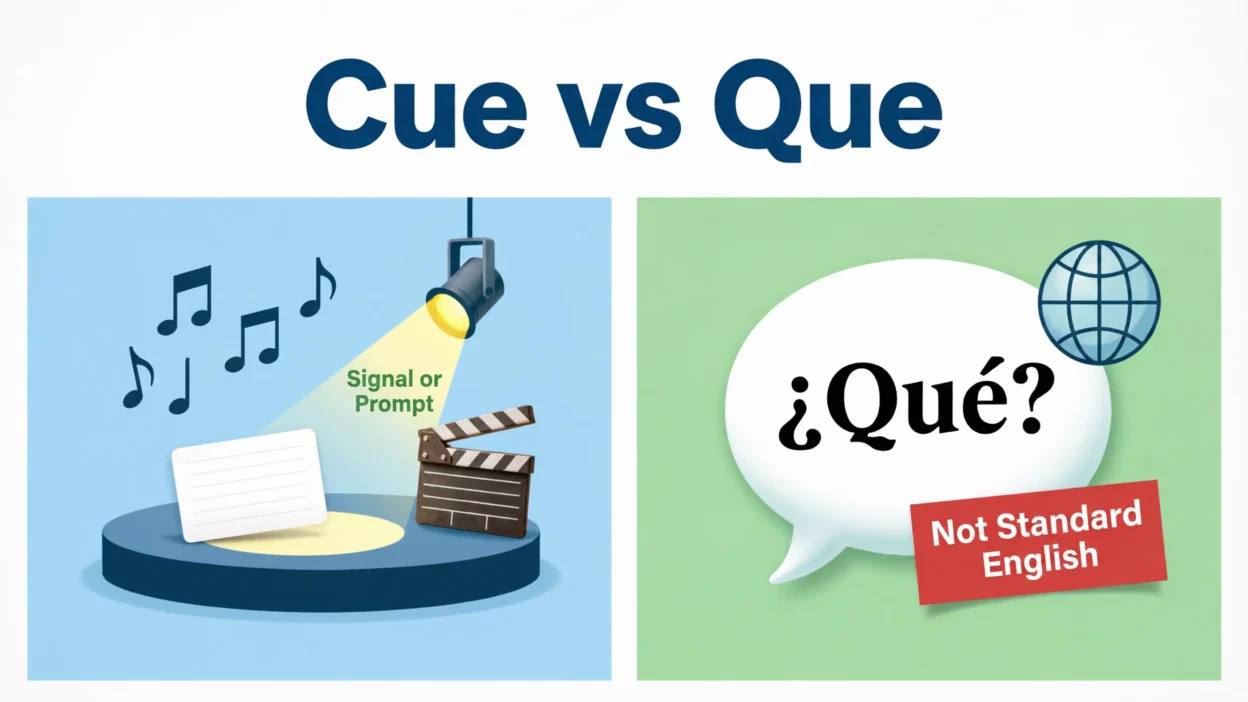
- Cue = Signal or prompt
- Que = Not standard English (unless used in another language)
What Does “Cue” Mean?
Cue is both a noun and a verb in English.
As a noun, it refers to a signal or prompt telling someone when to act or speak.
As a verb, it means to give someone that signal.
Examples of “Cue”
- That’s my cue to start speaking.
- The director gave the actors their cue.
- She smiled, which was my cue to leave.
- The music cue began exactly on time.
- Please cue the next video.
In every example, cue relates to a signal or instruction.
Common Uses of “Cue”
You’ll often see cue in these phrases:
- cue card
- cue to leave
- visual cue
- audio cue
- cue the music
- cue someone in
What Does “Que” Mean?
Que is not a standard English word.
However, it appears in other languages.
In Spanish
Que (or qué with an accent) is commonly used to mean:
- What
- That
- Which
Examples:
- ¿Qué haces? (What are you doing?)
- Creo que sí. (I think that yes.)
In Portuguese
Que is also a common word meaning that, which, or what, depending on the sentence.
In English
If you’re writing in English, que is usually a spelling mistake.
Examples:
- ❌ That’s my que.
- ✅ That’s my cue.
Cue vs Que Comparison Table
| Feature | Cue | Que |
|---|---|---|
| Is it a standard English word? | Yes | No (except in foreign-language contexts) |
| Part of speech | Noun or verb | Foreign-language word |
| Meaning | Signal, prompt, indication | “What” or “that” in Spanish and Portuguese |
| English usage | Common | Usually incorrect unless quoting another language |
| Example | Wait for your cue. | ¿Qué pasa? (Spanish) |
Key Differences Between Cue and Que
Although they look similar, these words belong to different languages.
Cue
- An English word.
- Means a signal or prompt.
- Used in theater, film, music, sports, and everyday conversations.
Example:
- That was my cue to speak.
Que
- Not standard English.
- Correct only when writing in languages such as Spanish or Portuguese.
- Often appears because of a typing mistake.
Example:
- ¿Qué hora es? (Spanish)
Examples of Cue vs Que
| Cue | Que |
|---|---|
| The actor missed his cue. | ¿Qué quieres? (Spanish) |
| That’s my cue to leave. | Creo que sí. (Spanish) |
| The teacher gave us a visual cue. | Used correctly only in another language. |
| Cue the music. | Not used as an English substitute for cue. |
| She waited for her cue. | ❌ That’s my que. |
Common Mistakes
People often type que when they actually mean cue.
Mistake 1
❌ That’s my que.
✅ That’s my cue.
Mistake 2
❌ Wait for your que.
✅ Wait for your cue.
Mistake 3
❌ The director forgot the que.
✅ The director forgot the cue.
Mistake 4
❌ Can you que the music?
✅ Can you cue the music?
Easy Memory Trick
Here’s a simple trick to remember the difference.
Cue begins with C, which can remind you of:
- Clue
- Command
- Cue card
All of these involve giving someone information or a signal.
Que is generally not English, so if you’re writing in English and mean a signal or prompt, choose cue.
Synonyms and Related Words
Synonyms for “Cue”
Depending on the context, you can use:
- Signal
- Prompt
- Indication
- Hint
- Sign
- Trigger
- Instruction
- Notification
Examples:
- That was my signal to begin.
- She waited for the prompt.
Related Foreign-Language Word
In Spanish, qué can mean:
- What
- Which
In Portuguese, que commonly means:
- That
- Which
- What
These meanings do not replace cue in English.
American vs British English
There is no difference between American English and British English regarding cue.
Both varieties use cue to mean a signal or prompt.
Likewise, que is not considered a standard English word in either variety unless it is being used as part of another language or a proper noun.
Examples accepted in both:
- Wait for your cue.
- Cue the music.
- That’s my cue to leave.
Tips to Avoid Confusing Cue and Que
Use these simple tips:
- If you’re writing in English and mean signal, use cue.
- If you accidentally type que, check whether you intended cue.
- Remember that que belongs mainly to Spanish and Portuguese.
- Proofread for common typing errors.
- Think of cue cards, which always use the spelling cue.
Practice Sentences
Choose the correct word.
- The actor waited for his _____.
- ✅ cue
- That’s my _____ to start talking.
- ✅ cue
- Can you _____ the next song?
- ✅ cue
- _____ significa “what” en español.
- ✅ Que (Spanish)
- The lights were the audience’s _____ that the show was starting.
- ✅ cue
FAQs
Is “que” an English word?
No. Que is not a standard English word. It is mainly used in languages such as Spanish and Portuguese.
What does “cue” mean?
Cue means a signal, prompt, or indication that tells someone when to act or speak.
Is “que” always incorrect?
Not if you’re writing in Spanish, Portuguese, or using a proper noun. In standard English, however, it is usually a spelling mistake.
Is “cue” a noun or a verb?
It can be both. As a noun, it means a signal. As a verb, it means to give a signal.
Why do people confuse cue and que?
They look similar, and many people type que by mistake or confuse it with other words like queue.
What is the difference between cue and queue?
Cue means a signal or prompt, while queue means a line of people or vehicles waiting their turn.
Is “cue the music” correct?
Yes. Cue the music is a common English expression meaning to start playing the music at the appropriate moment.
How can I remember the correct spelling?
Think of cue cards used by speakers and actors. If it’s a signal or prompt, the correct word is cue.
Summary
Understanding cue vs que is simple once you know that cue is the correct English word for a signal or prompt, while que is generally not an English word. Although que is perfectly valid in languages such as Spanish and Portuguese, it should not replace cue in English writing.
Whenever you’re writing in English, ask yourself whether you’re referring to a signal, prompt, or indication. If the answer is yes, use cue. If you’ve typed que, double-check whether you meant cue, queue, or were intentionally using a foreign-language word.
Actionable Takeaway: Before using cue or que, identify the language and context. In English, choose cue for signals and prompts, and avoid using que unless you’re intentionally writing in another language.

Mike Poop is a dedicated writer at Symboliy.com, creating clear, practical content about language, communication, and everyday expressions to help readers understand meaning and usage confidently in professional contexts worldwide.