Have you ever wondered whether the correct phrase is “take effect” or “take affect”? Since effect and affect are among the most commonly confused words in English, it’s easy to make this mistake. However, only one of these phrases is grammatically correct in standard English.
In this guide, you’ll learn the difference between take effect vs take affect, understand what each phrase means, see practical examples, avoid common mistakes, and discover an easy way to remember the correct usage.
Quick Answer
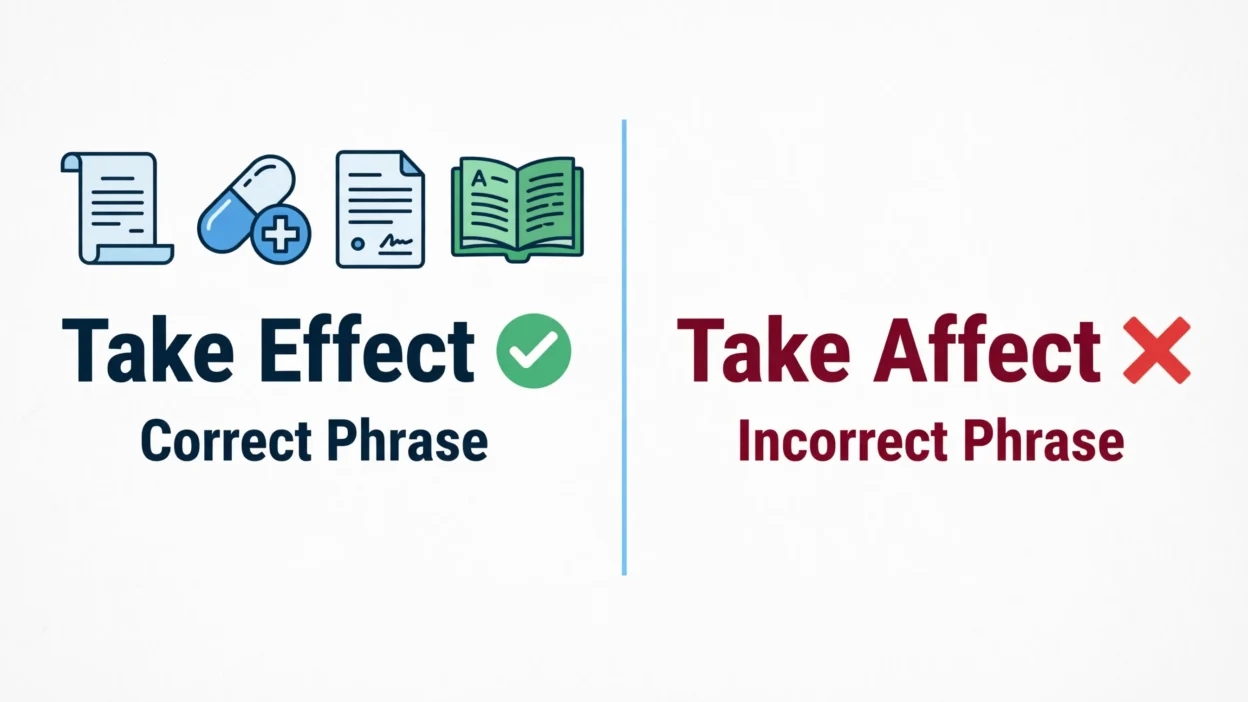
The correct phrase is “take effect.” It means to begin working, become active, or start producing results.
“Take affect” is not a correct English phrase. The word affect is usually a verb meaning to influence, so it does not fit after the verb take in this expression.
Examples:
- ✅ The new law will take effect next month.
- ✅ The medicine should take effect within an hour.
- ❌ The new policy will take affect tomorrow.
What Does “Take Effect” Mean?
Take effect is a common English idiom meaning to become operational, start working, or begin producing the intended result.
It is frequently used when discussing laws, policies, medicines, contracts, rules, and decisions.
Examples
- The new school rules will take effect on Monday.
- The medication should take effect within thirty minutes.
- The price increase will take effect next year.
- The agreement officially takes effect today.
When to Use “Take Effect”
Use take effect when talking about:
- Laws becoming active
- Policies starting
- Medicines beginning to work
- Contracts becoming valid
- Changes becoming official
- Rules being enforced
What Does “Take Affect” Mean?
Take affect is not a grammatically correct English expression.
The confusion happens because affect and effect sound similar, but they have different meanings and grammatical roles.
- Affect is usually a verb meaning to influence.
- Effect is commonly a noun meaning result.
The phrase take effect uses the noun effect, meaning that something begins producing its intended result.
Take Effect vs Take Affect: Comparison Table
| Feature | Take Effect | Take Affect |
|---|---|---|
| Is it grammatically correct? | ✅ Yes | ❌ No |
| Meaning | To begin working or become active | No accepted meaning |
| Uses | Laws, medicines, contracts, policies, rules | Not used in standard English |
| Part of Speech | Verb + noun | Verb + verb (incorrect combination) |
| Example | The changes take effect today. | The changes take affect today. ❌ |
Key Differences Between Take Effect and Take Affect
Understanding these differences will help you avoid one of the most common grammar mistakes.
1. Only One Is Correct
Take effect is the accepted English expression.
Take affect is considered incorrect in standard English.
2. Different Meanings of Effect and Affect
Effect is usually a noun meaning:
- Result
- Outcome
- Consequence
Affect is usually a verb meaning:
- Influence
- Change
- Impact
3. Grammar Matters
In the phrase take effect, the verb take is followed by the noun effect, creating an idiomatic expression.
Replacing effect with affect breaks the grammar because affect is generally a verb.
Easy Trick to Remember the Difference
Here’s a simple memory tip:
- Effect = End Result
- Take Effect = The result begins
If something starts working, it takes effect.
Another easy reminder:
- Affect = Action (verb)
- Effect = End Result (noun)
Since take effect refers to a result beginning, effect is always the correct choice.
Common Mistakes
Many writers accidentally replace effect with affect because the words are pronounced similarly.
Mistake 1: Writing “Take Affect”
Incorrect:
❌ The medicine will take affect soon.
Correct:
✅ The medicine will take effect soon.
Mistake 2: Mixing Up Affect and Effect
Incorrect:
❌ The law will affect tomorrow.
Correct:
✅ The law will take effect tomorrow.
Mistake 3: Assuming Similar Pronunciation Means Similar Usage
Although affect and effect sound alike, they have different meanings and cannot be swapped in fixed expressions.
Real-Life Example Sentences
Using “Take Effect”
- The new tax rules take effect on January 1.
- Your insurance coverage will take effect immediately.
- The medication usually takes effect within an hour.
- The contract will take effect after both parties sign it.
- The updated policy takes effect next week.
Incorrect Use of “Take Affect”
- ❌ The policy will take affect tomorrow.
- ❌ The medicine should take affect quickly.
- ❌ The agreement takes affect today.
Each sentence should use take effect instead.
American vs British English
There is no difference between American and British English regarding take effect.
Both varieties:
- Use take effect to mean “become active” or “begin working.”
- Consider take affect incorrect.
- Follow the same grammar rules.
The only variation may be pronunciation depending on regional accents, not spelling or usage.
Related Words and Phrases (LSI Keywords)
To better understand take effect vs take affect, it’s helpful to learn related vocabulary:
- affect vs effect
- take effect meaning
- effect meaning
- affect meaning
- become effective
- go into effect
- come into force
- start working
- legal terminology
- grammar mistakes
- English vocabulary
- commonly confused words
- writing tips
- correct English usage
- English grammar rules
These related terms improve your understanding of both grammar and vocabulary while helping search engines better understand the topic.
Best Practices for Using “Take Effect”
Follow these tips to avoid mistakes:
- Always write take effect, never take affect.
- Remember that effect is the noun used in this fixed expression.
- Use take effect when discussing laws, rules, policies, contracts, medicines, or changes that become active.
- Proofread carefully, as spell-checkers may not always catch homophone errors.
Frequently Asked Questions (FAQs)
1. Is “take affect” ever correct?
No. Take affect is not a correct English phrase. The accepted expression is take effect.
2. What does “take effect” mean?
It means to begin working, become active, or start producing results.
3. Why do people confuse “effect” and “affect”?
Because they are pronounced similarly and have related meanings. However, affect is usually a verb, while effect is usually a noun.
4. Can I use “take effect” in formal writing?
Yes. It is widely used in legal documents, contracts, business writing, academic writing, and everyday English.
5. What is another way to say “take effect”?
Some common alternatives include:
- Become effective
- Go into effect
- Come into force
- Become active
- Start working
6. Is “take effect” used in American and British English?
Yes. Both varieties use the phrase in exactly the same way.
7. How can I remember the correct phrase?
Think of effect as the end result. When something begins producing its intended result, it takes effect.
Summary
Understanding take effect vs take affect is simple once you know the roles of effect and affect. Take effect is the correct expression used when something begins working, becomes official, or starts producing results. In contrast, take affect is not a recognized phrase in standard English because affect is generally a verb and does not fit this idiomatic expression.
To avoid mistakes, remember the rule: Effect = Result, so when a law, policy, medicine, or agreement starts working, it takes effect. Keeping this simple distinction in mind will improve your grammar and make your writing more accurate and professional.

Shan Waston is a skilled writer at Symboliy.com, producing clear, engaging content on language, communication, and everyday expressions to help readers understand meaning and usage confidently in modern digital contexts.