Have you ever wondered whether to write “to bad” or “too bad”? This is a common confusion among English learners because the words to and too sound exactly the same.
However, they have very different meanings, and using the wrong one can make your writing grammatically incorrect.
In this guide, you’ll learn the difference between to bad vs too bad, understand when each expression is appropriate, see practical examples, avoid common mistakes, and discover an easy trick to remember the correct usage every time.
Quick Answer
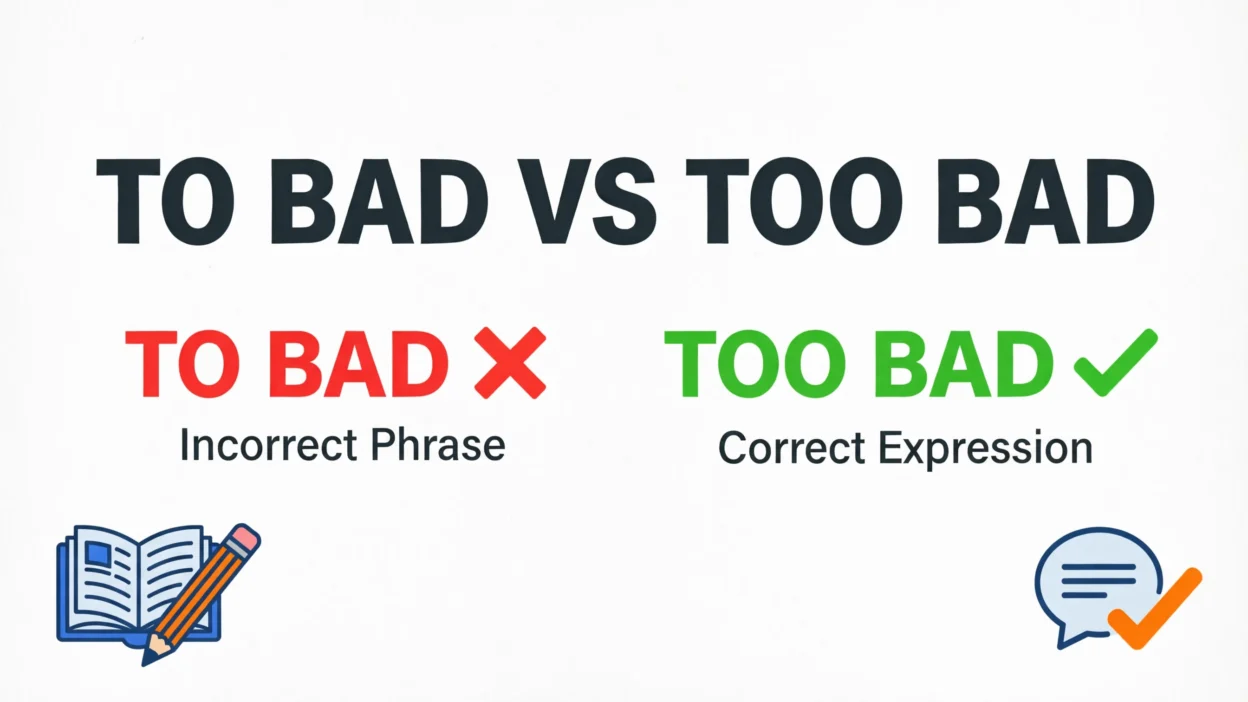
The correct phrase is “too bad.” It means unfortunate, disappointing, or unlucky and is commonly used to express sympathy or disappointment.
“To bad” is not a correct English phrase on its own. While to is a valid preposition or part of an infinitive, it does not combine with bad to form the expression “to bad.”
Examples:
- ✅ That’s too bad. I hope things get better.
- ✅ It’s too bad we missed the concert.
- ❌ That’s to bad.
What Does “Too Bad” Mean?
Too bad is a common English expression used to describe something unfortunate, disappointing, or regrettable. It can also be used to express sympathy when someone experiences bad news or an unfortunate situation.
Depending on the context, too bad may sound sincere, casual, or even slightly sarcastic.
Examples
- It’s too bad you couldn’t join us.
- That’s too bad. I know you were excited.
- It’s too bad the weather ruined our plans.
- Well, that’s too bad, but we’ll try again tomorrow.
When to Use “Too Bad”
Use too bad when:
- Expressing disappointment
- Showing sympathy
- Talking about unfortunate situations
- Describing something regrettable
What Does “To Bad” Mean?
On its own, to bad is not grammatically correct and is almost always a spelling mistake.
People often write to bad when they actually mean too bad because to and too are homophones—they sound the same but have different meanings.
However, the word to can appear before bad in very specific sentence structures, although it is not the phrase “to bad.”
For example:
- We went to bad neighborhoods to volunteer.
- He admitted to bad behavior.
In these sentences, to functions as a preposition and is not part of the expression “too bad.”
To Bad vs Too Bad: Comparison Table
| Feature | To Bad | Too Bad |
|---|---|---|
| Is it correct as a phrase? | ❌ No | ✅ Yes |
| Meaning | No standalone meaning | Unfortunate or disappointing |
| Part of Speech | Preposition + adjective (only in specific sentence structures) | Adverb + adjective forming a common expression |
| Common Usage | Rare and context-dependent | Very common in spoken and written English |
| Example | He admitted to bad decisions. | It’s too bad you couldn’t come. |
Key Differences Between To Bad and Too Bad
Understanding these differences makes it much easier to avoid mistakes.
1. One Is Correct, the Other Usually Isn’t
Too bad is the correct English expression.
To bad is almost always a spelling error unless to is serving its normal grammatical role before a noun or adjective phrase.
2. Different Meanings
Too bad expresses disappointment or regret.
To simply functions as a preposition or part of an infinitive and does not add the meaning of “unfortunate.”
3. Different Grammar
In too bad, too means “excessively” or forms an idiomatic expression.
In to bad neighborhoods, to indicates direction or relationship.
Easy Trick to Remember the Difference
Here’s a simple memory tip:
- Too = Also or Excessively
- Too bad = Unfortunately
If you’re expressing disappointment, choose too bad.
Remember that too has an extra “o.” Think of the extra letter as representing extra emotion or extra emphasis, making it easier to remember that too bad is the correct phrase.
Common Mistakes
Many writers accidentally type to bad because both words sound alike.
Mistake 1: Using “To Bad” Instead of “Too Bad”
Incorrect:
❌ That’s to bad.
Correct:
✅ That’s too bad.
Mistake 2: Forgetting the Meaning of “Too”
Incorrect:
❌ It’s to bad we missed the train.
Correct:
✅ It’s too bad we missed the train.
Mistake 3: Assuming Sound Equals Spelling
English contains many homophones.
Just because to and too sound identical doesn’t mean they’re interchangeable.
Real-Life Example Sentences
Using “Too Bad”
- It’s too bad the restaurant was closed.
- That’s too bad about your exam results.
- It’s too bad we couldn’t stay longer.
- Too bad the tickets sold out so quickly.
- That’s too bad, but there will be another opportunity.
Using “To” Correctly Before “Bad”
These examples are grammatically correct but are not using the phrase “to bad.”
- He confessed to bad decisions in his past.
- They moved to bad neighborhoods because housing was cheaper.
- She admitted to bad planning.
American vs British English
There is no difference between American and British English regarding too bad.
Both varieties:
- Use too bad to express disappointment or sympathy.
- Consider to bad incorrect as a standalone expression.
- Follow the same grammar and spelling rules.
Only pronunciation and accent may vary slightly depending on the speaker, but the usage remains identical.
Related Words and Phrases (LSI Keywords)
To better understand to bad vs too bad, it’s helpful to learn related terms:
- too vs to
- too meaning
- to meaning
- grammar mistakes
- commonly confused words
- English spelling
- English grammar
- homophones
- writing tips
- correct English usage
- unfortunate
- disappointing
- sympathy expressions
- phrase meaning
- grammar rules
Using these related words naturally in your writing can strengthen your vocabulary and improve overall language accuracy.
Best Practices for Using “Too Bad”
Follow these simple tips to use too bad correctly every time:
- Use too bad when expressing disappointment or regret.
- Double-check your spelling before publishing or sending a message.
- Remember that to bad is usually a typo.
- Read your sentence aloud and ask whether you’re expressing an unfortunate situation. If yes, too bad is almost certainly the right choice.
Frequently Asked Questions (FAQs)
1. Is “to bad” ever correct?
Not as a standalone phrase. In most cases, it’s a spelling mistake for too bad. However, to can correctly appear before bad as part of a larger grammatical structure, such as to bad neighborhoods.
2. What does “too bad” mean?
It means unfortunate, disappointing, or regrettable. It is often used to express sympathy or disappointment.
3. Why do people confuse “to” and “too”?
Because they are homophones—they sound the same but have different meanings and spellings.
4. Can I use “too bad” in formal writing?
Yes. Although it’s more common in everyday conversation, it is also acceptable in many forms of formal writing when the tone is appropriate.
5. Is “too bad” rude?
Not necessarily. It is usually sympathetic, but depending on tone and context, it can sound sarcastic or dismissive.
6. How can I remember the correct spelling?
Think of the extra “o” in too as representing extra emphasis. If you’re expressing regret or disappointment, use too bad.
7. Is there any difference between American and British English?
No. Both use too bad in exactly the same way and consider to bad incorrect as a standalone phrase.
Summary
Understanding to bad vs too bad is straightforward once you know that too bad is the correct expression used to describe something unfortunate or disappointing. In contrast, to bad is not a valid standalone phrase and is usually the result of confusing the homophones to and too. Recognizing this difference will help you avoid one of the most common spelling mistakes in English.
The easiest way to remember the rule is to associate too with extra emphasis. Whenever you’re expressing regret, sympathy, or disappointment, choose too bad. With regular reading and writing practice, using the correct phrase will soon become second nature.

Mike Poop is a dedicated writer at Symboliy.com, creating clear, practical content about language, communication, and everyday expressions to help readers understand meaning and usage confidently in professional contexts worldwide.