Have you ever paused while writing because you weren’t sure whether to use “to that effect” or “affect”? You’re not alone.
These two expressions may look or sound related, but they have completely different meanings and are used in entirely different contexts. Confusing them can make your writing unclear or even change the intended message.
In this guide, you’ll learn the difference between to that effect vs affect, discover easy-to-understand examples, avoid common mistakes, and gain practical tips to use both correctly in everyday conversations and professional writing.
Quick Answer
The difference between to that effect and affect is simple:
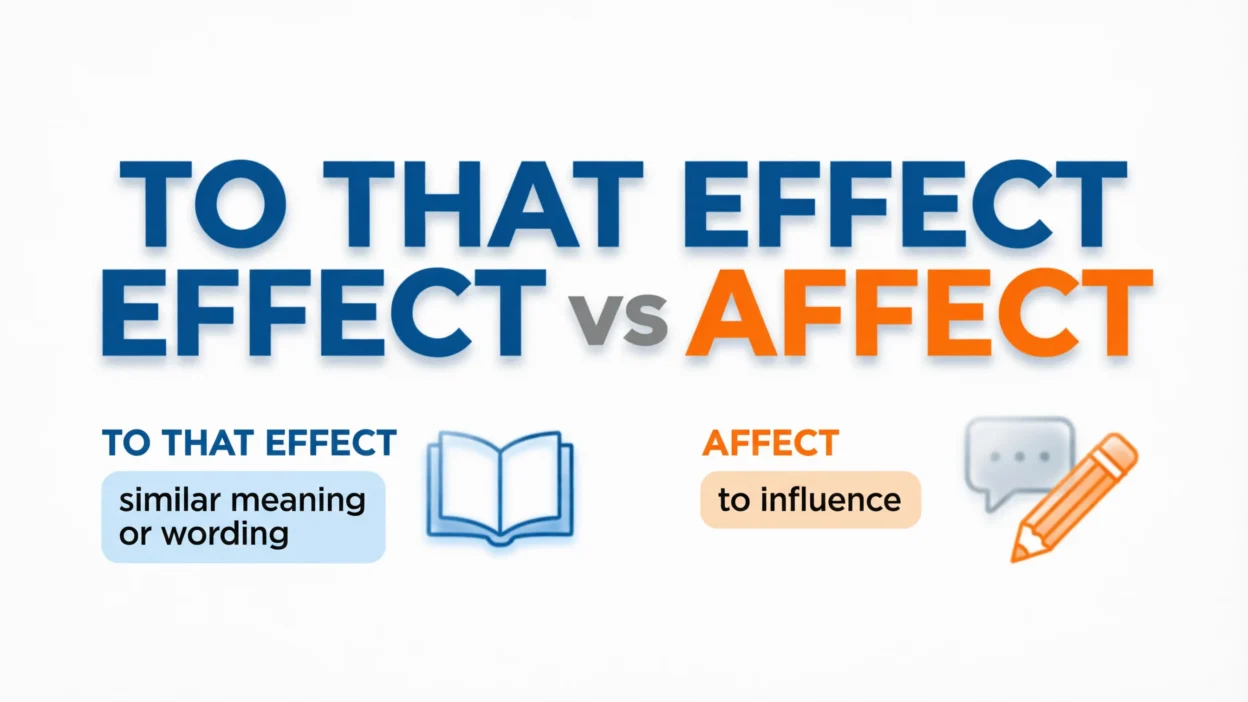
- To that effect is an idiomatic phrase meaning with that meaning, along those lines, or expressing something similar.
- Affect is usually a verb meaning to influence, change, or have an impact on something.
Example:
✅ She didn’t use those exact words, but she said something to that effect.
✅ The weather can affect your mood.
Although they sound somewhat similar, they serve completely different grammatical purposes and should never be used interchangeably.
What Does “To That Effect” Mean?
To that effect is an English idiom used when someone’s exact words are not being quoted, but their message or meaning is being summarized.
It tells readers or listeners that the original statement was similar in meaning, even if the wording was different.
Examples
- The manager said something to that effect, although I don’t remember the exact sentence.
- His email was to that effect, suggesting the meeting would be postponed.
- She nodded and made a comment to that effect.
When to Use “To That Effect”
Use this phrase when:
- Summarizing someone’s speech
- Referring to a previous statement
- Describing the general meaning instead of quoting directly
- Reporting conversations informally or formally
Similar Expressions
- In other words
- Along those lines
- With that meaning
- Essentially
- In essence
- Something similar
What Does “Affect” Mean?
Affect is most commonly used as a verb meaning to influence, change, or produce an effect on someone or something.
It describes how one thing impacts another.
Examples
- Lack of sleep can affect your concentration.
- Stress may affect your health.
- Rising prices affect millions of families.
- Good leadership positively affects employee morale.
In psychology, affect can also be a noun referring to a person’s emotional expression, but this usage is much less common in everyday English.
To That Effect vs Affect: Comparison Table
| Feature | To That Effect | Affect |
|---|---|---|
| Part of Speech | Idiomatic phrase | Usually a verb |
| Meaning | With that meaning; expressing something similar | To influence or change something |
| Used For | Summarizing statements | Describing influence or impact |
| Can Replace Each Other? | No | No |
| Example | She said something to that effect. | Noise can affect sleep. |
Key Differences Between To That Effect and Affect
Understanding these differences makes choosing the correct expression much easier.
1. Different Meanings
To that effect refers to the meaning of a statement.
Affect refers to influencing something.
Example:
- He made a remark to that effect.
- His remark didn’t affect my decision.
2. Different Grammar
To that effect functions as a fixed expression.
Affect functions primarily as a verb.
Incorrect:
❌ The news was to that affect.
Correct:
✅ The news had that effect.
or
✅ The news affected everyone.
3. Different Situations
Use to that effect when discussing speech or writing.
Use affect when discussing influence or consequences.
Easy Trick to Remember the Difference
Here’s a simple memory tip:
- Affect = Action
- To that effect = Explanation of Meaning
If someone is changing or influencing something, use affect.
If you’re summarizing what someone said, use to that effect.
Common Mistakes People Make
Many English learners—and even native speakers—mix these expressions because of their similar pronunciation.
Here are the most common errors.
Mistake 1: Using Affect Instead of Effect
Incorrect:
❌ She said something to that affect.
Correct:
✅ She said something to that effect.
Remember, the idiom is always to that effect.
Mistake 2: Confusing Effect and Affect
Incorrect:
❌ The storm had a bad affect.
Correct:
✅ The storm had a bad effect.
Here, effect is a noun meaning result.
Mistake 3: Using To That Effect for Influence
Incorrect:
❌ Pollution to that effect people’s health.
Correct:
✅ Pollution affects people’s health.
Real-Life Example Sentences
Using “To That Effect”
- The lawyer made a statement to that effect.
- I don’t remember her exact words, but they were to that effect.
- The article included comments to that effect.
Using “Affect”
- Exercise positively affects mental health.
- Inflation continues to affect consumers.
- Poor lighting can affect productivity.
- Medication may affect your appetite.
American vs British English
There is no significant difference between American and British English in the use of to that effect or affect.
Both varieties:
- Use to that effect with the same meaning.
- Use affect as a verb meaning “to influence.”
- Use the expressions in both formal and informal writing.
The only difference you might notice is pronunciation depending on regional accents, not grammar or meaning.
Related Words and Phrases (LSI Keywords)
When learning to that effect vs affect, it’s also useful to understand related vocabulary:
- affect vs effect
- effect meaning
- affect meaning
- influence
- impact
- consequence
- result
- expression
- idiom
- English grammar
- commonly confused words
- grammar mistakes
- writing tips
- word usage
- phrase meaning
Learning these related terms helps strengthen your understanding of English vocabulary and grammar.
Frequently Asked Questions (FAQs)
1. Is “to that affect” ever correct?
No. The correct idiom is always “to that effect.”
2. What does “to that effect” mean?
It means with that meaning, along those lines, or expressing a similar idea without quoting exactly.
3. Is affect a verb or noun?
Most of the time, affect is a verb meaning to influence. It can also be a noun in psychology, referring to emotional expression.
4. Can I replace “to that effect” with “affect”?
No. They have different meanings and grammatical functions.
5. How do I remember affect vs effect?
Think:
- Affect = Action (verb)
- Effect = End Result (noun)
The phrase to that effect uses the noun effect, not the verb affect.
6. Is “to that effect” formal?
Yes. It is commonly used in formal writing, journalism, legal documents, business communication, and everyday conversation.
7. Why do people confuse these words?
They sound similar, and both relate indirectly to ideas of influence or meaning, but they belong to different grammatical categories and are used in different contexts.
Summary
Understanding to that effect vs affect is easier once you recognize that they serve entirely different purposes. To that effect is an idiomatic phrase used to summarize the meaning of someone’s words without quoting them directly, while affect is a verb that describes influencing or changing someone or something. Because they differ in both meaning and grammar, they should never be substituted for one another.
The best way to master these terms is through regular practice. Read authentic English content, notice how each expression appears in context, and create your own example sentences. Over time, choosing the correct word or phrase will become natural, helping you write and communicate with greater clarity and confidence.

Here is a professional 30-word author biography including your site name Symboliy.com:
Martin Hood is a professional writer at Symboliy.com, creating clear, informative content focused on language, communication, and meaningful expressions for everyday and professional use.