Have you ever seen the words alterior and ulterior and wondered which one is correct? You’re not alone.
This is a common spelling confusion because both words sound somewhat similar, and many people accidentally write alterior motive when they actually mean ulterior motive.
If you’re comparing alterior vs ulterior, the good news is that the answer is simple. One word is recognized in standard English, while the other is generally considered a misspelling.
In this guide, you’ll learn the correct spelling, meaning, usage examples, common mistakes, and practical tips to remember the difference.
Quick Answer
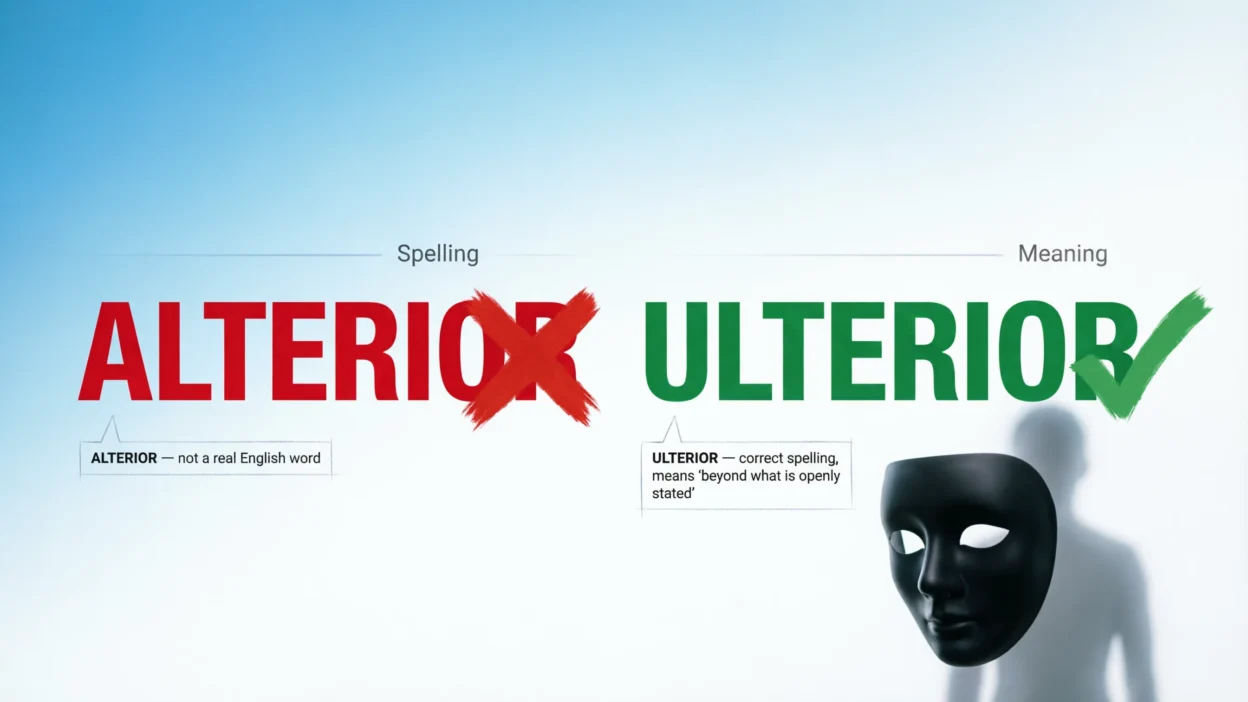
✅ Ulterior – Correct spelling
❌ Alterior – Incorrect spelling and common misspelling
The phrase “ulterior motive” is the correct expression in English. The word alterior is not recognized as a standard English word and should be avoided in formal and informal writing.
What Does Ulterior Mean?
The word ulterior is an adjective that describes something hidden, secret, or existing beyond what is openly stated.
It is most commonly used in the phrase “ulterior motive,” referring to a concealed reason for someone’s actions.
Definition
Ulterior (adjective):
- Existing beyond what is obvious or openly expressed.
- Hidden from immediate view or understanding.
- Secret or undisclosed.
Synonyms of Ulterior
- Hidden
- Secret
- Concealed
- Underlying
- Covert
- Unspoken
- Private
- Subtle
Antonyms of Ulterior
- Open
- Honest
- Direct
- Transparent
- Obvious
- Straightforward
What Does Alterior Mean?
In modern English, alterior is generally considered a misspelling of ulterior.
Many people mistakenly write alterior motive because they mishear or misremember the pronunciation of ulterior. However, major dictionaries and style guides recognize ulterior as the correct spelling.
Example
❌ She had an alterior motive for helping him.
✅ She had an ulterior motive for helping him.
If you’re writing professionally, academically, or online, always choose ulterior.
Why Do People Confuse Alterior and Ulterior?
The confusion often happens because of pronunciation.
When spoken quickly, ulterior can sound similar to “alterior,” especially in casual conversation. As a result, people sometimes spell the word the way they think it sounds.
Other factors include:
- Lack of familiarity with the word
- Hearing the phrase incorrectly
- Assuming the word begins with “al-” rather than “ul-“
- Relying on pronunciation rather than dictionary spelling
Despite these reasons, ulterior remains the only accepted spelling.
Alterior vs Ulterior: Comparison Table
| Feature | Alterior | Ulterior |
|---|---|---|
| Correct English spelling | ❌ No | ✅ Yes |
| Found in dictionaries | ❌ No | ✅ Yes |
| Accepted in academic writing | ❌ No | ✅ Yes |
| Accepted in business writing | ❌ No | ✅ Yes |
| Standard English usage | ❌ No | ✅ Yes |
| Meaning | None | Hidden or secret |
The comparison is straightforward: ulterior is always correct, while alterior should be avoided.
How to Use Ulterior Correctly
The word ulterior usually describes motives, intentions, reasons, or purposes that are not immediately obvious.
Everyday Examples
- I suspect he has an ulterior motive.
- She offered help, but many people believed she had an ulterior agenda.
- Their generosity seemed genuine, with no ulterior intentions.
Professional Examples
- The board questioned whether the proposal served an ulterior purpose.
- Investors looked for any ulterior motives behind the merger.
- The decision appeared straightforward, but some employees suspected ulterior reasons.
Academic Examples
- Researchers examined the politician’s ulterior motivations.
- The study explored whether participants acted from ulterior interests.
Common Phrases with Ulterior
Certain expressions frequently use the word ulterior.
Ulterior Motive
This is the most common phrase.
Meaning: A hidden reason for doing something.
Example:
- She volunteered to help, but some believed she had an ulterior motive.
Ulterior Purpose
A concealed objective behind an action.
Example:
- The campaign was criticized for having an ulterior purpose.
Ulterior Intentions
Secret plans or hidden goals.
Example:
- He denied having any ulterior intentions.
Common Mistakes with Ulterior
Many writers accidentally misuse this word.
Mistake #1: Writing Alterior Instead of Ulterior
❌ They suspected an alterior motive.
✅ They suspected an ulterior motive.
Mistake #2: Assuming Both Spellings Are Correct
Some people believe both versions are accepted.
❌ Alterior
✅ Ulterior
Only ulterior is recognized as standard English.
Mistake #3: Using Ulterior for Any Hidden Thing
The word typically refers to motives, reasons, agendas, or intentions rather than physical objects.
❌ The ulterior document was in the drawer.
✅ The hidden document was in the drawer.
Easy Trick to Remember the Correct Spelling
Here’s a simple memory technique:
Think of the word:
Ultimate → Ulterior
Both begin with “ul” and suggest something beyond the surface.
Another helpful reminder:
The common phrase is always:
Ulterior motive
If you remember that phrase, you’ll rarely make the spelling mistake.
American vs British English
There is no difference between American and British English in this case.
American English
✅ Ulterior
British English
✅ Ulterior
Incorrect in Both
❌ Alterior
Whether you’re writing for readers in the United States, the United Kingdom, Canada, Australia, or elsewhere, ulterior remains the correct spelling.
Origin and Etymology of Ulterior
The word ulterior comes from the Latin word ulterior, meaning:
- Further
- Beyond
- More distant
Over time, English adopted the word to describe motives or intentions that exist beyond what is immediately apparent.
This origin explains why ulterior carries the idea of something hidden beneath the surface.
Similar Commonly Confused Words
English contains many word pairs that create spelling confusion.
Examples
| Incorrect | Correct |
|---|---|
| Alterior | Ulterior |
| Visable | Visible |
| Undecisive | Indecisive |
| Definately | Definitely |
| Recieve | Receive |
| Seperate | Separate |
Learning these commonly confused words can significantly improve writing accuracy.
When Is the Word Ulterior Commonly Used?
The word ulterior appears frequently in discussions involving trust, motivation, and decision-making.
In Personal Relationships
People may question whether someone has an ulterior motive behind a kind gesture.
In Business
Companies and investors often evaluate whether decisions are driven by ulterior interests.
In Politics
Journalists frequently discuss possible ulterior motives behind public statements or policy changes.
In Literature
Authors use characters with ulterior motives to create suspense and complexity.
In each case, the word points to hidden intentions rather than openly stated reasons.
Frequently Asked Questions (FAQs)
1. Is alterior a real word?
No. Alterior is generally considered a misspelling of ulterior and is not recognized as standard English.
2. Which is correct: alterior or ulterior?
Ulterior is the correct spelling and should always be used.
3. What does ulterior mean?
Ulterior means hidden, secret, or existing beyond what is openly expressed.
4. What is an ulterior motive?
An ulterior motive is a concealed reason for doing something, often different from the stated reason.
5. Why do people write alterior?
Many people spell the word based on pronunciation or because they are unfamiliar with the correct spelling.
6. Is ulterior always negative?
Not necessarily. However, the phrase often carries a negative or suspicious implication because it suggests hidden intentions.
7. Is there an American and British spelling difference?
No. Both American and British English use ulterior.
8. Can ulterior be used outside the phrase “ulterior motive”?
Yes. It can describe hidden purposes, intentions, agendas, or reasons in many contexts.
Summary
When comparing alterior vs ulterior, the correct choice is always ulterior. The word refers to hidden motives, secret intentions, or purposes that are not immediately obvious. The spelling alterior is a common mistake and should be avoided in all forms of writing.
Remember that the familiar phrase is “ulterior motive,” not “alterior motive.” Using the correct spelling will help your writing appear more professional, accurate, and trustworthy in academic, business, and everyday communication.
Actionable Takeaway
Whenever you write about hidden intentions or secret reasons, use ulterior. A quick proofreading check for “alterior” can help eliminate one of the most common spelling mistakes in English.

Shan Waston is a skilled writer at Symboliy.com, producing clear, engaging content on language, communication, and everyday expressions to help readers understand meaning and usage confidently in modern digital contexts.