Have you ever written recognization and wondered if it was the right word? You’re not alone. Many English learners, students, professionals, and writers get confused when comparing recognization vs recognition because both words seem logical and are occasionally seen online.
However, only one of these terms is considered standard and widely accepted in modern English. Understanding the difference will help you write more confidently, improve your communication, and avoid a common vocabulary mistake.
In this guide, you’ll learn the meanings, correct usage, examples, common errors, and whether American and British English treat these words differently.
Quick Answer
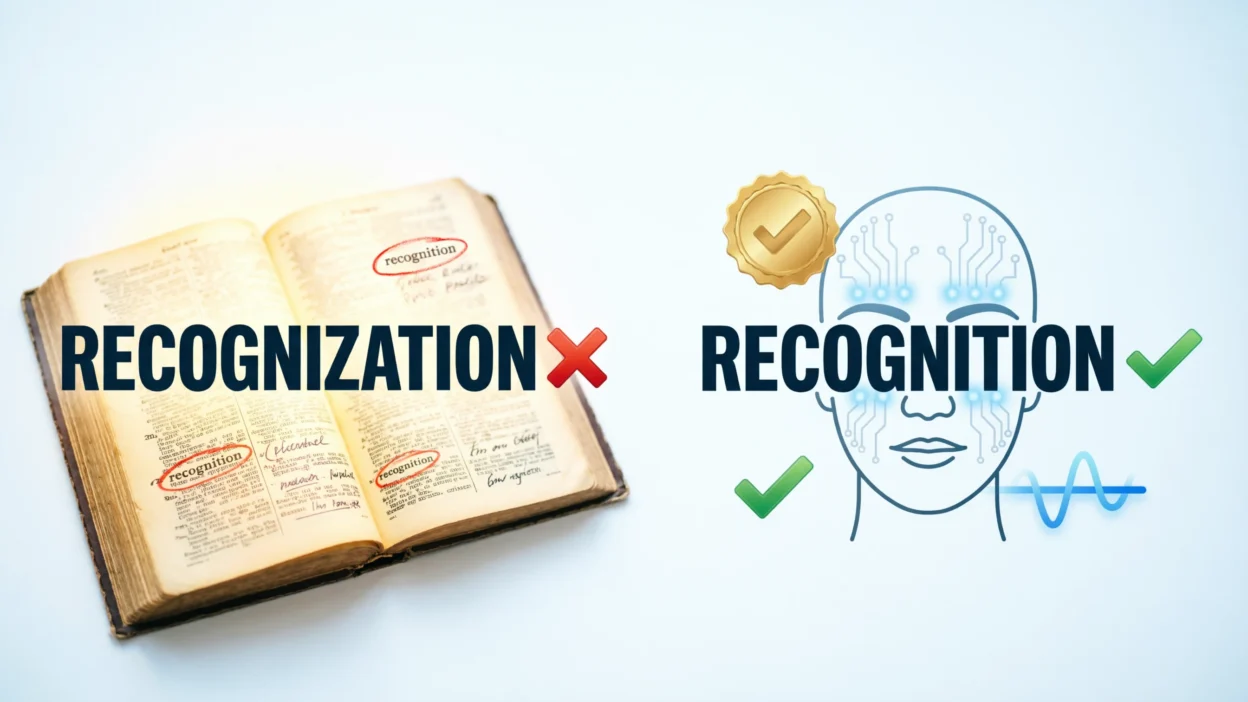
Recognition is the correct and standard English word.
Recognization is generally considered a nonstandard or incorrect variant and should be avoided in formal, academic, and professional writing.
✅ Correct: She received recognition for her hard work.
❌ Incorrect: She received recognization for her hard work.
✅ Correct: The company gained international recognition.
What Does Recognition Mean?
Recognition is a noun that refers to the act of identifying, acknowledging, appreciating, or accepting someone or something.
It can be used in several contexts, including:
- Acknowledging achievements
- Identifying a person or object
- Public appreciation
- Official acceptance
- Brand awareness
Examples of Recognition
- She earned recognition for her leadership skills.
- Facial recognition technology is becoming more advanced.
- The artist received international recognition.
- Employees appreciate recognition for their efforts.
- The organization gained recognition from industry experts.
In all these examples, recognition refers to acknowledgment, identification, or appreciation.
What Does Recognization Mean?
Recognization is sometimes used by speakers and writers who assume it follows the same pattern as words like:
- Organization
- Realization
- Modernization
While the formation appears logical, recognization is not the preferred standard noun form of recognize.
Most modern dictionaries, style guides, publishers, educators, and grammar experts recommend using recognition instead.
Examples of Incorrect Usage
❌ The employee received recognization for outstanding performance.
✅ The employee received recognition for outstanding performance.
❌ Brand recognization increased significantly.
✅ Brand recognition increased significantly.
Recognization vs Recognition: Key Difference
| Feature | Recognization | Recognition |
|---|---|---|
| Standard English word | No | Yes |
| Accepted in professional writing | No | Yes |
| Common in academic writing | No | Yes |
| Dictionary preference | Rarely | Yes |
| Used by native speakers | Rarely | Very common |
| Recommended for SEO writing | No | Yes |
The comparison makes it clear that recognition is the correct choice in modern English.
Why Do People Confuse Recognization and Recognition?
Several factors contribute to the confusion.
Similar Word Patterns
English contains many nouns ending in -ization, such as:
- Organization
- Globalization
- Modernization
- Specialization
As a result, people naturally assume that recognize should become recognization.
Influence of Verb Forms
Since the verb is recognize, some writers try to create a noun by simply adding -ation.
However, English does not always follow predictable word-formation rules.
Online Usage
Although recognization occasionally appears online, widespread usage does not make it standard English.
Language Learning Challenges
Non-native speakers often create words based on patterns they observe elsewhere in English vocabulary.
Why Recognition Is the Correct Form
The noun recognition has been established in English for centuries and is the accepted noun form of the verb recognize.
Word formation in English can be irregular.
Consider these examples:
| Verb | Correct Noun |
|---|---|
| Recognize | Recognition |
| Decide | Decision |
| Describe | Description |
| Revise | Revision |
| Expand | Expansion |
Notice that English often changes word endings rather than simply adding -ation.
This is why recognition became the accepted noun form.
Examples of Recognition in Sentences
Here are some examples showing proper usage.
In the Workplace
- Employees value recognition for their achievements.
- The company created an employee recognition program.
In Education
- The student received recognition for academic excellence.
- Recognition of effort can improve motivation.
In Technology
- Facial recognition software enhances security.
- Voice recognition systems continue to improve.
In Business
- Brand recognition is essential for long-term success.
- The startup gained recognition in the global market.
In Everyday Life
- Everyone appreciates recognition for their hard work.
- Community recognition can inspire future achievements.
These examples demonstrate how commonly recognition appears in everyday communication.
Common Mistakes Related to Recognization vs Recognition
Many writers make similar errors when using these words.
Mistake 1: Using Recognization in Formal Writing
❌ The project received recognization from industry leaders.
✅ The project received recognition from industry leaders.
Mistake 2: Following the Wrong Word Pattern
❌ Customer recognization increased this year.
✅ Customer recognition increased this year.
Mistake 3: Assuming Both Words Are Equally Correct
❌ Recognization and recognition are interchangeable.
✅ Recognition is the accepted standard form.
Using the correct noun improves credibility and professionalism.
Is Recognization Ever Correct?
Technically, recognization has appeared in some historical texts and occasional modern usage.
However, it is widely regarded as:
- Nonstandard
- Uncommon
- Unnecessary
- Inferior to recognition
Most style guides and dictionaries recommend avoiding it altogether.
For practical purposes, professional writers should always choose recognition.
American vs British English
Unlike some spelling differences between American and British English, there is no significant variation here.
Both forms of English overwhelmingly use:
Recognition
American English
- The athlete gained national recognition.
British English
- The scientist received recognition for her research.
Neither variety of English prefers recognization.
Related Words and Forms
Learning related vocabulary can help improve your understanding.
Recognize
The verb form.
Example:
- I recognize her from school.
Recognition
The noun form.
Example:
- The company earned industry recognition.
Recognizable
An adjective meaning easily identified.
Example:
- The logo is instantly recognizable.
Recognizably
An adverb form.
Example:
- The product is recognizably different from competitors.
Recognition Program
A common business term.
Example:
- The organization launched a new employee recognition program.
These related words are frequently used in business, education, technology, and everyday communication.
Tips to Remember the Correct Spelling
If you often confuse recognization and recognition, these tips can help.
- Remember that dictionaries favor recognition.
- Think of similar words like decision and description.
- Most professional writers use recognition.
- Avoid creating nouns by automatically adding -ation.
- Use spell-check tools for additional confirmation.
A simple memory trick:
Recognize → Recognition, not Recognization.
Think of it as following the pattern:
Describe → Description
Recognize → Recognition
When Should You Use Recognition?
Use recognition whenever you want to refer to:
- Appreciation
- Acknowledgment
- Identification
- Acceptance
- Awareness
- Public praise
Common examples include:
- Employee recognition
- Brand recognition
- Facial recognition
- Voice recognition
- Professional recognition
- Industry recognition
Examples:
- The company achieved global recognition.
- Recognition of talent encourages growth.
- The technology relies on facial recognition systems.
In virtually every modern context, recognition is the correct word.
Frequently Asked Questions
Which is correct: recognization or recognition?
Recognition is the correct and standard English word.
Is recognization a real word?
It occasionally appears in historical and nonstandard usage, but it is not the preferred form in modern English.
Why is recognition preferred?
Recognition has been the accepted noun form of recognize for centuries and is widely supported by dictionaries and style guides.
Can I use recognization in academic writing?
No. Academic and professional writing should use recognition.
What does recognition mean?
Recognition means acknowledgment, identification, appreciation, or acceptance of someone or something.
Is recognization used in American English?
Very rarely. American English overwhelmingly uses recognition.
Does British English use recognization?
No. British English also strongly prefers recognition.
What are common phrases using recognition?
Examples include:
- Brand recognition
- Employee recognition
- Facial recognition
- Industry recognition
- Public recognition
Summary
When comparing recognization vs recognition, the correct choice is clear. Recognition is the accepted and standard noun form of the verb recognize, used to describe acknowledgment, appreciation, identification, or acceptance. It appears in professional, academic, business, and everyday communication and is recognized by dictionaries and style guides worldwide.
While recognization occasionally appears in historical texts or informal writing, it is generally considered nonstandard and should be avoided. Whether you’re discussing employee recognition, facial recognition technology, or public recognition of achievements, choosing recognition will ensure your writing remains accurate, polished, and professional.
Actionable Takeaway
Whenever you need the noun form of recognize, use recognition. Avoid recognization in professional, academic, and everyday writing. If you’re unsure, remember that major dictionaries, educators, and style guides consistently recommend recognition as the correct choice.

Here is a professional 30-word author biography including your site name Symboliy.com:
Martin Hood is a professional writer at Symboliy.com, creating clear, informative content focused on language, communication, and meaningful expressions for everyday and professional use.