If you’ve ever typed cancell and wondered whether it is correct, you’re not alone. Many English learners, students, and even native speakers get confused between cancell and cancel, especially because English contains many words with double consonants.
The good news is that the answer is simple. Understanding the correct spelling can help you avoid grammar mistakes in emails, academic writing, business communication, and everyday conversations.
In this guide, you’ll learn the difference between cancell and cancel, see practical examples, discover common errors, and understand how American and British English handle related forms of the word.
Quick Answer
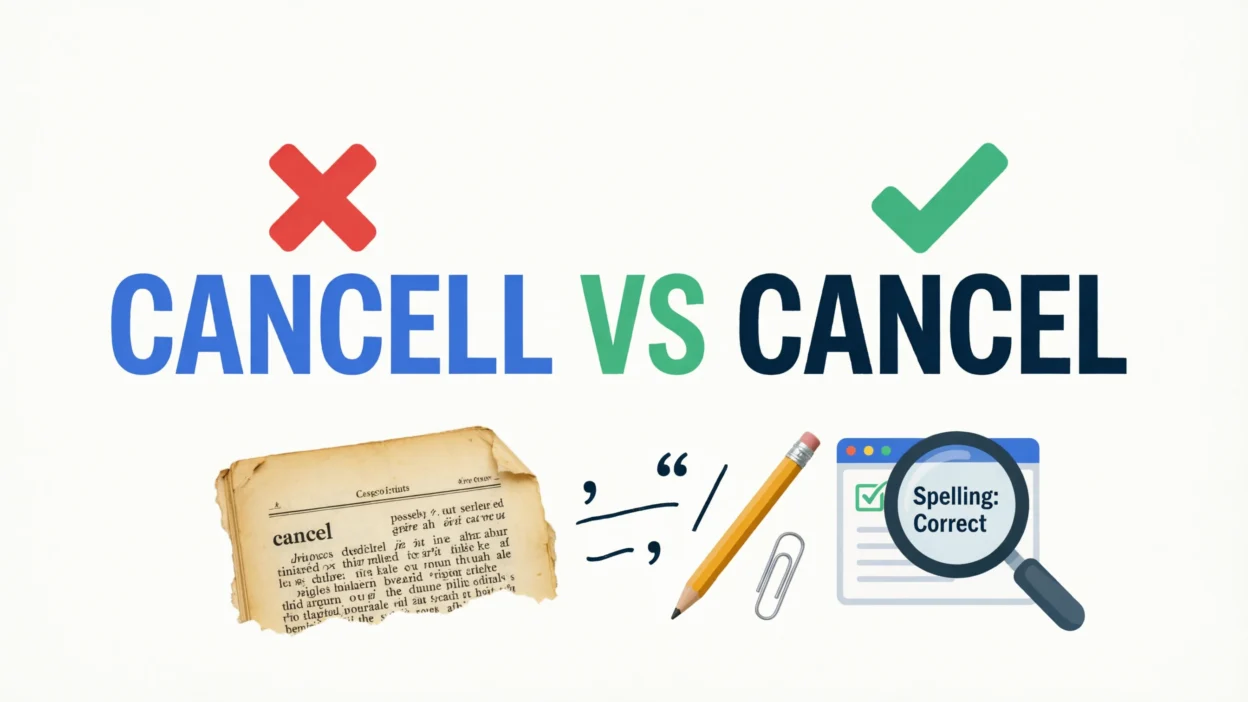
The correct spelling is “cancel.”
- ✅ Cancel = Correct spelling
- ❌ Cancell = Incorrect spelling
Cancel is a verb that means to call off, stop, revoke, or terminate something.
Example:
- We had to cancel the meeting.
- She decided to cancel her subscription.
The spelling cancell with a double “l” at the end is not recognized as a standard English word.
What Does “Cancel” Mean?
The word cancel means to decide that something planned will not happen or to officially end an agreement, arrangement, event, or action.
It is commonly used in both personal and professional communication.
Common Meanings of Cancel
- To call off an event
- To terminate a service
- To revoke an agreement
- To stop a planned action
- To invalidate something
Examples
- The airline canceled the flight due to bad weather.
- I need to cancel my gym membership.
- They decided to cancel the project.
- The school canceled classes for the day.
Cancell vs Cancel: Which Is Correct?
| Word | Correct? | Meaning |
|---|---|---|
| Cancel | ✅ Yes | To call off, stop, or terminate something |
| Cancell | ❌ No | Incorrect spelling |
| Cancelled | ✅ British English | Past tense spelling commonly used in British English |
| Canceled | ✅ American English | Past tense spelling commonly used in American English |
The confusion often comes from words like:
- Travelled
- Labelled
- Modelled
Since these words contain double “l” in some forms, many people mistakenly assume the base word should be cancell. However, the correct base form is always cancel.
Why Is “Cancel” the Correct Spelling?
The verb originates from Latin and entered English as cancel, ending with a single “l.”
The standard dictionary form is:
- Cancel
Not:
- Cancell
When adding certain suffixes, the spelling may change depending on the English variety being used, but the root word remains cancel.
Correct Base Forms
- Cancel
- Cancels
- Canceling (American English)
- Cancelling (British English)
- Canceled (American English)
- Cancelled (British English)
Examples of “Cancel” in Sentences
Everyday Examples
- I need to cancel my appointment.
- They decided to cancel the trip.
- Please cancel my reservation.
Business Examples
- The company may cancel the contract.
- We had to cancel the conference due to low attendance.
- Management chose to cancel the initiative.
Academic Examples
- The university might cancel the event.
- Students were disappointed when organizers canceled the workshop.
Technology Examples
- Click here to cancel your subscription.
- Users can cancel their membership anytime.
Common Mistakes People Make
1. Writing “Cancell” Instead of “Cancel”
This is the most common mistake.
❌ Cancell
✅ Cancel
Always use a single “l” in the base form.
2. Confusing Cancel With Cancelled
Many writers see cancelled and assume the base word must be cancell.
However:
- Cancel → Correct base form
- Cancelled → Past tense in British English
The base word never becomes cancell.
3. Mixing American and British Spellings
Writers sometimes use:
- Canceled in one paragraph
- Cancelled in another paragraph
Choose one style and remain consistent.
4. Double-Checking Spellcheck Too Late
Typing quickly can easily produce:
❌ cancell
Most spellcheck tools will flag this error, but proofreading remains important.
Cancel vs Cancelled vs Canceled
One of the biggest reasons for confusion is the difference between American and British spelling conventions.
| Form | American English | British English |
|---|---|---|
| Base Verb | Cancel | Cancel |
| Present Participle | Canceling | Cancelling |
| Past Tense | Canceled | Cancelled |
| Past Participle | Canceled | Cancelled |
Both styles are correct when used consistently within their respective language standards.
American vs British English
American English
American English typically uses a single “l” before suffixes.
Examples:
- Canceled
- Canceling
British English
British English often doubles the final “l” when adding suffixes.
Examples:
- Cancelled
- Cancelling
Important Note
Regardless of the spelling variation:
✅ Cancel
remains the correct base word in both American and British English.
❌ Cancell
is incorrect in both varieties.
Why Correct Spelling Matters
Using the correct spelling improves:
- Professional credibility
- Academic accuracy
- Search engine optimization
- Business communication
- Reader trust
Misspellings such as cancell can make content appear less polished and may distract readers from your message.
For businesses, bloggers, students, and professionals, proper spelling helps create a stronger impression.
Easy Trick to Remember the Correct Spelling
Use this simple memory rule:
The dictionary word is always “cancel” with one “l.”
Think:
- Cancel a meeting
- Cancel a booking
- Cancel a subscription
Every base form uses only one “l.”
The second “l” appears only in some British English inflected forms like cancelled and cancelling.
Frequently Asked Questions
Is “cancell” a real word?
No. Cancell is not recognized as a standard English word.
Which is correct: cancell or cancel?
Cancel is the correct spelling.
Why do people write “cancell”?
Many people mistakenly assume the base word should have two “l”s because they have seen words such as cancelled and cancelling.
Is “cancel” correct in American English?
Yes. Cancel is the correct base form in American English.
Is “cancel” correct in British English?
Yes. British English also uses cancel as the base verb.
What is the difference between canceled and cancelled?
- Canceled is the preferred American spelling.
- Cancelled is the preferred British spelling.
Is “cancel” acceptable in formal writing?
Yes. It is widely accepted in academic, professional, legal, and business writing.
How can I remember the correct spelling?
Remember that the dictionary form is always cancel with one “l.”
Summary
When comparing cancell vs cancel, the correct spelling is clearly cancel. The word means to call off, stop, terminate, or revoke something, and it is the accepted base form in both American and British English. The spelling cancell is considered a mistake and should be avoided in formal and informal writing.
Much of the confusion comes from related forms such as cancelled and cancelling, which are commonly used in British English. However, regardless of the English variety you use, the root word always remains cancel. Learning this simple rule will help you write with greater confidence and accuracy.
Actionable Takeaway
Whenever you’re unsure, remember that the dictionary form is always cancel with one “l.” If you see cancell, correct it immediately. For past tense and continuous forms, choose either American or British spelling conventions and use them consistently throughout your writing.

Mike Poop is a dedicated writer at Symboliy.com, creating clear, practical content about language, communication, and everyday expressions to help readers understand meaning and usage confidently in professional contexts worldwide.