
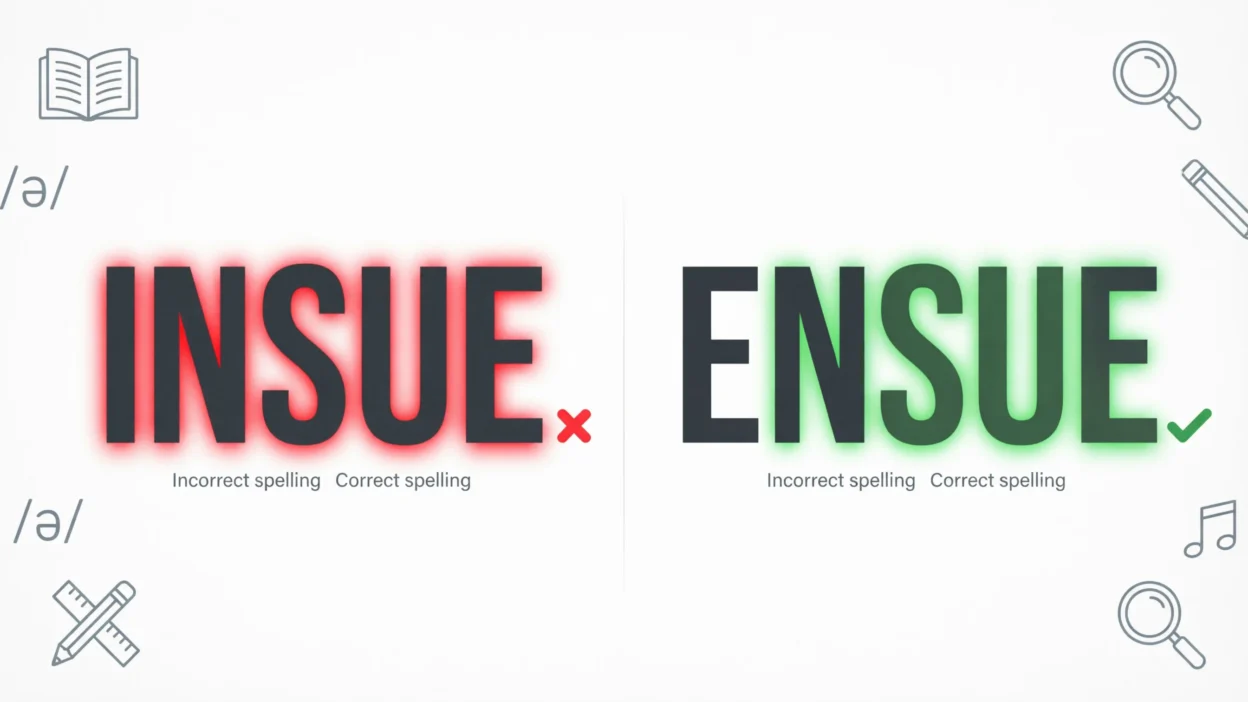
If you’ve ever come across the terms insue vs ensue and wondered which one is correct, you’re not alone. Many writers, students, and English learners frequently confuse these words because they look and sound somewhat similar.
However, there is a very important distinction that can affect the clarity and professionalism of your writing.
The good news is simple: “ensue” is a real English word, while “insue” is generally considered a misspelling. Understanding the difference can help you avoid common grammar mistakes and improve your writing confidence.
In this guide, we’ll explain the meaning of ensue, provide practical examples, highlight common errors, and answer frequently asked questions.
Quick Answer
Ensue is the correct English word and means to happen afterward as a result of something else.
Insue is not recognized as a standard English word and is almost always a spelling mistake for ensue.
Correct: Chaos may ensue if the instructions are ignored.
Incorrect: Chaos may insue if the instructions are ignored.
What Does Ensue Mean?
The verb ensue means to occur, follow, or happen as a consequence of a previous event. It is often used to describe situations that develop naturally after another action or event takes place.
Definition of Ensue
Ensue (verb): To happen afterward or as a result of something.
The word originates from Middle English and ultimately comes from Latin roots meaning “to follow.”
Simple Examples of Ensue
- A heated argument ensued after the controversial decision.
- If the power goes out, confusion may ensue.
- Heavy rain fell throughout the night, and flooding ensued.
- Several questions ensued following the presentation.
- Legal action could ensue if the contract is breached.
In each example, something happens first, and another event follows as a consequence.
Is Insue a Real Word?
No, insue is not a standard English word in modern dictionaries.
When people write “insue,” they are usually intending to write “ensue.” The mistake often occurs because:
- The pronunciation can be misunderstood.
- Typing errors happen frequently.
- Some writers incorrectly assume the word begins with “in” instead of “en.”
- Spell-check software may not always catch contextual errors.
For professional, academic, or business writing, you should always use ensue.
Insue vs Ensue: Side-by-Side Comparison
| Feature | Insue | Ensue |
|---|---|---|
| Is it a real English word? | No | Yes |
| Dictionary recognized? | No | Yes |
| Part of speech | N/A | Verb |
| Meaning | None in standard English | To happen afterward or as a result |
| Appropriate for formal writing? | No | Yes |
| Common usage | Misspelling | Correct usage |
The comparison clearly shows that ensue is the only correct choice in standard English.
How to Use Ensue Correctly
Understanding how to use ensue in a sentence is important because it often appears in formal writing, journalism, legal documents, and academic texts.
Common Sentence Patterns
Event + Ensue
- The negotiations failed, and protests ensued.
- The warning was ignored, and disaster ensued.
Ensue + After
- Confusion ensued after the announcement.
- Panic ensued after the fire alarm sounded.
Ensue + From
- Several complications ensued from the delay.
- Benefits may ensue from consistent practice.
Formal Examples
- A legal dispute ensued between the two companies.
- Extensive discussions ensued regarding the policy changes.
- Economic challenges ensued following the market downturn.
These examples demonstrate how ensue commonly appears in professional communication.
Common Mistakes People Make
Many English learners and native speakers alike make errors when using ensue. Here are the most frequent mistakes.
Mistake #1: Writing Insue Instead of Ensue
Incorrect: Several issues insued after the update.
Correct: Several issues ensued after the update.
Mistake #2: Using Ensue Without a Prior Event
Since ensue means “to follow,” there should usually be an earlier event that triggers it.
Weak: Problems ensued.
Better: The system crashed, and problems ensued.
Mistake #3: Confusing Ensue With Result
While related in meaning, they are not always interchangeable.
Result often functions as a noun.
- The result was positive.
Ensue functions as a verb.
- Positive outcomes ensued.
Mistake #4: Incorrect Verb Forms
Correct forms include:
- Ensue
- Ensues
- Ensued
- Ensuing
Examples:
- A disagreement ensued.
- More discussions are ensuing.
Synonyms of Ensue
Using related words can improve writing variety and SEO relevance.
Common Synonyms
- Follow
- Result
- Occur
- Happen
- Develop
- Arise
- Emerge
- Proceed
- Come afterward
- Take place
Example Comparisons
- Chaos ensued.
- Chaos followed.
- A debate ensued.
- A debate developed.
Although these alternatives can sometimes work, ensue often sounds more formal and precise.
When Should You Use Ensue?
Use ensue when describing a consequence, outcome, or event that naturally follows another event.
Good Situations for Ensue
- News reporting
- Academic writing
- Business communication
- Legal documents
- Professional emails
- Formal essays
Examples
- Following the announcement, widespread discussion ensued.
- Several opportunities ensued from the partnership.
- A lengthy investigation ensued after the incident.
American vs British English: Is There Any Difference?
Unlike many English words that differ between American and British spelling, ensue is spelled exactly the same in both American English and British English.
American English
- The controversy ensued after the statement.
British English
- The controversy ensued after the statement.
There are no spelling, pronunciation, or usage differences between the two versions of English.
This makes ensue a universally accepted term across English-speaking countries.
Why Is Ensue Often Confused?
The confusion surrounding insue vs ensue usually stems from pronunciation and spelling assumptions.
Several factors contribute to the mistake:
- The word is not commonly used in everyday conversation.
- Writers may hear it before seeing it written.
- The “en” prefix is mistaken for “in.”
- Autocorrect does not always identify intended words.
A helpful memory trick is:
Ensue begins with “en” because events “enter” after another event happens.
While not etymologically accurate, it can help you remember the correct spelling.
Examples of Ensue in Real-Life Contexts
Business
- The merger was announced, and significant restructuring ensued.
Education
- The professor asked a challenging question, and a lively discussion ensued.
Legal
- The contract was violated, and litigation ensued.
Healthcare
- Complications ensued following the procedure.
Sports
- A dispute over the referee’s decision ensued after the match.
These examples illustrate how versatile the word is across different contexts.
Frequently Asked Questions
Is insue a correct spelling?
No. Insue is considered a misspelling. The correct word is ensue.
What does ensue mean?
Ensue means to happen afterward or as a consequence of a previous event.
How do you use ensue in a sentence?
Example: The announcement was made, and excitement ensued.
Is ensue formal or informal?
Ensue is generally regarded as a formal or semi-formal word commonly used in professional and academic writing.
What is the past tense of ensue?
The past tense of ensue is ensued.
Example: A discussion ensued after the meeting.
What are some synonyms for ensue?
Common synonyms include:
- Follow
- Result
- Occur
- Happen
- Arise
- Develop
Is ensue used in American English?
Yes. It is commonly used in both American and British English.
Why do people write insue?
People often write insue because they mishear the pronunciation or incorrectly assume the word starts with “in” instead of “en.”
Summary
The debate over insue vs ensue has a straightforward answer: ensue is the correct English word, while insue is a misspelling. The word ensue means “to happen afterward” or “to occur as a result of something else.” It is widely used in formal writing, academic contexts, business communication, journalism, and legal documents.
Whenever you want to describe an event that follows another event, use ensue with confidence. Remember that insue does not exist in standard English, so avoiding this spelling mistake will make your writing clearer, more professional, and more credible.
Actionable Takeaway
Before submitting any piece of writing, quickly check for the spelling ensue whenever you’re describing a consequence or outcome. If you see insue, replace it immediately with ensue.
A simple rule to remember is: When one event follows another, the correct word is always ensue.

Here is a professional 30-word author biography including your site name Symboliy.com:
Martin Hood is a professional writer at Symboliy.com, creating clear, informative content focused on language, communication, and meaningful expressions for everyday and professional use.