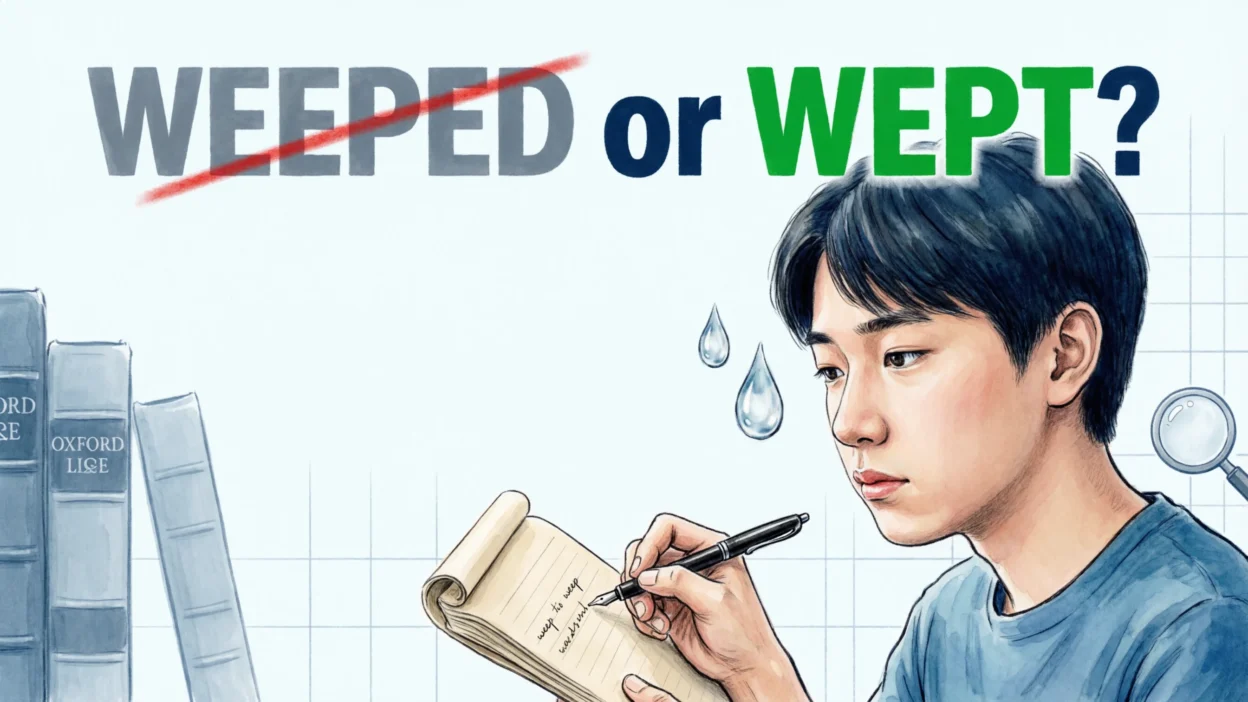
Have you ever paused while writing and wondered whether “weeped” or “wept” is the correct word?
You’re not alone. Many English learners, writers, and even native speakers occasionally get confused about irregular verbs, especially when they don’t follow standard grammar patterns.
If you’ve searched for weeped or wept, you’re likely looking for the correct past tense of weep and how to use it properly in everyday writing and speech.
This guide explains everything you need to know, including meanings, examples, common mistakes, and practical tips to help you remember the correct form.
Quick Answer
The correct past tense and past participle of “weep” is “wept.”
✅ Correct: She wept after hearing the sad news.
❌ Incorrect: She weeped after hearing the sad news.
While some people mistakenly use weeped, it is not considered standard English. Wept is the accepted form in both formal and informal writing.
What Does “Weep” Mean?
The verb weep means to cry, shed tears, or express deep sorrow or emotion. It is often used in literary, formal, or emotional contexts.
Definition
Weep (verb):
To cry tears because of sadness, grief, joy, or strong emotion.
Synonyms of Weep
- Cry
- Sob
- Mourn
- Lament
- Shed tears
- Grieve
- Wail
- Sorrow
Example Sentences
- The child began to weep when she lost her favorite toy.
- Many people weep during emotional movies.
- He could not help but weep at the funeral.
Is It Weeped or Wept?
The simple answer is wept.
The verb weep is an irregular verb, meaning it does not form its past tense by simply adding -ed.
Verb Forms of Weep
| Verb Form | Correct Form |
|---|---|
| Base Verb | Weep |
| Past Tense | Wept |
| Past Participle | Wept |
| Present Participle | Weeping |
Examples
Present Tense
- I weep whenever I hear that song.
Past Tense
- I wept after reading the heartbreaking letter.
Past Participle
- She had wept for hours before finally calming down.
Present Participle
- He is weeping quietly in the corner.
Why Do People Say “Weeped”?
Many English verbs create their past tense by adding -ed.
Examples:
- Walk → Walked
- Jump → Jumped
- Laugh → Laughed
Because of this pattern, some learners naturally assume:
- Weep → Weeped
However, English contains many irregular verbs that follow unique historical patterns.
Examples include:
- Sleep → Slept
- Keep → Kept
- Sweep → Swept
- Weep → Wept
Notice how these verbs change their vowel sound rather than adding -ed.
Wept in Sentences
Using the correct form in context helps reinforce understanding.
Examples of Wept
- She wept with happiness at her graduation ceremony.
- The audience wept during the emotional final scene.
- He silently wept after hearing the news.
- They wept for those who were lost.
- The mother wept tears of joy when her son returned home.
Literary Examples
The word wept frequently appears in novels, poetry, and religious texts because it conveys deep emotion.
Examples:
- The widow wept beside the river.
- He wept bitterly throughout the night.
- She wept for the future she had imagined.
Common Mistakes with Weep and Wept
Many writers make similar grammar mistakes when using this verb.
Mistake 1: Using Weeped as the Past Tense
❌ I weeped when I watched the movie.
✅ I wept when I watched the movie.
Mistake 2: Using Weep Instead of Wept
❌ Yesterday, she weep all night.
✅ Yesterday, she wept all night.
Mistake 3: Incorrect Past Participle
❌ She has weeped since morning.
✅ She has wept since morning.
Mistake 4: Confusing Weeping and Wept
❌ He was wept loudly.
✅ He was weeping loudly.
Weeped vs Wept Comparison Table
| Feature | Weeped | Wept |
|---|---|---|
| Standard English | No | Yes |
| Past Tense of Weep | No | Yes |
| Past Participle of Weep | No | Yes |
| Accepted in Formal Writing | No | Yes |
| Accepted in Academic Writing | No | Yes |
| Common Learner Mistake | Yes | No |
The clear winner is wept, which is the only grammatically correct choice.
Memory Trick to Remember Wept
A simple trick is to group weep with similar irregular verbs.
Pattern
- Keep → Kept
- Sleep → Slept
- Sweep → Swept
- Weep → Wept
If you remember kept, slept, and swept, it’s much easier to remember wept.
American vs British English
Good news: there is no difference between American and British English when it comes to this word.
American English
- She wept quietly.
British English
- She wept quietly.
Both varieties of English use wept as the standard past tense and past participle.
Neither American nor British English accepts weeped as the standard form.
When Should You Use Wept?
Use wept whenever you are referring to a completed act of crying in the past.
Use Wept for:
- Sadness
- Grief
- Emotional moments
- Literary writing
- Formal writing
- Historical narratives
Examples
- The king wept over the loss of his kingdom.
- She wept after receiving the heartfelt letter.
- The family wept together during the memorial service.
Wept vs Cried
Many people wonder whether wept and cried mean the same thing.
While they are similar, there is a slight difference in tone.
| Word | Tone |
|---|---|
| Cried | Common, everyday language |
| Wept | More emotional, literary, formal |
Examples
Everyday:
- He cried after losing the match.
More emotional:
- He wept after losing his lifelong dream.
Both are correct, but wept often conveys deeper emotion.
FAQs About Weeped or Wept
1. Is weeped a real word?
While it occasionally appears in informal usage or learner mistakes, weeped is not considered standard English. Wept is the correct form.
2. What is the past tense of weep?
The past tense of weep is wept.
3. What is the past participle of weep?
The past participle is also wept.
4. Is wept grammatically correct?
Yes. Wept is the grammatically correct past tense and past participle of weep.
5. Why is wept irregular?
English inherited many irregular verbs from earlier forms of the language. Weep follows the same pattern as keep-kept and sleep-slept.
6. Do Americans say wept?
Yes. Americans use wept just like British speakers.
7. Can I use weeped in academic writing?
No. Academic, professional, and formal writing should always use wept.
8. What is the difference between cried and wept?
Both mean shedding tears, but wept usually sounds more emotional, literary, or formal than cried.
Summary
If you’re wondering whether weeped or wept is correct, the answer is simple: wept is the proper past tense and past participle of weep. The form weeped is considered nonstandard and should generally be avoided in professional, academic, and everyday writing.
Because weep is an irregular verb, it follows the same pattern as words like keep-kept, sleep-slept, and sweep-swept. Learning this pattern makes it much easier to remember the correct form. Whether you’re writing an essay, a story, or an email, choosing wept ensures your grammar is accurate and polished.
Actionable Takeaway
Whenever you need the past tense of weep, use wept—never weeped. A quick memory trick is to remember the pattern: keep-kept, sleep-slept, sweep-swept, weep-wept. Mastering this one irregular verb can instantly improve your English accuracy and confidence.

Here is a professional 30-word author biography including your site name Symboliy.com:
Martin Hood is a professional writer at Symboliy.com, creating clear, informative content focused on language, communication, and meaningful expressions for everyday and professional use.