If you’ve ever wondered whether to use as soon as or once in a sentence, you’re not alone. Both expressions introduce a condition or time relationship, and in many situations, they can replace each other.
However, they don’t always carry the same meaning or tone. Choosing the right one can make your writing sound more natural and precise.
Understanding as soon as vs once is useful for everyday conversations, professional emails, academic writing, and English exams.
In this guide, you’ll learn the meaning of each expression, when to use them, their key differences, common mistakes, and practical examples to help you use them confidently.
Quick Answer
The main difference between as soon as and once is the emphasis they place on time.
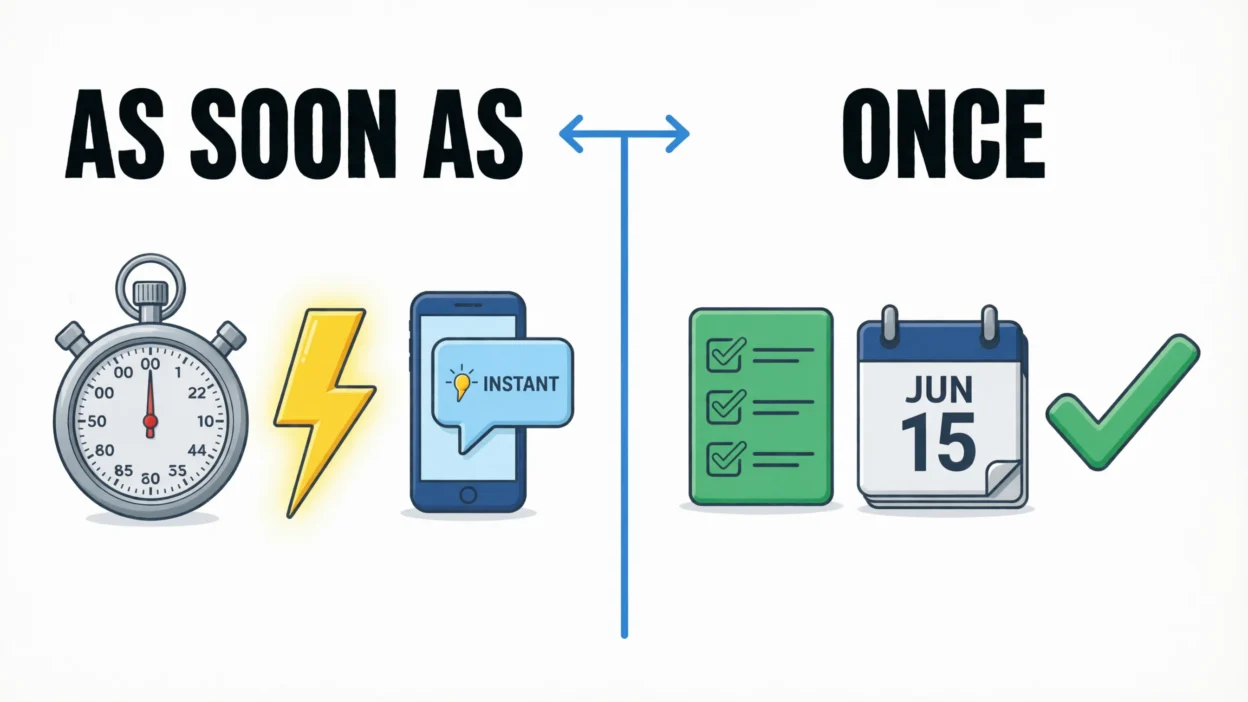
- As soon as means immediately after something happens. It emphasizes speed or urgency.
- Once means after something has happened or when something is completed. It focuses more on completion than immediacy.
Examples:
- I’ll call you as soon as I arrive. ✅ (Immediately after arriving.)
- I’ll call you once I arrive. ✅ (After arriving; the exact timing is less emphasized.)
In many everyday situations, both expressions are correct, but as soon as sounds more immediate.
What Does “As Soon As” Mean?
As soon as is a conjunction used to show that one action happens immediately after another.
It highlights that there is little or no delay between the two events.
Examples
- I’ll text you as soon as I get home.
- Please let me know as soon as you receive the package.
- She started working as soon as she finished lunch.
- We’ll leave as soon as the rain stops.
In each example, the second action happens immediately after the first.
What Does “Once” Mean?
Once is a conjunction that means after, when, or following the completion of something.
Unlike as soon as, it doesn’t necessarily stress immediate action. It simply indicates that one event follows another.
Examples
- Once you finish your homework, you can watch TV.
- We’ll begin the meeting once everyone arrives.
- Once the payment is confirmed, your order will be shipped.
- You can apply once you meet the requirements.
These sentences focus on completion rather than urgency.
As Soon As vs Once: Key Differences
| Feature | As Soon As | Once |
|---|---|---|
| Meaning | Immediately after | After or when something is completed |
| Focus | Speed and immediacy | Completion or condition |
| Tone | More urgent | More neutral |
| Common use | Everyday conversation, instructions | Formal and informal writing |
| Example | Call me as soon as you arrive. | Call me once you arrive. |
The biggest difference is that as soon as emphasizes how quickly something happens, while once emphasizes that it happens after another event.
Why Does the Difference Matter?
Although the two expressions often appear interchangeable, choosing the right one can subtly change the meaning of your sentence.
- I’ll email you as soon as I finish the report.
- I’ll email you once I finish the report.
Both are correct, but the first promises an immediate email, while the second simply states that the email will come after the report is finished.
Understanding this difference helps you communicate your intentions more accurately.
When Should You Use “As Soon As”?
Use as soon as when you want to emphasize that something will happen without delay.
It’s especially common in:
- Conversations
- Customer service
- Instructions
- Promises
- Notifications
- Emails
Example Sentences
- I’ll reply as soon as possible.
- Contact us as soon as you notice the problem.
- She smiled as soon as she saw her family.
- We started eating as soon as everyone arrived.
Whenever immediacy matters, as soon as is the better choice.
When Should You Use “Once”?
Use once when you’re emphasizing that one action depends on another being completed.
It’s common in:
- Business writing
- Contracts
- Instructions
- Academic writing
- Professional emails
- Formal communication
Example Sentences
- Once your account is verified, you’ll gain access.
- We’ll continue once the issue is resolved.
- You may begin once the instructor gives permission.
- Once the software is installed, restart your computer.
Here, the emphasis is on the condition being met rather than immediate timing.
Real-Life Examples
Here are some everyday situations where both expressions can be used.
At Work
- I’ll review the document as soon as I receive it.
- I’ll review the document once I receive it.
The first suggests immediate action, while the second simply states the sequence.
Online Shopping
- We’ll notify you as soon as your order ships.
- You’ll receive tracking information once your order ships.
At School
- Start the assignment as soon as class ends.
- Begin the project once you’ve read the instructions.
Travel
- Call me as soon as you land.
- Message me once you arrive at the hotel.
Both versions are correct, but the emphasis changes slightly.
Common Mistakes People Make
Many English learners confuse these expressions or use them interchangeably in situations where one sounds more natural.
Avoid these common mistakes:
- Using once when immediate action is expected.
- Assuming as soon as always means exactly the same as once.
- Mixing both expressions inconsistently within formal documents.
- Using the future tense after as soon as or once in time clauses.
For example:
❌ I’ll call you as soon as I will arrive.
✅ I’ll call you as soon as I arrive.
❌ We’ll start once everyone will be here.
✅ We’ll start once everyone is here.
In English, time clauses introduced by as soon as and once usually take the present simple when referring to the future.
American vs British English
There is no significant American vs British English difference between as soon as and once. Both expressions are common and follow the same grammar rules in both varieties of English.
However, once may appear slightly more often in formal British writing, while as soon as is extremely common in everyday speech on both sides of the Atlantic.
Regardless of your audience, both expressions are correct when used in the appropriate context.
Related Words and LSI Keywords
Using related vocabulary helps deepen your understanding of this topic while improving topical relevance.
Relevant LSI keywords and related phrases include:
- after
- when
- immediately
- as soon as possible
- once completed
- time conjunctions
- English grammar
- sequencing words
- conditional clauses
- future time clauses
- linking words
- transition words
- grammar examples
- sentence connectors
- conjunctions in English
These related terms often appear in grammar lessons and writing guides.
Best Practices for Writers and English Learners
If you’re deciding between as soon as and once, follow these simple tips:
- Use as soon as when speed or urgency is important.
- Use once when focusing on completion or a condition.
- Don’t use the future tense after either expression in time clauses.
- Consider the tone of your writing—once often sounds slightly more formal.
- Read your sentence aloud to see which expression sounds more natural.
Following these guidelines will help you write clearer and more accurate English.
Frequently Asked Questions
What is the difference between as soon as and once?
As soon as emphasizes that something happens immediately after another event, while once simply means after or when something has been completed.
Can as soon as and once be used interchangeably?
Yes, in many situations they can. However, as soon as places more emphasis on immediate action, while once focuses on the sequence of events.
Which is more formal, once or as soon as?
Once generally sounds slightly more formal and is common in business, legal, and academic writing. As soon as is widely used in both formal and informal contexts.
Should I use the future tense after as soon as?
No. Use the present simple in time clauses.
✅ I’ll call you as soon as I arrive.
❌ I’ll call you as soon as I will arrive.
Is “once” only used for time?
No. Besides indicating time, once can also introduce a condition, meaning “if” or “when.”
Example: Once you understand the rules, the game becomes easier.
Do American and British English use these expressions differently?
No. Both American and British English use as soon as and once in the same way.
Which expression is better in customer service?
As soon as is often preferred because it reassures customers that action will be taken promptly.
How can I remember the difference?
Think of this simple rule: as soon as = immediately after, while once = after it’s completed.
Summary
The comparison of as soon as vs once comes down to emphasis rather than grammar. Both expressions connect two events, but as soon as highlights immediate action, while once emphasizes that one event follows another after completion. In many situations, either expression works, but choosing the right one can make your meaning more precise.
Whether you’re writing emails, giving instructions, or improving your English, understanding this subtle difference will help you communicate more naturally. Use as soon as when speed matters and once when you’re simply referring to the order of events. Mastering these common conjunctions will make your spoken and written English more fluent.
Actionable Takeaway: Before choosing between as soon as and once, ask yourself whether you want to stress immediate action or simply what happens after something is completed. That simple question will help you pick the right expression every time.

Here is a professional 30-word author biography including your site name Symboliy.com:
Martin Hood is a professional writer at Symboliy.com, creating clear, informative content focused on language, communication, and meaningful expressions for everyday and professional use.