The words cord and chord are classic examples of English homophones. They sound exactly alike but have completely different meanings and spellings.
Because of their identical pronunciation, many people accidentally use one when they mean the other, especially in writing.
If you’ve ever wondered about cord vs chord, this guide will make the distinction simple.
You’ll learn what each word means, how they’re used in different contexts, common mistakes to avoid, practical examples, and easy memory tricks to help you remember the correct spelling every time.
Quick Answer
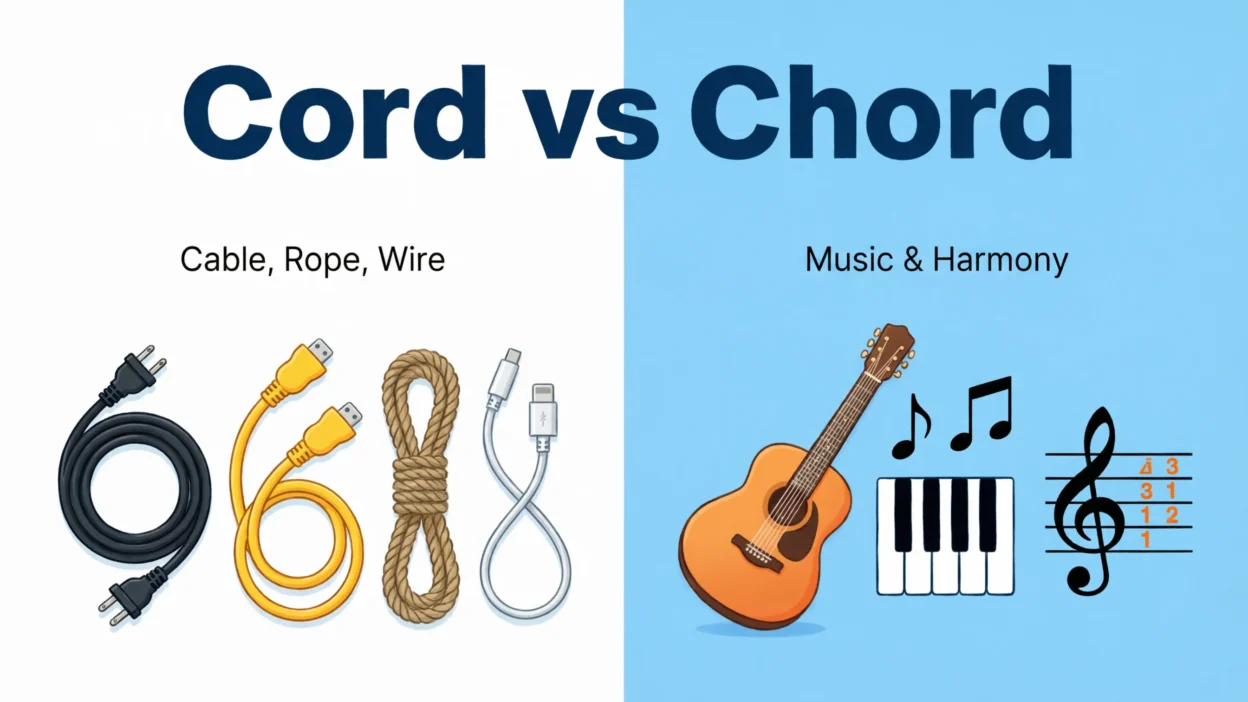
- Cord is a noun that usually refers to a rope, cable, string, or flexible wire.
- Chord is a noun that most commonly refers to a group of musical notes played together or, in mathematics, a line segment connecting two points on a curve.
Examples:
- ✅ Plug the power cord into the outlet.
- ✅ She played a beautiful chord on the guitar.
The easiest way to remember is:
- Cord = Rope, cable, or wire
- Chord = Music or geometry
What Does “Cord” Mean?
Cord is a noun that refers to a long, thin, flexible piece of material such as rope, string, cable, or wire. It is commonly used in everyday situations involving electronics, clothing, tools, and household items.
Examples of “Cord”
- The extension cord is too short.
- Tie the package with a strong cord.
- She unplugged the power cord.
- The curtain was held back with a decorative cord.
- Keep the charging cord in your bag.
In each sentence, cord refers to a physical object used for connecting, tying, or supplying power.
Common Uses of “Cord”
You’ll often see cord in phrases like:
- power cord
- extension cord
- charging cord
- elastic cord
- spinal cord
- vocal cords
Although spinal cord and vocal cords are medical terms, they still use the spelling cord.
What Does “Chord” Mean?
Chord is a noun with two primary meanings.
In music, a chord is a combination of three or more notes played together to create harmony.
In geometry, a chord is a straight line connecting two points on a curve, especially within a circle.
Examples of “Chord”
- She learned her first guitar chord.
- The pianist played a major chord.
- This song uses four simple chords.
- Draw a chord inside the circle.
- The opening chord sounded beautiful.
Most people encounter chord in musical contexts.
Common Uses of “Chord”
You’ll commonly see chord in expressions such as:
- guitar chord
- piano chord
- major chord
- minor chord
- chord progression
- vocal chord (incorrect)
Important: The correct anatomical term is vocal cords, not vocal chords.
Cord vs Chord Comparison Table
| Feature | Cord | Chord |
|---|---|---|
| Part of speech | Noun | Noun |
| Main meaning | Rope, cable, wire, or string | Group of musical notes or geometric line |
| Common context | Electronics, ropes, anatomy | Music and mathematics |
| Example | The power cord is damaged. | Play a C major chord. |
| Easy memory | Think of cables and wires | Think of music and harmony |
Key Differences Between Cord and Chord
Although they sound identical, cord and chord refer to completely different things.
Cord
- Refers to a physical rope, cable, or wire.
- Commonly appears in technology, household items, and anatomy.
- Used for tying, connecting, or transmitting power.
Example:
- The charging cord stopped working.
Chord
- Refers to multiple musical notes played together.
- Also used in geometry.
- Common in music lessons and mathematics.
Example:
- He practiced every guitar chord before the concert.
Examples of Cord vs Chord
| Cord | Chord |
|---|---|
| The lamp’s power cord is frayed. | She played a beautiful piano chord. |
| Wrap the cord neatly after use. | The guitarist learned a new chord. |
| The extension cord reached the garage. | That opening chord sounded powerful. |
| Pull the cord gently. | Every beginner should learn basic guitar chords. |
| The spinal cord carries nerve signals. | Draw a chord across the circle. |
Common Mistakes
Because the words sound the same, they’re often confused in writing.
Mistake 1
❌ Plug in the power chord.
✅ Plug in the power cord.
Mistake 2
❌ Learn your first guitar cord.
✅ Learn your first guitar chord.
Mistake 3
❌ The extension chord is broken.
✅ The extension cord is broken.
Mistake 4
❌ She played a beautiful cord on the piano.
✅ She played a beautiful chord on the piano.
Mistake 5
❌ The vocal chords were injured.
✅ The vocal cords were injured.
Easy Memory Trick
Here’s an easy way to remember:
Cord has no “h.” Think of a simple cord or cable without any extra letters.
Chord includes the letter “h,” which you can associate with harmony, a key concept in music.
Remember:
- Cord = Cable or rope
- Chord = Harmony in music
Synonyms and Related Words
Synonyms for “Cord”
Depending on the context, you can use:
- Rope
- Cable
- String
- Wire
- Line
- Twine
- Strap
Examples:
- Replace the damaged cable.
- Tie it with a strong rope.
Synonyms for “Chord”
In music-related contexts, similar terms include:
- Harmony
- Musical interval
- Progression
- Note combination
- Triad (for specific chord types)
Examples:
- The harmony sounded rich.
- Practice the chord progression daily.
American vs British English
There is no difference between American English and British English in the spelling or meaning of cord and chord.
Both varieties use these words the same way.
Examples accepted in both:
- Plug in the extension cord.
- She played a beautiful guitar chord.
- The spinal cord controls many body functions.
- Draw a chord inside the circle.
Tips to Avoid Confusing Cord and Chord
Keep these tips in mind:
- If you’re talking about a rope, wire, cable, or anatomy, use cord.
- If you’re discussing music or geometry, use chord.
- Remember that h in chord stands for harmony.
- Read your sentence aloud and think about the context.
- Check whether the word refers to a physical object or musical notes.
Practice Sentences
Choose the correct word.
- Plug the charging _____ into the phone.
- ✅ cord
- She played a beautiful _____ on the guitar.
- ✅ chord
- The extension _____ reached the backyard.
- ✅ cord
- Every beginner learns this piano _____.
- ✅ chord
- The spinal _____ is protected by the backbone.
- ✅ cord
FAQs
What is the difference between cord and chord?
Cord refers to a rope, cable, wire, or similar object, while chord refers to multiple musical notes played together or a line segment in geometry.
Are cord and chord pronounced the same?
Yes. They are homophones, meaning they have the same pronunciation but different meanings and spellings.
Is it “power cord” or “power chord”?
The correct term is power cord because it refers to an electrical cable.
Is it “guitar cord” or “guitar chord”?
The correct term is guitar chord because it refers to a combination of musical notes played on a guitar.
Is “vocal chord” correct?
No. The correct anatomical term is vocal cords.
What is a chord in geometry?
A chord is a straight line segment connecting two points on the circumference of a circle.
How can I remember the difference?
Think of cord as a cable or rope and chord as harmony in music.
Can both words be used as nouns?
Yes. Both cord and chord are nouns, but they refer to entirely different concepts.
Summary
Understanding cord vs chord becomes much easier once you connect each word with its context. Cord refers to ropes, cables, wires, and certain anatomical structures such as the spinal cord and vocal cords. Chord, on the other hand, belongs mainly to the worlds of music and geometry, describing either a group of notes played together or a line segment connecting two points on a curve.
Whenever you write, ask yourself whether you’re talking about a physical cable or musical harmony. If it’s something you can plug in, tie, or connect, use cord. If it’s related to music or mathematics, use chord. This simple habit will help you avoid one of the most common homophone mistakes in English.
Actionable Takeaway: Before choosing between cord and chord, identify the context. Use cord for cables, ropes, and anatomy, and chord for music and geometry.

Shan Waston is a skilled writer at Symboliy.com, producing clear, engaging content on language, communication, and everyday expressions to help readers understand meaning and usage confidently in modern digital contexts.