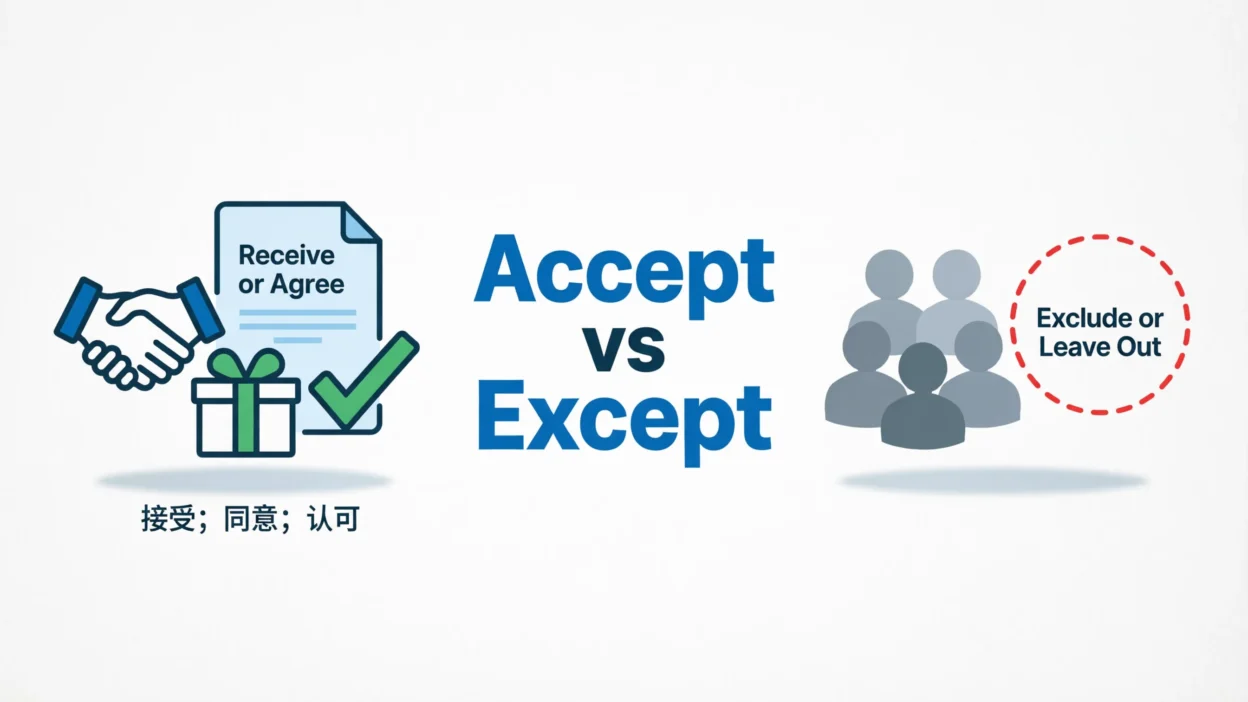
The words accept and except are among the most commonly confused words in English. They sound similar and differ by only one letter, but they have completely different meanings.
Using the wrong one can change the meaning of your sentence and make your writing less clear.
If you’ve ever searched for accept vs except, you’re in the right place. This guide explains the meaning of each word, provides real-life examples, highlights common mistakes, and shares easy memory tricks so you can use both words correctly with confidence.
Quick Answer
- Accept is a verb that means to receive, agree to, or approve something.
- Except is usually a preposition that means excluding or not including. It can also function as a conjunction or, less commonly, a verb.
Examples:
- ✅ I gladly accept your invitation.
- ✅ Everyone came except Sarah.
The easiest way to remember is:
- Accept = Receive or agree
- Except = Excluding
What Does “Accept” Mean?
Accept is a verb that means to willingly receive, agree to, approve, or believe something.
It often refers to accepting offers, invitations, gifts, responsibility, payments, or facts.
Examples of “Accept”
- I accept your apology.
- She accepted the job offer.
- The store accepts credit cards.
- They accepted the terms of the agreement.
- He finally accepted the truth.
In each sentence, accept means to receive or agree.
Common Uses of “Accept”
You’ll often see accept in phrases like:
- accept an invitation
- accept responsibility
- accept payment
- accept an offer
- accept the challenge
- accept defeat
What Does “Except” Mean?
Except usually means excluding someone or something.
It identifies what is left out of a group or situation.
Although except is most commonly a preposition, it can also act as a conjunction or, in formal writing, a verb meaning “to exclude.”
Examples of “Except”
- Everyone passed except John.
- The museum is open every day except Monday.
- I like all vegetables except spinach.
- Nobody knew the answer except the teacher.
- All flights were on time except one.
Here, except means “excluding.”
Common Uses of “Except”
You’ll commonly find except in expressions such as:
- everyone except
- except for
- all except
- anything except
- nowhere except
Accept vs Except Comparison Table
| Feature | Accept | Except |
|---|---|---|
| Part of speech | Verb | Usually a preposition |
| Meaning | Receive, agree, approve | Excluding, not including |
| Function | Shows acceptance | Shows exclusion |
| Example | I accept your offer. | Everyone came except Tom. |
| Easy memory | Accept = Receive | Except = Exclude |
Key Differences Between Accept and Except
Although they look and sound similar, they perform completely different jobs in a sentence.
Accept
- Means to receive or agree.
- Always functions as a verb.
- Describes approval or willingness.
Example:
- She accepted the award.
Except
- Means excluding or leaving out.
- Usually functions as a preposition.
- Identifies an exception.
Example:
- Everyone attended except Lisa.
Examples of Accept vs Except
| Accept | Except |
|---|---|
| I accept your invitation. | Everyone came except David. |
| She accepted the promotion. | All stores are open except one. |
| They accept online payments. | Nobody answered except the manager. |
| He accepted responsibility. | I eat everything except seafood. |
| We gladly accept donations. | Every student passed except Alex. |
Common Mistakes
Because these words sound alike, they’re frequently confused in writing.
Mistake 1
❌ I except your apology.
✅ I accept your apology.
Mistake 2
❌ Everyone accept James arrived.
✅ Everyone except James arrived.
Mistake 3
❌ The company excepts credit cards.
✅ The company accepts credit cards.
Mistake 4
❌ I like all fruits accept bananas.
✅ I like all fruits except bananas.
Easy Memory Trick
Here’s an easy way to remember the difference.
Accept begins with A, which can remind you of:
- Agree
- Approve
- Accept
Except begins with Ex-, which can remind you of:
- Exclude
- Exception
Remember:
- Accept = Agree or receive
- Except = Exclude
Synonyms and Related Words
Synonyms for “Accept”
Depending on the context, you can use:
- Receive
- Approve
- Agree to
- Admit
- Embrace
- Welcome
- Consent to
- Take
Examples:
- She agreed to the proposal.
- They welcomed the new employee.
Synonyms for “Except”
Depending on the sentence, alternatives include:
- Excluding
- Other than
- Apart from
- Leaving out
- Minus
- Save (formal)
- But (in some contexts)
Examples:
- Everyone attended apart from Emma.
- All students passed other than one.
American vs British English
There is no difference between American English and British English in the spelling or meaning of accept and except.
Both varieties use these words in exactly the same way.
Examples accepted in both:
- I accept your offer.
- Everyone came except Mark.
- The school accepts applications online.
- Everything is finished except the report.
Tips to Avoid Confusing Accept and Except
Keep these tips in mind:
- If the sentence means receive, use accept.
- If it means excluding, use except.
- Replace accept with receive to see if the sentence still makes sense.
- Replace except with excluding to check your meaning.
- Pay attention to whether the sentence describes approval or exclusion.
Practice Sentences
Choose the correct word.
- We happily _____ your invitation.
- ✅ accept
- Everyone arrived _____ Mia.
- ✅ except
- The restaurant _____ debit cards.
- ✅ accepts
- I like every color _____ orange.
- ✅ except
- She decided to _____ the award.
- ✅ accept
FAQs
What is the difference between accept and except?
Accept means to receive or agree to something, while except means excluding or leaving something out.
Is accept a verb?
Yes. Accept is a verb that means to receive, approve, or agree.
Is except always a preposition?
Usually, yes. However, it can also function as a conjunction or, less commonly, a formal verb meaning “to exclude.”
How can I remember accept vs except?
Think of accept as agree or receive, and except as exclude or exception.
Can I replace except with excluding?
In many sentences, yes. If excluding fits naturally, except is probably the correct choice.
Which is correct: “accept responsibility” or “except responsibility”?
The correct phrase is accept responsibility because it means to take ownership or acknowledge responsibility.
Is “everyone accept me” correct?
No. The correct sentence is Everyone except me because you are being excluded from the group.
Why do people confuse accept and except?
They have similar spellings and pronunciations, making them one of the most commonly mixed-up word pairs in English.
Summary
Understanding accept vs except becomes easy once you remember their core meanings. Accept is a verb that means to receive, agree to, or approve something, while except is usually a preposition meaning excluding or leaving something out. Although they sound alike, they serve completely different grammatical purposes.
Whenever you’re writing, ask yourself whether the sentence is about receiving or excluding. If you’re talking about agreeing to something, use accept. If you’re identifying someone or something left out, use except. Keeping this simple distinction in mind will help you write more accurately and avoid one of the most common English word mistakes.
Actionable Takeaway: Before choosing between accept and except, replace accept with receive or agree, and except with excluding. If the sentence still makes sense, you’ve selected the correct word.

Here is a professional 30-word author biography including your site name Symboliy.com:
Martin Hood is a professional writer at Symboliy.com, creating clear, informative content focused on language, communication, and meaningful expressions for everyday and professional use.