Punctuation can completely change the meaning and flow of a sentence, and one of the most common grammar questions is comma vs semicolon.
Since both punctuation marks create pauses and separate ideas, many writers struggle to know when to use each one.
Choosing the wrong punctuation can make writing confusing, awkward, or even grammatically incorrect.
In this complete guide, you’ll learn the difference between comma vs semicolon, understand when each punctuation mark should be used, explore practical examples, avoid common mistakes, and discover simple memory tricks that make choosing the correct punctuation much easier.
Quick Answer
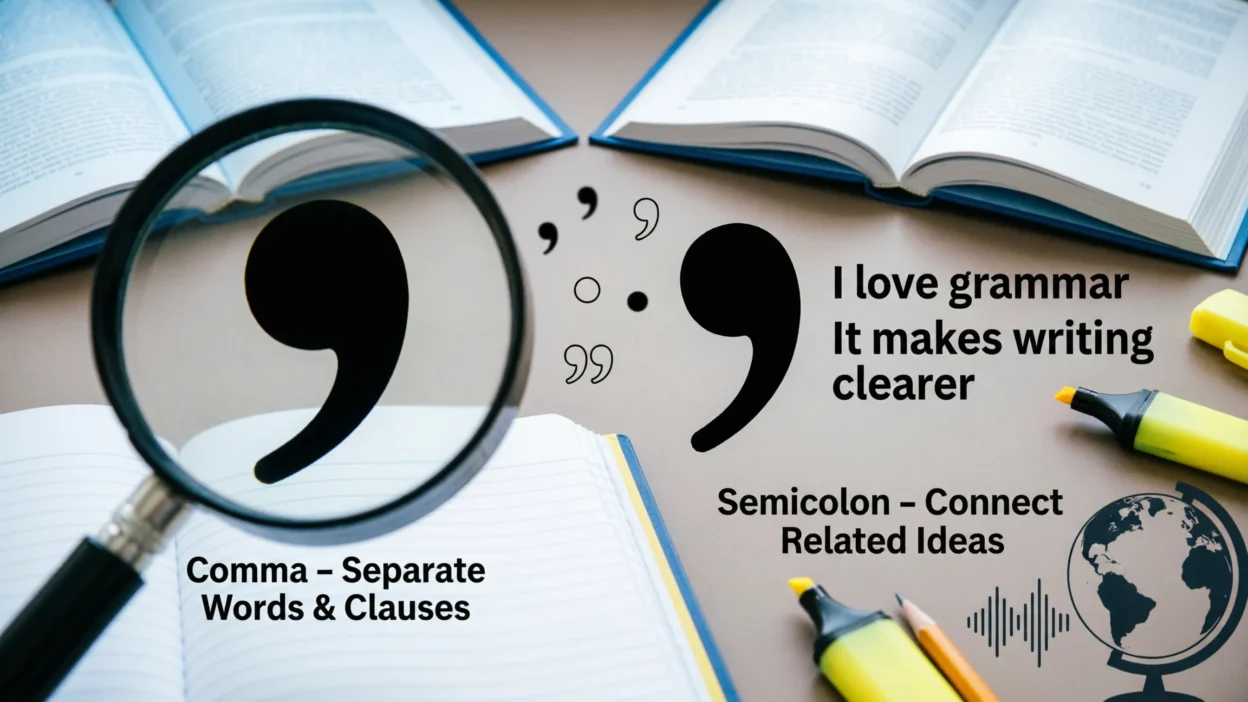
A comma (,) separates words, phrases, or clauses within a sentence and usually creates a short pause.
A semicolon (;) connects two closely related independent clauses without using a coordinating conjunction or separates complex list items that already contain commas.
In simple terms:
- Use a comma for shorter separations and lists.
- Use a semicolon to connect complete ideas that are closely related.
What Is a Comma?
A comma (,) is one of the most frequently used punctuation marks in English. It helps organize sentences, improve readability, and prevent misunderstandings.
A comma is commonly used to:
- Separate items in a list.
- Separate introductory words or phrases.
- Join two independent clauses with a coordinating conjunction.
- Set off nonessential information.
- Separate coordinating adjectives.
Examples of Commas
- I bought apples, oranges, bananas, and grapes.
- After dinner, we watched a movie.
- She studied hard, so she passed the exam.
- My brother, who lives in London, is visiting next week.
- It was a long, exhausting journey.
Each comma helps make the sentence clearer and easier to read.
What Is a Semicolon?
A semicolon (;) is used to connect closely related ideas without using a conjunction such as and, but, or so. It creates a stronger connection than a period but a longer pause than a comma.
A semicolon is commonly used to:
- Join two independent clauses.
- Separate complex list items containing commas.
- Improve sentence variety in formal writing.
Examples of Semicolons
- I finished my homework; now I can relax.
- She loves painting; her sister prefers photography.
- We visited Paris, France; Rome, Italy; and Madrid, Spain.
In each example, the semicolon creates clarity while linking related ideas.
Comma vs Semicolon: The Main Difference
Although both punctuation marks separate parts of a sentence, they serve different purposes.
| Feature | Comma (,) | Semicolon (;) |
|---|---|---|
| Purpose | Separates words, phrases, or clauses | Connects closely related complete sentences |
| Pause Length | Short | Longer than a comma, shorter than a period |
| Joins Independent Clauses | Only with a coordinating conjunction | Yes, without a conjunction |
| Used in Lists | Yes | Yes, for complex lists |
| Common in Everyday Writing | Very common | Less common but important in formal writing |
The key difference is that a comma organizes sentence parts, while a semicolon connects complete thoughts.
When to Use a Comma
Use a comma in the following situations.
1. Separate Items in a List
Examples:
- We bought milk, bread, eggs, and cheese.
- She enjoys reading, swimming, and hiking.
2. After Introductory Words or Phrases
Examples:
- In the morning, I usually exercise.
- Surprisingly, nobody complained.
3. Before Coordinating Conjunctions
When joining two independent clauses with for, and, nor, but, or, yet, or so, use a comma.
Examples:
- I wanted coffee, but the café was closed.
- She studied all night, so she passed the test.
4. Set Off Extra Information
Examples:
- My cousin, who is a doctor, lives in Canada.
- The meeting, despite the rain, continued as planned.
When to Use a Semicolon
Use a semicolon in these situations.
1. Join Two Independent Clauses
If both parts could stand alone as complete sentences, a semicolon may connect them.
Examples:
- The weather was beautiful; we decided to go hiking.
- He loves coffee; she prefers tea.
2. Separate Complex List Items
When list items already contain commas, semicolons make the list much easier to read.
Examples:
- Our offices are located in New York, USA; Toronto, Canada; London, England; and Sydney, Australia.
- The speakers included Emma Brown, CEO; Daniel Smith, Marketing Director; and Olivia Clark, Product Manager.
Comma vs Semicolon Examples
Here are side-by-side examples showing the difference.
| Comma | Semicolon |
|---|---|
| She was tired, so she went to bed. | She was tired; she went to bed. |
| We packed snacks, drinks, and blankets. | We visited Boston, Massachusetts; Denver, Colorado; and Miami, Florida. |
| After lunch, we returned to work. | I enjoy writing; it helps me think clearly. |
Notice that the comma often works with a conjunction, while the semicolon replaces one.
American vs British English
There is no significant difference between American and British English regarding comma and semicolon usage.
Both varieties follow the same grammatical rules for:
- Lists
- Independent clauses
- Introductory phrases
- Complex lists
The main differences between American and British English involve quotation marks and punctuation placement, not the use of commas and semicolons themselves.
Common Mistakes to Avoid
Many writers misuse commas and semicolons in similar ways.
Avoid these common errors:
- Using a comma instead of a semicolon between two complete sentences.
- Joining independent clauses with only a comma (comma splice).
- Replacing every comma with a semicolon.
- Using a semicolon before a coordinating conjunction like and or but.
- Forgetting that both sides of a semicolon must usually be complete sentences.
Correct:
- I was hungry; I made a sandwich.
Incorrect:
- I was hungry, I made a sandwich.
Easy Memory Trick
Here’s a simple way to remember the difference.
Think of punctuation as different-sized pauses.
- Comma = Small pause
- Semicolon = Medium pause
- Period = Full stop
Another helpful reminder:
- Comma connects sentence parts.
- Semicolon connects complete sentences.
If both sides can stand alone as separate sentences, a semicolon may be the right choice.
Related Terms and LSI Keywords
Using related grammar terms naturally improves understanding and SEO.
Relevant LSI keywords include:
- comma rules
- semicolon rules
- punctuation marks
- comma splice
- independent clause
- coordinating conjunction
- English punctuation
- grammar guide
- sentence structure
- punctuation examples
- comma usage
- semicolon examples
- grammar mistakes
- writing tips
- punctuation in English
These related terms help provide a more comprehensive explanation while supporting the primary keyword.
Why Proper Punctuation Matters
Correct punctuation improves clarity, readability, and professionalism.
- Let’s eat, Grandma.
- Let’s eat Grandma.
The comma completely changes the meaning.
Likewise:
- She studied hard; she passed the exam.
- She studied hard, she passed the exam.
The first sentence is grammatically correct because the semicolon properly joins two independent clauses.
FAQs
What is the main difference between a comma and a semicolon?
A comma separates words, phrases, or clauses, while a semicolon joins two closely related independent clauses or separates complex list items.
Can a semicolon replace a comma?
Sometimes. A semicolon can replace a comma when connecting two complete sentences without a coordinating conjunction, but it cannot replace every comma.
What is a comma splice?
A comma splice occurs when two independent clauses are joined using only a comma instead of a semicolon, period, or conjunction.
When should I use a semicolon instead of “and”?
Use a semicolon when connecting two closely related independent clauses without using a coordinating conjunction like and.
Can I use a semicolon in a list?
Yes. Semicolons are especially useful when list items already contain commas.
Is a semicolon stronger than a comma?
Yes. A semicolon creates a stronger separation than a comma but a weaker separation than a period.
Do American and British English use commas and semicolons differently?
No. Both varieties generally follow the same grammatical rules for comma and semicolon usage.
Summary
Understanding comma vs semicolon becomes much easier when you know the role each punctuation mark plays. A comma separates words, phrases, or clauses within a sentence and is commonly used in lists, after introductory phrases, and before coordinating conjunctions. A semicolon, on the other hand, connects closely related independent clauses or separates complex list items that already include commas. Although they may seem similar, they serve different grammatical purposes and are not interchangeable in most situations.
The easiest way to choose between them is to examine your sentence. If you’re separating simple items or joining clauses with a conjunction like and or but, use a comma. If you’re connecting two complete, closely related sentences without a conjunction or organizing a complicated list, use a semicolon. Mastering these punctuation marks will make your writing clearer, smoother, and more professional.
Actionable Takeaway
Remember this simple rule: Use a comma for smaller separations and a semicolon to connect complete ideas. If both sides of the punctuation can stand alone as full sentences, a semicolon is often the correct choice.

Shan Waston is a skilled writer at Symboliy.com, producing clear, engaging content on language, communication, and everyday expressions to help readers understand meaning and usage confidently in modern digital contexts.