Many English learners wonder whether they should use despite or in spite of in a sentence. The good news is that both expressions have the same meaning and are used to show contrast.
However, there are small differences in style and sentence structure that can make one choice sound more natural than the other.
Whether you’re writing an essay, email, blog post, or simply improving your English grammar, understanding the difference between despite and in spite of will help you write more fluently and confidently.
This guide explains their meanings, usage, examples, common mistakes, and when each expression is the better choice.
Quick Answer
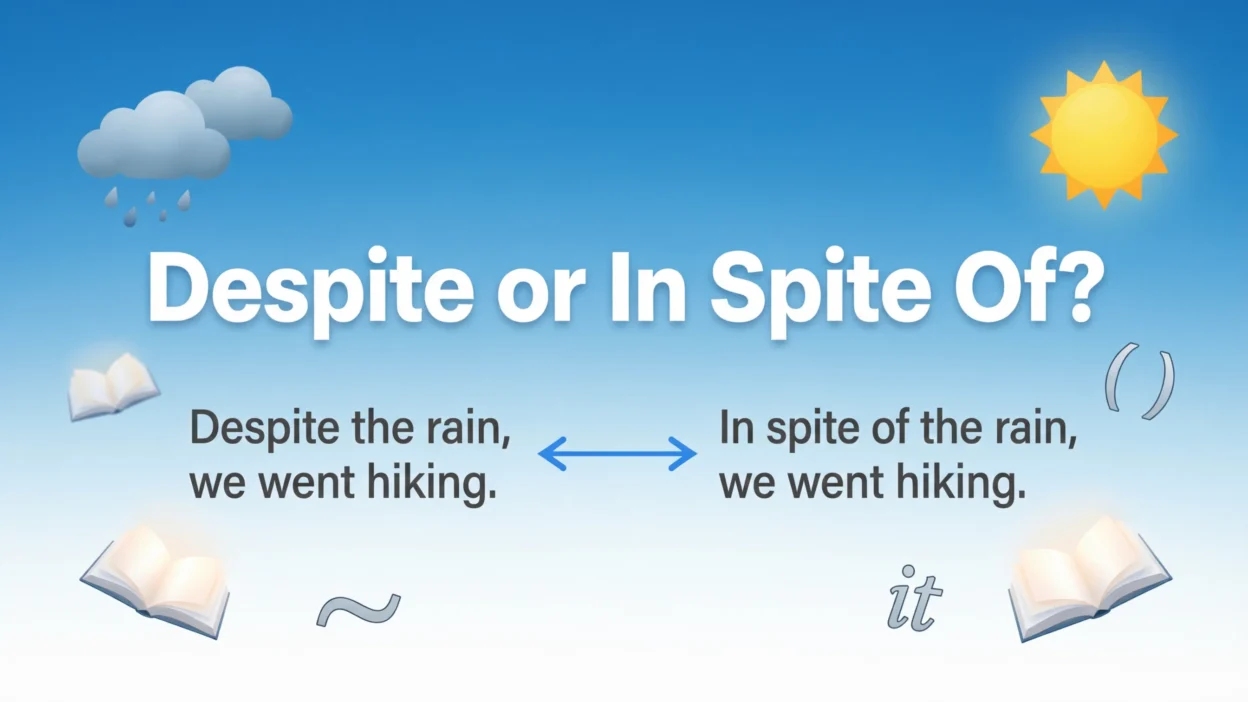
Despite and in spite of have the same meaning.
Both mean “without being affected by” or “regardless of.”
Examples:
- ✅ Despite the rain, we went hiking.
- ✅ In spite of the rain, we went hiking.
Both sentences are grammatically correct and mean exactly the same thing.
The main difference is that despite is a single word, while in spite of is a three-word phrase.
What Does “Despite” Mean?
Despite is a preposition used to show that something happened even though there was an obstacle, difficulty, or unexpected situation.
Examples:
- Despite the cold weather, we played football.
- She smiled despite the bad news.
- Despite his busy schedule, he attended the meeting.
- They finished the project despite several challenges.
In each example, the action happened even though there was a reason it might not have.
What Does “In Spite Of” Mean?
In spite of is also a prepositional phrase that expresses the same idea as despite.
Examples:
- In spite of the heavy traffic, we arrived on time.
- He continued working in spite of feeling tired.
- They enjoyed the picnic in spite of the cloudy weather.
- In spite of her fear, she gave an excellent presentation.
The meaning is identical to despite, but the phrase is slightly longer.
Despite vs In Spite Of Comparison Table
| Feature | Despite | In Spite Of |
|---|---|---|
| Meaning | Without being affected by | Without being affected by |
| Part of speech | Preposition | Prepositional phrase |
| Number of words | One | Three |
| Formality | Slightly more concise | Slightly more conversational |
| Meaning difference | None | None |
How to Use “Despite”
Use despite before:
- A noun
- A pronoun
- A gerund (verb ending in -ing)
Examples:
- Despite the storm, the event continued.
- Despite his efforts, he couldn’t finish.
- Despite working late, she arrived early.
- Despite everything, they remained optimistic.
How to Use “In Spite Of”
Use in spite of in exactly the same way.
Examples:
- In spite of the storm, the event continued.
- In spite of his efforts, he couldn’t finish.
- In spite of working late, she arrived early.
- In spite of everything, they stayed positive.
You can replace despite with in spite of in almost every sentence without changing the meaning.
Examples in Everyday English
At School
- Despite studying hard, she found the exam difficult.
- In spite of studying hard, she found the exam difficult.
At Work
- Despite the deadline, the team remained calm.
- In spite of the deadline, the team remained calm.
In Daily Life
- Despite the rain, we went for a walk.
- In spite of the rain, we went for a walk.
During Travel
- Despite the delay, our flight arrived safely.
- In spite of the delay, our flight arrived safely.
Common Mistakes
Many learners mix despite, in spite of, and although.
Mistake 1
❌ Despite of the rain, we stayed outside.
✅ Despite the rain, we stayed outside.
Despite is never followed by of.
Mistake 2
❌ In spite the rain, we stayed outside.
✅ In spite of the rain, we stayed outside.
The word of is always required after in spite.
Mistake 3
❌ Despite it was raining, we played football.
✅ Despite the rain, we played football.
✅ Although it was raining, we played football.
Remember that despite and in spite of are followed by a noun, pronoun, or gerund, not a full clause.
Mistake 4
❌ Despite she was tired, she worked.
✅ Despite being tired, she worked.
✅ Although she was tired, she worked.
Despite vs Although
Many people confuse these words because they all express contrast.
Here’s the difference.
| Expression | Followed By | Example |
|---|---|---|
| Despite | Noun or gerund | Despite the rain, we played. |
| In spite of | Noun or gerund | In spite of the rain, we played. |
| Although | Subject + verb | Although it rained, we played. |
This is one of the most important grammar rules to remember.
American vs British English
Both American English and British English use despite and in spite of in the same way.
There is no difference in spelling, meaning, or grammar between the two varieties.
Some writers prefer despite because it is shorter and more concise, while in spite of may sound slightly more conversational. Both are perfectly correct.
SEO Perspective: Which Keyword Should You Use?
If you’re writing for search engines, use both despite and in spite of naturally throughout your article because users search for both expressions.
Your headings and examples should clearly explain that they have the same meaning while highlighting the small differences in structure. This approach improves relevance for grammar-related search queries without keyword stuffing.
Related Keywords (LSI)
Including related terms naturally improves topical authority.
Useful LSI keywords include:
- despite meaning
- in spite of meaning
- despite vs although
- contrast words
- English grammar
- grammar rules
- prepositions
- conjunctions
- sentence connectors
- despite examples
- in spite of examples
- common grammar mistakes
- transition words
Frequently Asked Questions
Is there a difference between “despite” and “in spite of”?
No. Both have the same meaning and can usually be used interchangeably.
Which is more formal?
Neither is significantly more formal, although despite is often preferred because it is shorter and more concise.
Can I say “despite of”?
No. Despite of is incorrect. Use despite without of.
Does “in spite” always need “of”?
Yes. The correct phrase is in spite of.
Can “despite” be followed by a sentence?
Not directly. It should be followed by a noun, pronoun, or gerund.
Correct:
- Despite the rain…
- Despite working hard...
Incorrect:
- ❌ Despite it was raining…
What is the difference between “despite” and “although”?
Despite is followed by a noun or gerund, while although is followed by a complete clause with a subject and verb.
Do American and British English use different rules?
No. Both varieties follow the same grammar rules for despite and in spite of.
Summary
Despite and in spite of have the same meaning and are used to express contrast or show that something happened regardless of a difficulty or obstacle. The only real difference is that despite is a single-word preposition, while in spite of is a three-word prepositional phrase. In most sentences, you can replace one with the other without changing the meaning.
The most common mistakes involve writing despite of or forgetting the of in in spite of. Another frequent error is using these expressions before a full clause instead of a noun or gerund. By understanding these simple grammar rules, you’ll be able to use both expressions naturally and accurately in everyday English.
Actionable Takeaway
Whenever you need to express contrast, remember this simple rule: Use “despite” without “of” and always use the complete phrase “in spite of.”
If you’re writing a full sentence with a subject and verb after the connector, choose although instead. Following this habit will make your writing clearer, more fluent, and grammatically correct.

Here is a professional 30-word author biography including your site name Symboliy.com:
Martin Hood is a professional writer at Symboliy.com, creating clear, informative content focused on language, communication, and meaningful expressions for everyday and professional use.