Have you ever found yourself wondering whether to use either or neither in a sentence?
These two small words often confuse English learners and even native speakers because they look similar but have opposite meanings. Using the wrong one can completely change the meaning of your sentence.
In this complete grammar guide, you’ll learn the difference between either vs neither, their meanings, correct usage, common mistakes, practical examples, and easy tips to remember them. By the end, you’ll know exactly when to use each word with confidence.
Quick Answer
Either refers to one of two options and is generally used in positive choices or with negative statements.
Neither means not one and not the other. It indicates that both options are excluded.
Correct Examples:
- You can choose either dress. ✅
- Neither answer is correct. ✅
What Do “Either” and “Neither” Mean?
Although these words are related, they have opposite meanings.
Either Meaning
Either means:
- One or the other of two people or things.
- It gives a choice between two options.
- It can also mean also not when used after a negative sentence.
Examples
- You may sit on either chair.
- We can travel on either Saturday or Sunday.
- I don’t like coffee, and my sister doesn’t either.
Neither Meaning
Neither means:
- Not one nor the other.
- It rejects both choices.
- It creates a negative meaning.
Examples
- Neither road leads to the city.
- Neither student passed the exam.
- I like neither option.
Either vs Neither: Comparison Table
| Feature | Either | Neither |
|---|---|---|
| Meaning | One of two | Not one of two |
| Expresses | Choice | Negative choice |
| Number of options | Two | Two |
| Positive meaning | Usually yes | No |
| Used with “or” | Yes | Yes (or with “nor”) |
| Common pair | Either…or | Neither…nor |
When to Use “Either”
Use either when you’re talking about one of two choices.
Choosing Between Two Options
- You can take either bus.
- Either answer will receive full marks.
- We can meet on either Monday or Tuesday.
After a Negative Statement
In informal English, either can mean also not.
Examples:
- I don’t watch horror movies either.
- She doesn’t eat meat, and I don’t either.
- They weren’t invited, and we weren’t either.
When to Use “Neither”
Use neither when both options are not true.
Rejecting Both Choices
- Neither restaurant is open.
- Neither solution works.
- Neither player scored.
Using “Neither…Nor”
The phrase neither…nor connects two negative ideas.
Examples:
- Neither John nor Emma attended the meeting.
- She likes neither tea nor coffee.
- Neither the manager nor the employees knew about the change.
Key Difference Between Either and Neither
The easiest way to remember the difference is this:
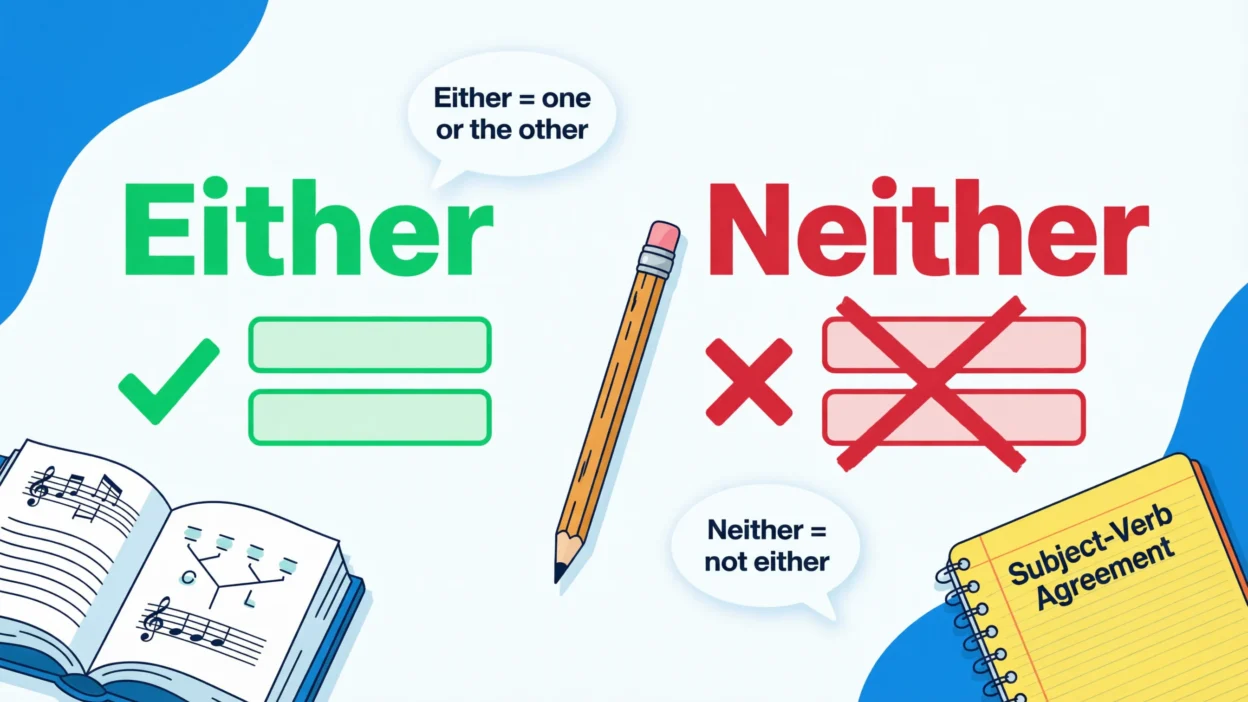
- Either = one of the two
- Neither = none of the two
For example:
You have two books.
- You may borrow either book. (Choose one.)
- You may borrow neither book. (You cannot choose any.)
Examples in Everyday English
Talking About Food
- You can order either pizza or pasta.
- Neither meal contains nuts.
Talking About Travel
- Either route will get you there.
- Neither road is safe after the storm.
Talking About School
- Either student can represent the class.
- Neither student submitted the assignment.
Talking About Work
- We can schedule the meeting on either Friday or Monday.
- Neither proposal meets the client’s requirements.
Common Mistakes to Avoid
Many English learners mix up these words because they both refer to two options.
Mistake 1: Using “Either” Instead of “Neither”
❌ Either answer is wrong.
✅ Neither answer is correct.
Mistake 2: Double Negatives
❌ I don’t like neither option.
✅ I like neither option.
✅ I don’t like either option.
Both corrected sentences are grammatically correct, but they have different structures.
Mistake 3: Mixing “Neither” with “Or”
❌ Neither Jack or Sarah came.
✅ Neither Jack nor Sarah came.
Always pair neither with nor when connecting two subjects.
Easy Memory Trick
Here’s a simple way to remember them:
- Either = one is acceptable.
- Neither = zero are acceptable.
Think of it this way:
- Either opens a choice.
- Neither closes both choices.
This simple rule works in almost every situation.
American vs British English
There is no spelling difference between American English and British English.
Both varieties use:
- Either ✅
- Neither ✅
However, pronunciation can vary.
In American English, you’ll commonly hear:
- EE-ther
- NEE-ther
In British English, speakers may also say:
- EYE-ther
- NYE-ther
Both pronunciations are widely accepted and considered correct.
Related Words and Phrases
Learning similar expressions will improve your vocabulary.
- Either…or
- Neither…nor
- Both
- One of two
- None
- Any
- Choice
- Alternative
- Selection
- Not either
These related words often appear in grammar lessons and everyday conversations.
Why Using Either and Neither Correctly Matters
Choosing the correct word makes your writing clearer and more accurate.
Using either and neither correctly helps you:
- Avoid confusing readers.
- Improve grammar accuracy.
- Write more professionally.
- Communicate choices clearly.
- Strengthen academic and business writing.
Whether you’re writing an essay, email, blog, or workplace document, using these words properly enhances readability and credibility.
Frequently Asked Questions
Is either positive or negative?
Either usually has a positive meaning because it offers one of two choices. It can also appear after a negative sentence to mean also not.
What does neither mean?
Neither means not one and not the other. It rejects both options.
Can I say “I don’t like neither”?
No. This creates a double negative.
Correct forms are:
- I don’t like either.
- I like neither.
Should I use “neither or” or “neither nor”?
Always use neither…nor.
Example:
Neither the teacher nor the students were late.
Is either used with two options only?
Yes. Either normally refers to one of two choices.
Is neither singular or plural?
Neither is generally treated as singular when referring to two singular nouns.
Example:
Neither answer is correct.
Can either and neither be pronouns?
Yes.
Examples:
- Either is acceptable.
- Neither was available.
Summary
The difference between either vs neither is simple once you understand their meanings. Either refers to one of two options and is used when offering a choice or agreeing with a negative statement. Neither, on the other hand, means not one and not the other, making it the correct choice when both options are excluded. Remember that either often pairs with or, while neither is commonly paired with nor.
Using these words correctly improves the clarity and professionalism of your writing. Whether you’re writing essays, emails, blog posts, or having everyday conversations, choosing either or neither appropriately helps you express your ideas accurately. With regular practice and the simple memory trick of “either equals one, neither equals none,” you’ll avoid common grammar mistakes and communicate with confidence.
Actionable Takeaway
Whenever you write about two choices, pause for a moment and ask yourself: Am I choosing one option or rejecting both?
If you’re choosing one, use either. If you’re rejecting both, use neither. This quick habit will help you use these words correctly every time.

Mike Poop is a dedicated writer at Symboliy.com, creating clear, practical content about language, communication, and everyday expressions to help readers understand meaning and usage confidently in professional contexts worldwide.