Have you ever heard someone say “me either” or “me neither” and wondered which one is actually correct?
These two expressions are common in everyday English, but they often confuse learners because both seem to express agreement with a negative statement. To make things even more confusing, native speakers frequently use both in casual conversations.
In this complete grammar guide, you’ll learn the difference between me either vs me neither, when each expression is appropriate, common grammar rules, real-life examples, mistakes to avoid, and whether one is more correct than the other. By the end, you’ll be able to respond naturally and confidently in any conversation.
Quick Answer
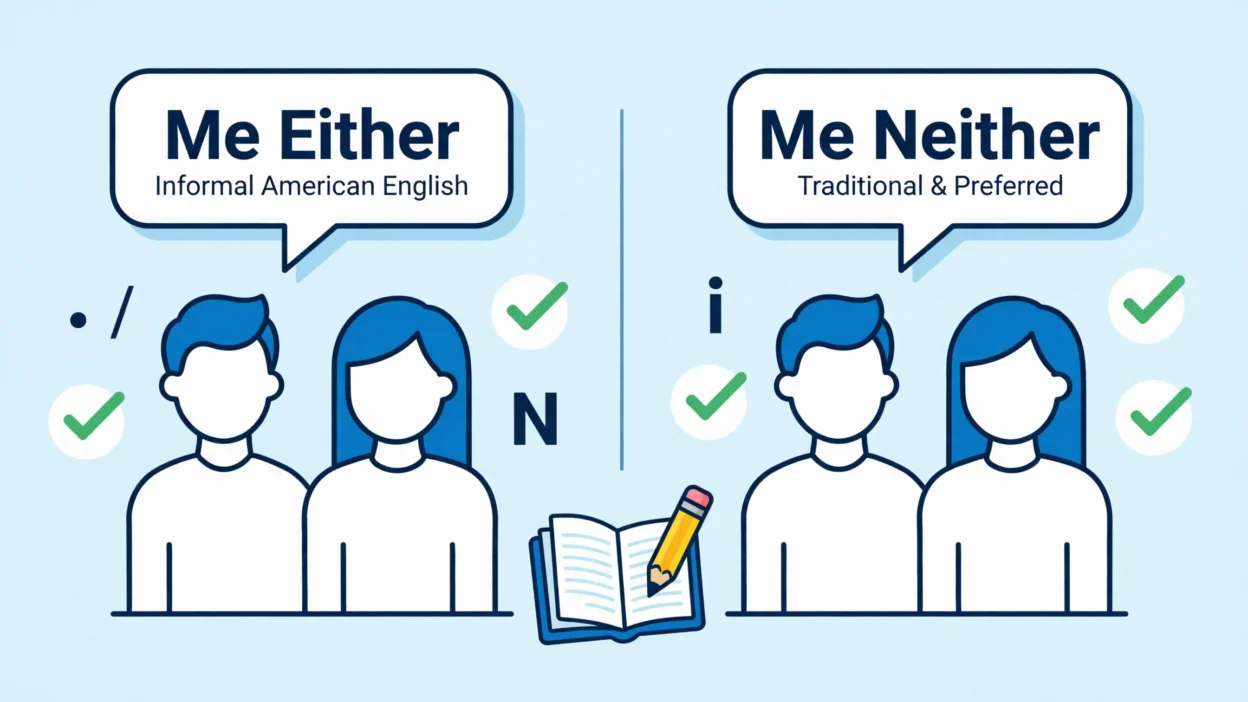
Traditionally, me neither is considered the grammatically correct response to a negative statement.
However, me either is widely used in informal American English and is accepted in everyday conversation by many native speakers.
Examples:
- I don’t like spicy food.
- Me neither. ✅ (Traditional and grammatically preferred)
- Me either. ✅ (Common in informal American English)
What Do “Me Either” and “Me Neither” Mean?
Both expressions are used to agree with someone’s negative statement.
For example:
Person A: I don’t watch horror movies.
Person B:
- Me neither.
- Me either.
In both cases, Person B means:
“I don’t watch horror movies either.”
Although they express the same idea, their grammar and usage differ.
Me Either vs Me Neither: Comparison Table
| Feature | Me Either | Me Neither |
|---|---|---|
| Meaning | I don’t either | I don’t neither (understood as “Neither do I”) |
| Traditional grammar | Less preferred | Preferred |
| Informal conversation | Very common | Very common |
| Formal writing | Not recommended | Acceptable |
| American English | Very common | Common |
| British English | Less common | Preferred |
What Does “Me Neither” Mean?
Me neither is a shortened conversational form of:
Neither do I.
It means you agree with someone’s negative statement.
Examples
Person A: I don’t drink coffee.
Person B: Me neither.
Person A: I wasn’t invited.
Person B: Me neither.
Person A: I can’t swim.
Person B: Me neither.
This expression has long been considered the standard grammatical response.
What Does “Me Either” Mean?
Me either is also used to agree with a negative statement.
It is understood as a shortened version of:
I don’t either.
Although some traditional grammar guides prefer me neither, me either has become extremely common in spoken American English.
Examples
Person A: I don’t enjoy cold weather.
Person B: Me either.
Person A: I haven’t seen that movie.
Person B: Me either.
Person A: I can’t hear anything.
Person B: Me either.
Which One Is More Correct?
From a traditional grammar perspective:
✅ Me neither is the preferred expression.
However, language changes over time.
Today:
- Me neither remains the standard choice.
- Me either is widely accepted in casual American speech.
- Both expressions are easily understood by native speakers.
If you’re writing formally or taking an English exam, me neither is usually the safer option.
Examples in Everyday Conversations
Talking About Food
Person A: I don’t like mushrooms.
Person B: Me neither.
Person B: Me either. (Informal)
Talking About Movies
Person A: I haven’t watched that film.
Person B: Me neither.
Talking About School
Person A: I didn’t finish the homework.
Person B: Me either.
Talking About Work
Person A: I don’t work on weekends.
Person B: Me neither.
Both responses sound natural depending on the situation and the speaker.
Common Mistakes to Avoid
Many learners confuse these expressions because they have similar meanings.
Mistake 1: Using Them After Positive Statements
❌ I love pizza.
Me neither.
✅ I love pizza.
Me too.
Use me too after positive statements, not me neither or me either.
Mistake 2: Using Double Negatives
❌ I don’t like it neither.
✅ I don’t like it either.
Or:
✅ Neither do I.
Mistake 3: Using Them in Formal Writing
Expressions like me either and me neither are conversational.
In formal writing, use:
- Neither do I.
- I don’t either.
These are more grammatically complete.
Easy Memory Trick
Remember this simple rule:
If someone says something negative:
- Formal English → Neither do I.
- Casual English → Me neither.
- Informal American English → Me either.
This makes choosing the right response much easier.
American vs British English
This is one area where regional usage differs.
American English
Both me neither and me either are commonly heard.
Many native speakers use them interchangeably in everyday conversation.
British English
Me neither is much more common and generally preferred.
While British speakers understand me either, it is heard less often than in the United States.
Related Words and Phrases
Learning similar expressions can improve your conversational English.
- Neither do I
- I don’t either
- Me too
- So do I
- So am I
- Nor do I
- I agree
- Same here
- Likewise
These expressions help you respond naturally in different situations.
Why Understanding the Difference Matters
Knowing when to use me either and me neither helps you sound more natural and confident in English conversations.
Using the right expression allows you to:
- Communicate clearly.
- Avoid grammar mistakes.
- Sound more like a native speaker.
- Choose the appropriate level of formality.
- Improve both spoken and written English.
Understanding regional differences also helps if you’re speaking with people from different English-speaking countries.
Frequently Asked Questions
Is “me either” grammatically correct?
Traditionally, me neither is considered more grammatically correct. However, me either is widely accepted in informal American English.
Is “me neither” formal?
It is acceptable in conversation but still considered informal. In formal writing, use Neither do I.
Which is more common in American English?
Both are common, but me either is especially popular in casual American speech.
Which is more common in British English?
Me neither is generally the preferred and more common expression.
Can I use “me either” in an English exam?
It’s better to use Neither do I, as it is the most grammatically complete and widely accepted form.
What should I say after a positive sentence?
Use Me too or So do I, not me neither or me either.
Example:
Person A: I love chocolate.
Person B: Me too.
Are “me either” and “me neither” interchangeable?
In many casual conversations, yes. However, me neither is traditionally preferred and more suitable in careful English.
Summary
The difference between me either vs me neither comes down to grammar, formality, and regional usage. Me neither has long been regarded as the traditional and grammatically preferred response to a negative statement because it reflects the meaning of “Neither do I.” On the other hand, me either has become very common in informal American English and is widely accepted in everyday conversation, even though some style guides still favor me neither.
To choose the best expression, consider your audience and the context. In casual conversations, both responses are generally understood, especially in the United States. For formal writing, academic work, or English exams, it’s safest to use Neither do I or me neither. Knowing this distinction will help you communicate naturally while avoiding common grammar mistakes.
Actionable Takeaway
The next time someone makes a negative statement, remember this simple guide: Use “me neither” for the safest and most traditional response, “me either” in informal American conversations, and “Neither do I” whenever you need a grammatically complete and formal answer. Practicing these expressions in daily conversations will help them become second nature.

Mike Poop is a dedicated writer at Symboliy.com, creating clear, practical content about language, communication, and everyday expressions to help readers understand meaning and usage confidently in professional contexts worldwide.