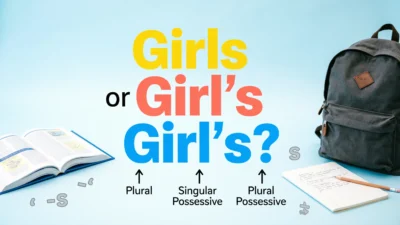
Many English learners and even native speakers get confused between plural and possessive nouns.
At first glance, they may look similar, especially when apostrophes are involved. However, they serve completely different purposes in English grammar.
Understanding the difference between plural and possessive forms will improve your writing, help you avoid common grammar mistakes, and make your communication more professional.
This guide explains the meaning of each form, provides easy examples, highlights common errors, and shows you exactly when to use each one.
Quick Answer
A plural noun means more than one person, place, thing, or idea.
A possessive noun shows ownership, belonging, or a relationship.
Examples:
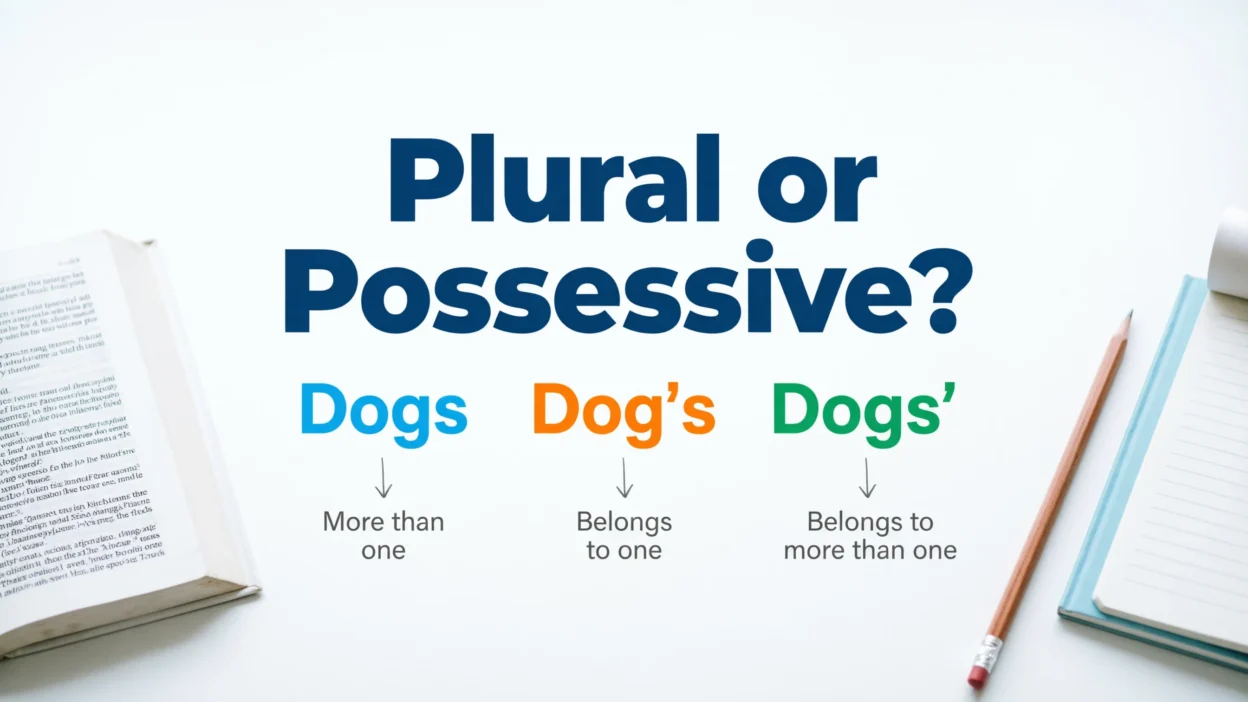
- Dogs = more than one dog (plural)
- Dog’s = something belongs to one dog (singular possessive)
- Dogs’ = something belongs to multiple dogs (plural possessive)
The key difference is simple:
- Plural = quantity
- Possessive = ownership
What Is a Plural Noun?
A plural noun refers to more than one person, animal, place, object, or concept.
Most plural nouns are formed by adding -s or -es to the end of a singular noun.
Examples:
- Cat → Cats
- Book → Books
- Student → Students
- House → Houses
Some nouns have irregular plural forms.
Examples:
- Man → Men
- Woman → Women
- Child → Children
- Tooth → Teeth
- Foot → Feet
- Mouse → Mice
Plural nouns simply indicate there is more than one. They do not show ownership.
What Is a Possessive Noun?
A possessive noun shows that something belongs to someone or something.
Possessive nouns are usually formed by adding an apostrophe.
Examples:
- Sarah’s book
- The dog’s collar
- The teacher’s desk
- James’s backpack
In these examples, the apostrophe indicates ownership or association.
Types of Possessive Nouns
Singular Possessive
Add ‘s to a singular noun.
Examples:
- The girl’s bicycle
- The doctor’s office
- The company’s policy
- My friend’s phone
Plural Possessive
If a plural noun already ends in s, add only an apostrophe.
Examples:
- The students’ classroom
- The teachers’ meeting
- The dogs’ toys
- The players’ uniforms
For irregular plural nouns that do not end in s, add ‘s.
Examples:
- The men’s team
- The children’s playground
- The women’s restroom
- The people’s choice
Plural vs Possessive Comparison Table
| Feature | Plural | Possessive |
|---|---|---|
| Purpose | Shows more than one | Shows ownership or relationship |
| Uses apostrophe | ❌ No | ✅ Yes |
| Example | Dogs | Dog’s |
| Example meaning | More than one dog | Belonging to one dog |
| Another example | Students | Students’ |
Easy Examples
Plural Examples
- Three cars are parked outside.
- The books are on the shelf.
- Birds fly south during winter.
- Apples are healthy snacks.
Possessive Examples
- The car’s engine needs repair.
- The birds’ nests are in the tree.
- My parents’ house is nearby.
- The child’s toy is missing.
Notice how the possessive examples answer the question “Who owns it?” or “What does it belong to?”
How to Tell the Difference
Ask yourself one simple question.
Is the sentence talking about more than one?
If yes, use the plural form.
Example:
- The dogs are barking.
Now ask:
Does something belong to someone or something?
If yes, use the possessive form.
Example:
- The dog’s leash is blue.
This quick test works in most situations.
Common Mistakes
Many writers accidentally confuse plural and possessive nouns.
Incorrect:
- ❌ Apple’s are delicious.
Correct:
- ✅ Apples are delicious.
Incorrect:
- ❌ The teachers lounge is upstairs.
Correct:
- ✅ The teachers’ lounge is upstairs.
Incorrect:
- ❌ The childrens toys are everywhere.
Correct:
- ✅ The children’s toys are everywhere.
Incorrect:
- ❌ My brothers car is new. (when referring to one brother)
Correct:
- ✅ My brother’s car is new.
Special Cases
Words Ending in “S”
Style guides differ slightly.
Examples:
- James’s book
- James’ book
Both are accepted in some style guides, although many modern grammar guides prefer James’s.
Irregular Plurals
Irregular plurals never end in s, so add ‘s.
Examples:
- Men’s clothing
- Women’s soccer
- Children’s books
- People’s opinions
American vs British English
American and British English follow the same basic grammar rules for plural and possessive nouns.
The main differences appear in certain style guides.
For example:
- American English often prefers James’s.
- British English may sometimes accept James’ in formal writing.
Regardless of style, both varieties use the same possessive rules for regular and irregular nouns.
Helpful Tips to Remember
Remember these simple rules:
- Plural means more than one.
- Possessive means ownership.
- Apostrophes never make a noun plural.
- If something belongs to someone, use an apostrophe.
- Read the sentence carefully before adding punctuation.
- Practice with common examples to build confidence.
Related Grammar Terms (LSI Keywords)
Understanding these related grammar concepts can strengthen your writing:
- plural nouns
- possessive nouns
- apostrophe rules
- singular nouns
- singular possessive
- plural possessive
- irregular plurals
- English grammar
- punctuation rules
- noun forms
- grammar mistakes
- possessive apostrophe
Frequently Asked Questions
What is the difference between plural and possessive?
A plural noun shows there is more than one, while a possessive noun shows ownership or a relationship.
Does adding an apostrophe make a word plural?
No. Apostrophes indicate possession, not plurality.
What is the plural of child?
The plural of child is children.
What is the possessive form of children?
The correct possessive form is children’s because children is already plural.
Is “dogs” plural or possessive?
Dogs is plural. Dog’s is singular possessive, and dogs’ is plural possessive.
Why is “men’s” possessive?
Because men is already the plural form of man, adding ‘s creates the possessive form.
How do I know when to use an apostrophe?
Use an apostrophe only when showing ownership, possession, or association—not simply because a word is plural.
Summary
Plural and possessive nouns may look similar, but they serve different purposes. A plural noun tells you there is more than one person, place, or thing, while a possessive noun shows ownership or a close relationship. Learning to recognize this distinction will make your writing clearer and more accurate.
A simple way to remember the rule is this: if you’re talking about quantity, use the plural form. If you’re showing ownership, use the possessive form with an apostrophe. With regular practice, choosing the correct form becomes second nature and helps you write with confidence in both academic and professional settings.
Actionable Takeaway
Before writing a noun, ask yourself: “Am I talking about more than one, or am I showing ownership?”
If it’s about quantity, use the plural form. If it shows that something belongs to someone or something, use the possessive form with the correct apostrophe placement. This one habit will help you avoid one of the most common grammar mistakes in English.

Mike Poop is a dedicated writer at Symboliy.com, creating clear, practical content about language, communication, and everyday expressions to help readers understand meaning and usage confidently in professional contexts worldwide.