The words flair and flare sound exactly alike, making them one of the most commonly confused pairs in English.
Although they are homophones, they have completely different meanings and are used in different contexts. Mixing them up can change the meaning of your sentence and make your writing less accurate.
In this guide, you’ll learn the difference between flair vs flare, their meanings, real-life examples, common mistakes, and an easy memory trick to remember which word to use. By the end, you’ll be able to choose the correct word with confidence.
Quick Answer
The difference between flair and flare is simple:
- Flair is a noun that means a natural talent, special ability, or distinctive style.
- Flare is usually a noun or verb that refers to a sudden burst of light, fire, emotion, or the act of spreading outward.
Examples:
- ✅ She has a flair for interior design.
- ✅ The campfire began to flare in the wind.
- ❌ She has a flare for interior design.
- ❌ The fire began to flair.
What Does “Flair” Mean?
Flair is a noun that describes a person’s natural talent, instinctive ability, or unique sense of style.
It often refers to someone who is especially skilled or creative in a particular area.
Examples
- She has a flair for painting.
- He has a flair for public speaking.
- The designer decorated the room with flair.
- Sarah’s flair for storytelling keeps everyone engaged.
In each example, flair refers to talent or style.
When to Use Flair
Use flair when talking about:
- Natural talent
- Special ability
- Creativity
- Personal style
- Artistic skill
LSI Keywords:
- natural talent
- special ability
- creative skill
- sense of style
- artistic flair
What Does “Flare” Mean?
Flare can be used as both a noun and a verb.
As a noun, it usually means a sudden burst of light, fire, brightness, or emotion.
As a verb, it means to burn brightly, spread outward, or suddenly become stronger.
Examples
- The signal flare lit up the night sky.
- His temper began to flare.
- The fire flared after more wood was added.
- Her medical condition flared up again.
Here, flare refers to sudden intensity, brightness, or expansion.
When to Use Flare
Choose flare when referring to:
- Fire or flames
- Bright light
- Strong emotions
- Medical flare-ups
- Objects widening outward
- Sudden bursts of activity
Related Keywords:
- flare up
- burst of light
- signal flare
- emotional flare
- medical flare-up
Flair vs Flare: Comparison Table
| Feature | Flair | Flare |
|---|---|---|
| Part of Speech | Noun | Noun or Verb |
| Meaning | Natural talent or style | Burst of light, fire, emotion, or spread outward |
| Refers To | Ability or creativity | Brightness, fire, emotion, widening shape |
| Common Contexts | Art, fashion, writing, cooking | Fire, medicine, astronomy, emotions |
| Example | She has flair for music. | The flames began to flare. |
Easy Examples to Remember
Flair
- He has a flair for photography.
- Maria writes with flair.
- The chef has a flair for creating unique recipes.
- Emma’s flair for fashion impressed everyone.
Flare
- The torch began to flare.
- His anger flared during the meeting.
- My allergies flare every spring.
- The sun flared brightly at sunset.
Common Mistakes People Make
Since the words sound identical, writers often confuse them.
Mistake 1
❌ She has a flare for music.
✅ She has a flair for music.
Natural ability is called flair.
Mistake 2
❌ The flames began to flair.
✅ The flames began to flare.
Fire flares, not flairs.
Mistake 3
❌ His asthma flairs up in winter.
✅ His asthma flares up in winter.
Medical conditions flare up.
Mistake 4
❌ The designer decorated the room with flare.
✅ The designer decorated the room with flair.
Here, flair means style and creativity.
Memory Trick
A simple trick makes these words easy to remember.
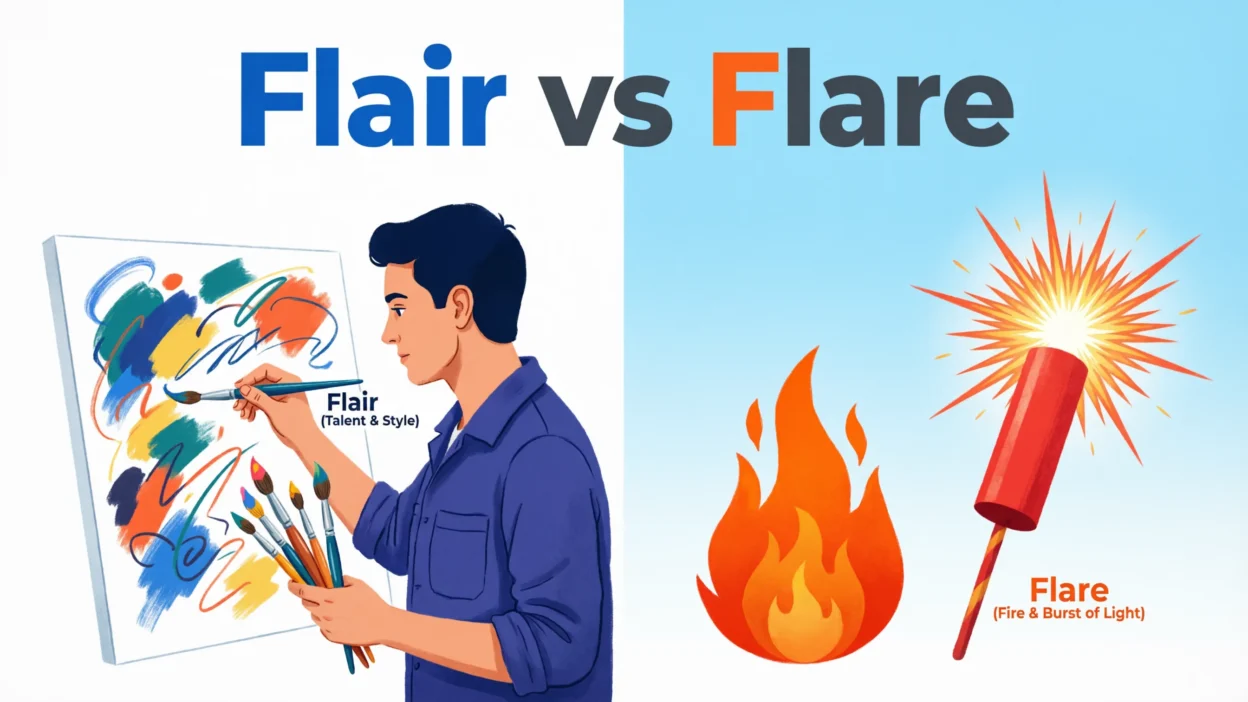
- Flair = Talent or style.
- Flare = Fire or bright burst.
Think of the letter “E” in flare as standing for Energy, Explosion, or Emergency, all of which relate to sudden bursts of light, fire, or emotion.
Think of flair as something rare and special—your unique talent or style.
Flair vs Flare in Everyday Writing
At School
- Lily has a flair for mathematics.
- Tempers flared during the debate competition.
At Work
- The manager has a flair for leadership.
- Discussions flared after the announcement.
At Home
- My grandmother has a flair for baking.
- The fireplace flared when fresh logs were added.
In Health
- My eczema tends to flare during cold weather.
- Allergies often flare in spring.
American vs British English
There is no significant difference between American English and British English in the use of flair and flare.
Both varieties use:
- Flair for talent, creativity, or distinctive style.
- Flare for fire, light, emotions, medical flare-ups, or objects spreading outward.
The meanings and grammar remain the same in both forms of English.
Why Choosing the Right Word Matters
Using the correct word helps your writing stay clear and professional.
For example:
Incorrect:
She has a flare for painting.
Correct:
She has a flair for painting.
Or:
Incorrect:
The fire began to flair.
Correct:
The fire began to flare.
A single misplaced letter completely changes the meaning of the sentence.
Related Words and Synonyms
Flair Synonyms
- Talent
- Gift
- Ability
- Aptitude
- Creativity
- Style
- Knack
Flare Synonyms
- Blaze
- Burst
- Flash
- Ignite
- Glow
- Erupt
- Brighten
While these synonyms are useful, always choose the one that best fits your sentence.
Frequently Asked Questions
1. What is the difference between flair and flare?
Flair means natural talent or style, while flare refers to a sudden burst of light, fire, emotion, or an object spreading outward.
2. Is it “flair for fashion” or “flare for fashion”?
The correct phrase is flair for fashion because it refers to style and talent.
3. What does “flare up” mean?
Flare up means to suddenly become stronger or more intense, such as anger, pain, allergies, or flames.
4. Can flare be used as a verb?
Yes. For example:
- The flames flared in the wind.
5. Is flair always a noun?
Yes. Flair is used as a noun referring to talent, creativity, or style.
6. Why do people confuse flair and flare?
They are homophones, meaning they are pronounced the same but have different spellings and meanings.
7. Is there any American vs British English difference?
No. Both American and British English use flair and flare with the same meanings and grammar.
Summary
Understanding flair vs flare is easy once you remember what each word represents. Flair is a noun that refers to natural talent, creativity, or a distinctive sense of style. Flare, on the other hand, refers to a sudden burst of light, fire, emotion, or something that spreads outward, and it can function as both a noun and a verb.
Whenever you’re unsure, ask yourself whether you’re talking about someone’s ability or a sudden burst of energy, light, or emotion. If it’s talent or style, choose flair. If it’s fire, brightness, emotions, or something that suddenly becomes more intense, choose flare. This simple distinction will help you write more confidently and accurately.
Actionable Takeaway
Remember this easy phrase: “Flair is your talent; flare is your fire.” If the sentence is about creativity or ability, use flair. If it’s about flames, bright light, strong emotions, or a sudden increase in intensity, use flare.

Mike Poop is a dedicated writer at Symboliy.com, creating clear, practical content about language, communication, and everyday expressions to help readers understand meaning and usage confidently in professional contexts worldwide.