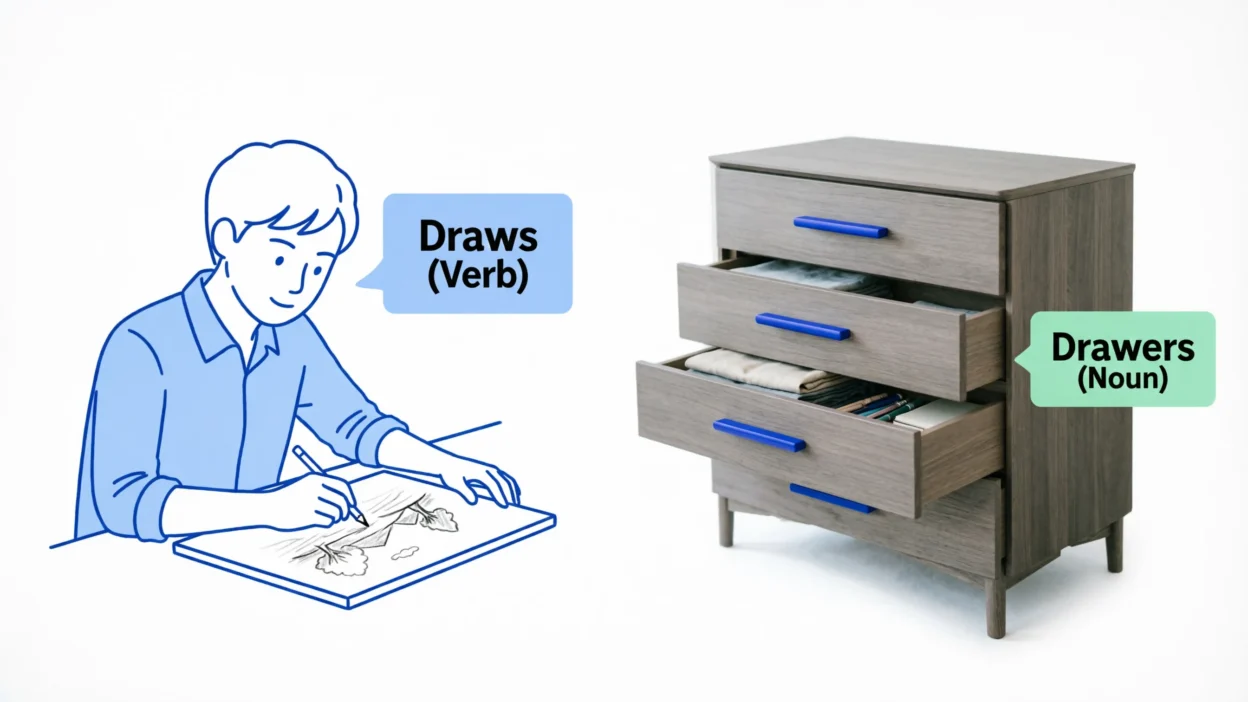
The words draws and drawers may look similar, but they have completely different meanings and grammatical functions.
Because they differ by only a few letters, many English learners accidentally confuse them in writing and speech. Understanding the distinction will help you communicate more clearly and avoid common mistakes.
In this guide, you’ll learn the difference between draws vs drawers, when to use each word, practical examples, common errors, and an easy memory trick. By the end, you’ll know exactly which word belongs in every situation.
Quick Answer
The difference between draws and drawers is straightforward:
- Draws is the third-person singular form of the verb draw, meaning to create a picture, pull something, attract attention, or move something.
- Drawers is a plural noun referring to sliding storage compartments in furniture like desks, dressers, or cabinets.
Examples:
- ✅ She draws beautiful portraits.
- ✅ The kitchen has five large drawers.
- ❌ She drawers beautiful portraits.
- ❌ The cabinet has three draws.
What Does “Draws” Mean?
Draws is a verb. It is the present tense form of draw used with singular subjects like he, she, or it.
Depending on the context, draws can have several meanings.
Examples
- She draws cartoons every weekend.
- He draws maps for his students.
- The magnet draws metal objects.
- The movie draws large crowds.
- The horse draws the carriage.
In each sentence, draws describes an action.
When to Use Draws
Use draws when someone or something:
- Creates a picture or sketch.
- Pulls or drags something.
- Attracts people or attention.
- Causes something to move.
LSI Keywords:
- draw verb
- draws meaning
- draws definition
- present tense of draw
- attracts
- sketches
What Does “Drawers” Mean?
Drawers is the plural form of drawer, a noun that refers to a sliding storage compartment found in furniture.
Drawers are commonly used to organize clothes, documents, kitchen utensils, and other household items.
Examples
- The dresser has six drawers.
- I keep my socks in the top drawers.
- The office desk includes locking drawers.
- Please close the kitchen drawers.
Here, drawers refers to physical storage spaces.
When to Use Drawers
Choose drawers when referring to:
- Storage compartments
- Furniture
- Cabinets
- Dressers
- Office desks
Related Keywords:
- dresser drawers
- desk drawers
- storage drawers
- cabinet drawers
- furniture compartments
Draws vs Drawers: Comparison Table
| Feature | Draws | Drawers |
|---|---|---|
| Part of Speech | Verb | Noun (Plural) |
| Meaning | Performs the action of drawing, pulling, or attracting | Sliding storage compartments |
| Refers To | An action | A physical object |
| Can Describe People? | Yes | No |
| Example | She draws flowers. | The dresser has four drawers. |
Easy Examples to Remember
Draws
- My sister draws comic books.
- The advertisement draws attention.
- The artist draws with charcoal.
- This event draws thousands of visitors.
Drawers
- These drawers are made of oak.
- I organized my clothes in the drawers.
- The filing cabinet contains four drawers.
- The kitchen drawers are full of utensils.
Common Mistakes People Make
Because the words sound somewhat alike, writers often mix them up.
Mistake 1
❌ She drawers amazing portraits.
✅ She draws amazing portraits.
Since the sentence describes an action, draws is correct.
Mistake 2
❌ The desk has three draws.
✅ The desk has three drawers.
Furniture contains drawers, not draws.
Mistake 3
❌ He opens the draws every morning.
✅ He opens the drawers every morning.
Storage compartments are called drawers.
Mistake 4
❌ The concert drawers huge crowds.
✅ The concert draws huge crowds.
Here, draws means “attracts.”
Memory Trick
Here’s an easy way to remember the difference:
- Draws = Does something. (It’s a verb.)
- Drawers = Stores something. (It’s a noun.)
A helpful clue is the ending:
- -ers often refers to a person or thing, like players, teachers, or computers. Likewise, drawers are things you use for storage.
Draws vs Drawers in Everyday Writing
At Home
- She draws while listening to music.
- I keep my clothes in the bedroom drawers.
At School
- The student draws diagrams for science class.
- The teacher stores supplies in classroom drawers.
At Work
- The presentation draws positive feedback.
- Important files are locked inside the office drawers.
In Everyday Conversations
- My daughter draws every evening.
- Please check the top drawers for the keys.
American vs British English
There is no significant difference between American English and British English in the use of draws and drawers.
In both varieties:
- Draws functions as a verb.
- Drawers refers to storage compartments in furniture.
One interesting note is that drawers has historically also meant underwear in older British English. Today, this usage is considered old-fashioned and is rarely used in modern conversation. In everyday English, drawers almost always refers to furniture storage compartments.
Why Choosing the Right Word Matters
Using the correct word improves clarity and prevents confusion.
For example:
Incorrect:
She drawers beautiful landscapes.
Correct:
She draws beautiful landscapes.
Or:
Incorrect:
My dresser has five draws.
Correct:
My dresser has five drawers.
Choosing the right word ensures your writing is both grammatically correct and easy to understand.
Related Words and Synonyms
Draws Synonyms
- Sketches
- Illustrates
- Pulls
- Attracts
- Drags
Drawers Related Words
- Cabinets
- Compartments
- Dressers
- Storage units
- Filing cabinets
These related words can help expand your vocabulary while keeping your writing natural.
Frequently Asked Questions
1. What is the difference between draws and drawers?
Draws is a verb meaning to sketch, pull, or attract, while drawers is the plural noun for storage compartments in furniture.
2. Is “draws” a verb?
Yes. Draws is the third-person singular present tense of the verb draw.
3. Is “drawers” a noun?
Yes. Drawers is the plural form of drawer, meaning sliding storage compartments.
4. Which is correct: “desk draws” or “desk drawers”?
The correct phrase is desk drawers because they are storage compartments.
5. Can “draws” mean “attracts”?
Yes. For example:
- The museum draws thousands of tourists every year.
6. Why do people confuse draws and drawers?
They have similar spelling and pronunciation, but they belong to different parts of speech and have completely different meanings.
7. Is there any difference between American and British English?
No. Both American and British English use draws and drawers with the same meanings. Only the older British meaning of drawers as underwear differs, and it is now uncommon.
Summary
Understanding draws vs drawers is simple once you know their roles in a sentence. Draws is a verb used to describe actions such as sketching, pulling, or attracting, while drawers is a plural noun referring to the storage compartments found in furniture. Although the words look similar, they are never interchangeable.
Whenever you’re writing, ask yourself whether you’re describing an action or a storage compartment. If it’s an action, choose draws. If you’re talking about furniture storage, choose drawers. Following this simple rule will make your writing more accurate and easier to understand.
Actionable Takeaway
Remember this phrase: “Draws does, drawers stores.” If the word describes an action, use draws. If it refers to a place where you keep clothes, documents, or other items, use drawers.

Shan Waston is a skilled writer at Symboliy.com, producing clear, engaging content on language, communication, and everyday expressions to help readers understand meaning and usage confidently in modern digital contexts.