English spelling mistakes can easily happen, especially when two words sound somewhat similar. One common confusion people search for is seak vs seek. If you’ve ever wondered whether seak is a real word or simply a typo, you’re not alone.
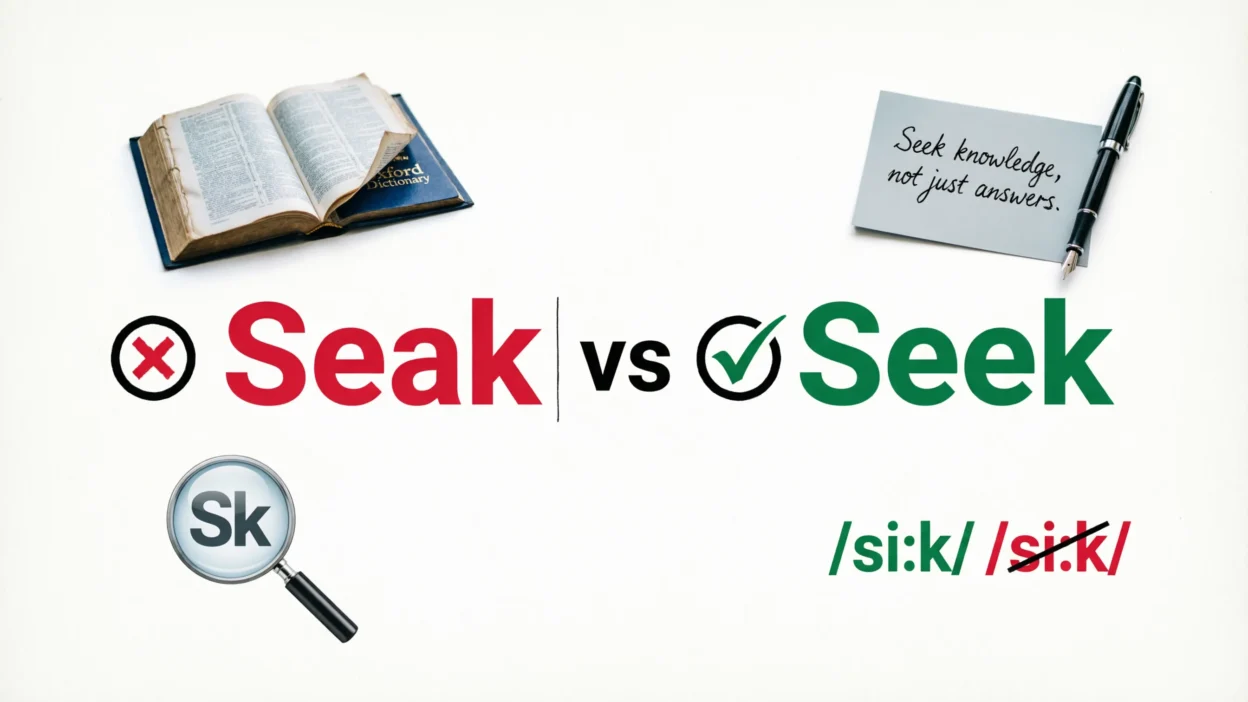
The short answer is simple: “seek” is the correct English word, while “seak” is generally considered a misspelling. Understanding the difference can help improve your grammar, writing clarity, and professional communication.
Whether you’re writing an email, blog post, essay, or social media caption, using the correct spelling matters.
Quick Answer
- ✅ Seek = Correct spelling
- ❌ Seak = Incorrect spelling in standard English
The word seek means to search for, look for, or try to obtain something.
Correct Example
- Many students seek better career opportunities.
Incorrect Example
- Many students seak better career opportunities.
What Does “Seek” Mean?
The word seek is a verb used to describe searching for something, trying to achieve something, or asking for help or information.
Definition of Seek
Seek means:
- To search for
- To attempt to find
- To pursue or request something
It is commonly used in both formal and casual English.
Common Uses of “Seek”
1. Seeking Information
People often use seek when looking for knowledge or answers.
Examples:
- I seek advice from experienced people.
- Researchers seek accurate data.
2. Seeking Opportunities
It can describe pursuing goals or improvements.
Examples:
- She seeks a better future for her family.
- Many graduates seek international jobs.
3. Seeking Help or Support
The word is frequently used in emotional, medical, and legal contexts.
Examples:
- You should seek professional guidance.
- He decided to seek medical attention.
Is “Seak” a Real Word?
In modern standard English, seak is not considered a correct word. Most of the time, it appears because of:
- Typing mistakes
- Pronunciation confusion
- Spelling errors
- Autocorrect issues
If you intend to mean “search for” or “look for,” the correct word is always seek.
Seak vs Seek: Comparison Table
| Feature | Seek | Seak |
|---|---|---|
| Correct English Word | Yes | No |
| Dictionary Accepted | Yes | No |
| Meaning | Search for something | Misspelling |
| Used in Professional Writing | Yes | No |
| Grammatically Correct | Yes | No |
Why People Confuse “Seak” and “Seek”
There are several reasons why this spelling confusion happens.
1. Similar Pronunciation
The vowel sound in seek may lead some people to spell it phonetically as seak.
2. English Spelling Complexity
English contains many irregular spelling patterns, which can make learning difficult.
Examples:
- Speak
- Peak
- Weak
Because these words contain “ea,” some writers incorrectly assume seek follows the same pattern.
3. Fast Typing Errors
Typing quickly often causes accidental spelling mistakes, especially in digital communication.
Examples of “Seek” in Sentences
Using the word in context helps reinforce the correct spelling.
Everyday Examples
- People seek happiness in different ways.
- I seek peace and balance in life.
Professional Examples
- The company seeks talented employees.
- Employers seek candidates with experience.
Academic Examples
- Students seek reliable sources for research.
- Scientists seek solutions to climate challenges.
Emotional Examples
- Many people seek emotional support during hard times.
- He sought comfort after the loss.
Different Forms of “Seek”
Understanding related forms of the word can improve vocabulary and grammar skills.
| Word Form | Example |
|---|---|
| Seek | I seek knowledge. |
| Seeks | She seeks success. |
| Seeking | They are seeking help. |
| Sought | He sought advice yesterday. |
Important Note
The past tense of seek is sought, not “seeked.”
Correct:
- She sought help immediately.
Incorrect:
- She seeked help immediately.
Common Mistakes Related to “Seek”
1. Writing “Seak” Instead of “Seek”
Incorrect:
- We seak better solutions.
Correct:
- We seek better solutions.
2. Using the Wrong Past Tense
Incorrect:
- He seeked attention.
Correct:
- He sought attention.
3. Incorrect Pronunciation-Based Spelling
Many spelling errors happen when writers rely only on sound rather than learned spelling patterns.
Easy Trick to Remember the Correct Spelling
A quick memory trick:
“Seek has double E because you use your eyes to seek.”
The two “e” letters can remind you of eyes looking for something.
American vs British English Differences
There is no spelling difference between American and British English for the word seek.
Both versions use:
- ✅ Seek
- ❌ Seak
However, pronunciation accents may differ slightly depending on the region.
Synonyms of Seek
Using synonyms naturally improves writing variety and SEO relevance.
Common Synonyms
- Search for
- Look for
- Pursue
- Explore
- Request
- Hunt for
- Attempt to find
- Try to obtain
Related LSI Keywords
- seek meaning
- seek definition
- seak spelling
- common spelling mistakes
- seek vs seak
- English grammar rules
- correct spelling of seek
- seek examples
- seek synonym
- grammar correction
Why Correct Spelling Matters
Correct spelling affects communication more than many people realize.
1. Builds Credibility
Using accurate spelling makes your writing appear more professional and trustworthy.
2. Improves Readability
Readers understand your message faster when words are spelled correctly.
3. Helps SEO Performance
Search engines favor clear, high-quality content with proper grammar.
4. Prevents Misunderstandings
Correct spelling reduces confusion in professional and academic communication.
How to Avoid Spelling Mistakes Like “Seak”
Read Regularly
Reading quality English content improves natural spelling recognition.
Use Spell Check Tools
Grammar tools can quickly identify incorrect spellings.
Practice Frequently Confused Words
Creating a personal list of difficult words can strengthen memory.
Slow Down While Typing
Many mistakes happen simply because of rushing.
FAQs About Seak vs Seek
Is “seak” a real English word?
No. “Seak” is generally considered a misspelling of “seek.”
What does “seek” mean?
Seek means to search for, pursue, or try to obtain something.
Which spelling is correct: seak or seek?
The correct spelling is “seek.”
What is the past tense of seek?
The past tense of seek is “sought.”
Is “seek” formal or informal?
It can be used in both formal and informal English.
Why do people spell seek as seak?
People often confuse the spelling because of similar English words containing “ea.”
Is seek used in business English?
Yes. It is commonly used in professional communication.
Are there British and American spelling differences?
No. Both use the spelling “seek.”
Final Summary
The confusion between seak vs seek is common, but the correct answer is straightforward. Seek is the proper English word used when talking about searching for, pursuing, or trying to obtain something. On the other hand, seak is simply a spelling mistake and is not accepted in standard English dictionaries.
Learning the correct spelling helps improve writing quality, communication clarity, and professional credibility. Whether you are writing academic content, business emails, or casual messages, using “seek” correctly ensures your English appears polished and accurate.
Actionable Takeaway
Whenever you want to express the idea of searching or pursuing something, always use:
- ✅ Seek
- ❌ Seak
A simple memory trick is to remember that “seek” contains double “e,” just like a pair of eyes searching for something.

Here is a professional 30-word author biography including your site name Symboliy.com:
Martin Hood is a professional writer at Symboliy.com, creating clear, informative content focused on language, communication, and meaningful expressions for everyday and professional use.