If you’ve ever been confused about farther vs further, you’re not alone. These two words are often used interchangeably because they both relate to distance or progress. However, there is a subtle difference that can make your writing more precise and professional.
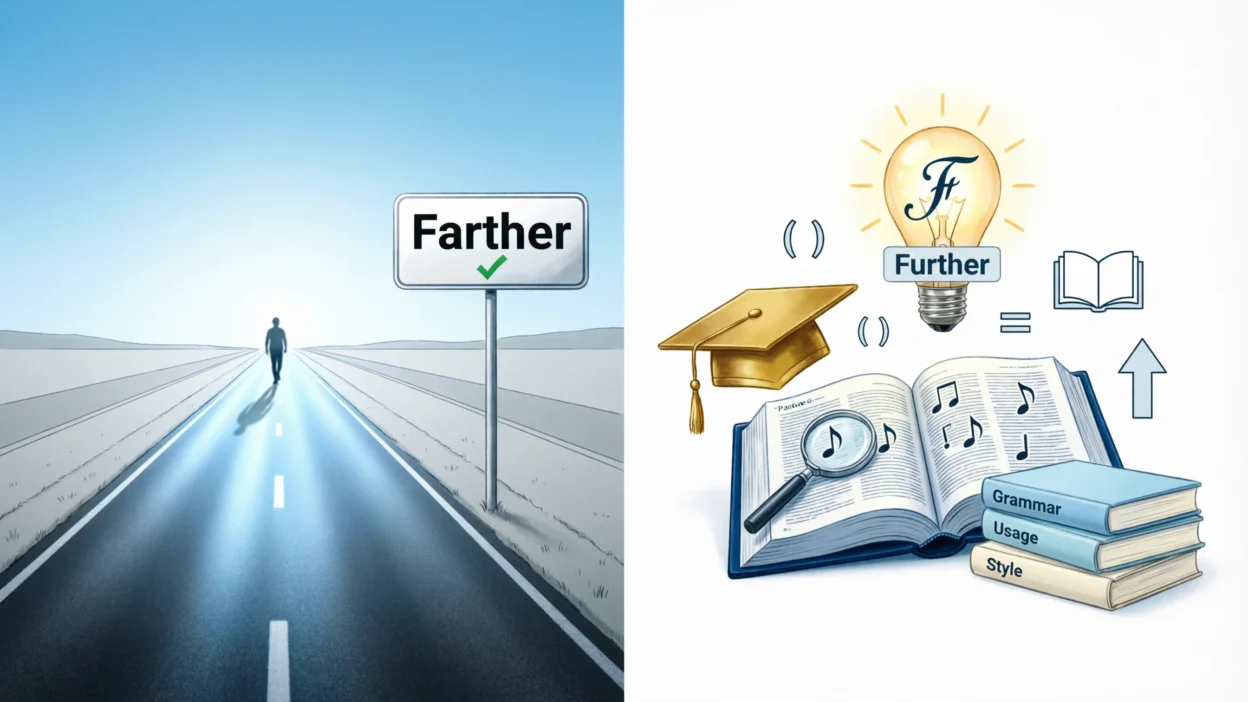
The good news is that the distinction is easy to remember. Farther usually refers to physical distance, while further is commonly used for figurative distance, additional information, or advancement.
In this guide, you’ll learn the meaning of each word, see practical examples, avoid common mistakes, and understand how both American and British English use them.
Quick Answer
Use “farther” for physical distance.
Use “further” for figurative distance, additional information, time, or advancement.
Examples:
- ✅ The park is farther than I expected.
- ✅ We need further discussion before making a decision.
- ✅ She walked farther down the road.
- ✅ For further information, contact customer support.
Although many people use them interchangeably, following this rule makes your writing clearer.
What Does “Farther” Mean?
Farther refers to a greater physical distance. It answers the question, “How much farther away is something?”
Whenever you’re talking about measurable distance, farther is generally the better choice.
Examples of “Farther”
- The grocery store is farther than the library.
- We drove farther than planned.
- She threw the ball farther than anyone else.
- The hiking trail continues farther into the forest.
- My office is farther from home than yours.
In each example, the distance can be physically measured.
What Does “Further” Mean?
Further usually refers to additional information, greater progress, advancement, time, or figurative distance rather than physical distance.
It often means:
- More
- Additional
- Beyond
- To a greater extent
- Advancement of something
Examples of “Further”
- We need further investigation.
- Please contact us for further assistance.
- She wants to continue her education further.
- The committee requested further evidence.
- We cannot proceed without further discussion.
Here, further does not refer to measurable physical distance.
Farther vs Further: Comparison Table
| Feature | Farther | Further |
|---|---|---|
| Physical distance | ✅ Yes | Sometimes |
| Figurative meaning | ❌ Rarely | ✅ Yes |
| Additional information | ❌ No | ✅ Yes |
| Progress or advancement | ❌ No | ✅ Yes |
| Common in formal writing | ✅ Yes | ✅ Yes |
| Everyday conversation | ✅ Yes | ✅ Yes |
When Should You Use “Farther”?
Choose farther when discussing measurable physical distance.
Examples include:
- Walking farther
- Driving farther
- Throwing something farther
- Traveling farther
- Moving farther away
Example Sentences
- We walked farther than expected.
- The hotel is farther from the airport.
- He ran farther than anyone else.
- Can you throw the ball farther?
If you could measure the distance with a ruler, map, or GPS, farther is usually the correct choice.
When Should You Use “Further”?
Use further when talking about ideas, progress, knowledge, time, or additional actions.
Common situations include:
- Further research
- Further education
- Further explanation
- Further discussion
- Further instructions
- Further improvements
- Further assistance
Example Sentences
- We need further clarification.
- She pursued further studies abroad.
- No further action is required.
- Please read further for more details.
- They discussed the issue further.
These examples describe progress or additional information rather than physical distance.
Common Mistakes
Many writers mix these words because they sound similar.
Mistake 1
❌ We need farther information.
✅ We need further information.
Mistake 2
❌ She walked further than her brother.
✅ She walked farther than her brother.
Mistake 3
❌ Please contact us for farther assistance.
✅ Please contact us for further assistance.
Mistake 4
❌ The restaurant is further down the street.
✅ The restaurant is farther down the street.
Choosing the right word makes your writing more precise.
Can “Further” Be Used for Physical Distance?
Yes, especially in modern English.
Many dictionaries now accept further for physical distance as well.
For example:
- We walked further down the road.
This sentence is grammatically correct.
However, many grammar experts still recommend using:
- Farther for physical distance.
- Further for figurative distance.
Following this traditional distinction helps avoid confusion and is often preferred in formal writing.
American vs British English
Both American English and British English recognize the distinction between farther and further, but usage differs slightly.
American English
American style guides often recommend:
- Farther = Physical distance
- Further = Figurative distance
Examples:
- She drove farther than expected.
- We need further analysis.
British English
British English more commonly uses further for both physical and figurative distance.
Examples:
- We walked further along the river.
- Further discussion is necessary.
Although farther is still correct in British English, further is generally more common.
Grammar Tip to Remember
A simple memory trick is:
Farther = Far
Both words begin with Far, making it easy to remember that farther relates to physical distance.
Think of:
- Far → Farther
And:
- Further → Further discussion
- Further education
- Further information
This trick helps you choose the correct word quickly.
Related Words and Synonyms
Here are some related words that naturally connect with farther and further:
For Farther
- More distant
- Beyond
- Away
- Remote
- Longer distance
For Further
- Additional
- Extra
- More
- Continued
- Extended
- Supplemental
- Advanced
- Greater
Using these related terms improves vocabulary and enhances writing variety.
Tips for Using “Farther” and “Further” Correctly
Follow these simple tips:
- Use farther for measurable physical distance.
- Use further for ideas, progress, or additional information.
- Remember that further is more flexible and can sometimes refer to physical distance.
- In formal writing, follow the traditional distinction for greater clarity.
- Proofread your writing to ensure you’re using the correct word for the context.
Frequently Asked Questions
What is the main difference between farther and further?
Farther refers to physical distance, while further usually refers to figurative distance, additional information, or advancement.
Can “further” be used instead of “farther”?
Yes. Modern English often accepts further for physical distance, but many style guides still recommend using farther for measurable distances.
Which is more common in British English?
British English frequently uses further for both physical and figurative meanings.
Is “farther” only about distance?
Yes. Farther almost always refers to measurable physical distance.
Which word should I use for “further information”?
Always use further information.
Is “farther education” correct?
No. The correct phrase is further education.
Can I say “walk further”?
Yes. It is acceptable, especially in British English. However, walk farther is traditionally preferred when referring to measurable distance.
How can I remember the difference?
Think:
Farther = Far = Physical distance
Further = Further discussion, further research, further progress
Summary
Understanding farther vs further becomes simple once you know their primary uses. Farther is traditionally used for measurable physical distance, while further refers to additional information, advancement, time, or figurative distance. Although modern English sometimes allows further for physical distance, following the traditional distinction makes your writing clearer and more precise.
Whether you’re writing an academic paper, business email, blog post, or everyday message, choosing the correct word demonstrates strong grammar skills. Remember the easy rule: if you can measure the distance, use “farther”; if you’re talking about ideas or progress, use “further.”
Actionable Takeaway
Before choosing between farther and further, ask yourself one question: “Am I talking about physical distance?” If the answer is yes, use farther. If you’re referring to additional information, progress, or something abstract, choose further for accurate and polished writing.

Here is a professional 30-word author biography including your site name Symboliy.com:
Martin Hood is a professional writer at Symboliy.com, creating clear, informative content focused on language, communication, and meaningful expressions for everyday and professional use.