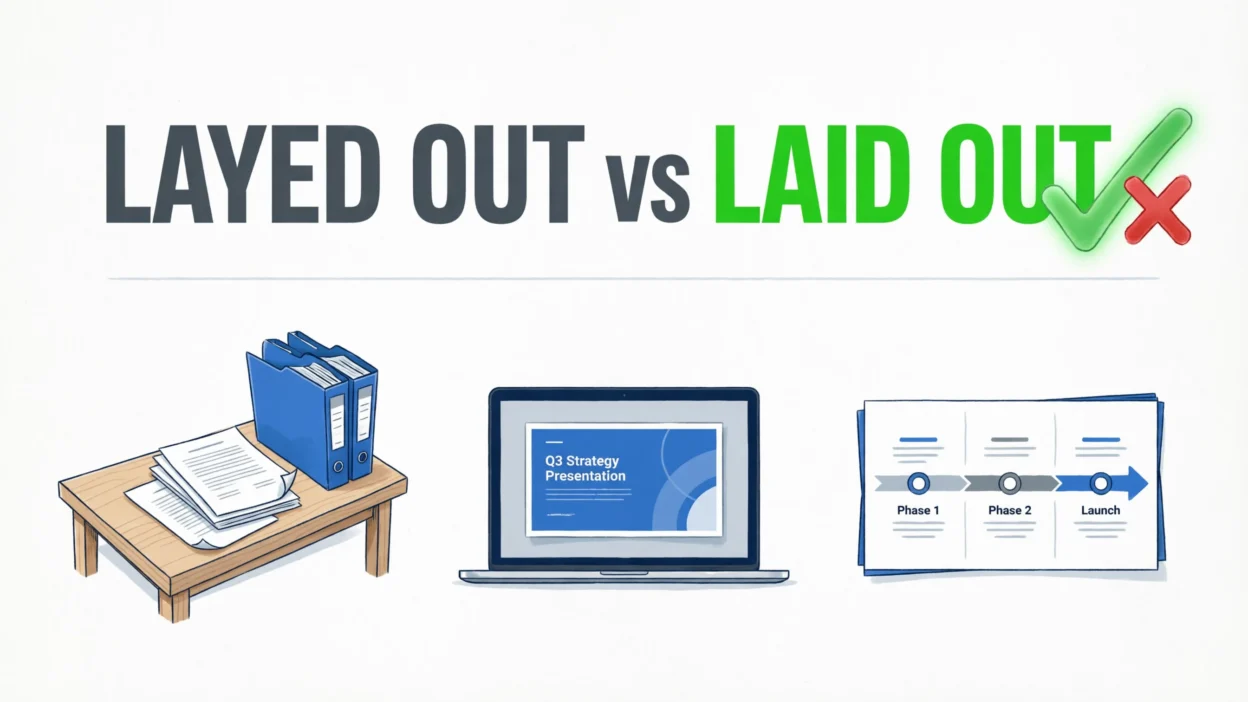
If you’ve ever written layed out and wondered whether it was correct, you’re not alone. Many English speakers assume that adding -ed to the verb lay creates its past tense, but English grammar doesn’t work that way in this case.
The confusion between layed out vs laid out is extremely common in business writing, academic papers, emails, and everyday communication.
Fortunately, the rule is straightforward once you understand how the verb lay changes in the past tense. In this guide, you’ll learn the correct usage, grammar rules, examples, common mistakes, and an easy trick to remember the difference.
Quick Answer
✅ Laid out is the correct phrase.
❌ Layed out is incorrect in standard English.
Examples:
- She laid out the plans for the project.
- The designer laid out the brochure carefully.
- We laid out all the options before making a decision.
Whenever you need the past tense of lay out, use laid out, not layed out.
What Does “Laid Out” Mean?
Laid out is the past tense and past participle form of the phrasal verb lay out.
The phrase can have several meanings depending on the context:
- To arrange something neatly
- To present information clearly
- To organize plans or ideas
- To spread items out for display
- To explain something in detail
Examples of “Laid Out” in Sentences
- The teacher laid out the lesson plan for the week.
- She laid out her clothes the night before the trip.
- The architect laid out the building design.
- We laid out our expectations during the meeting.
- The evidence was clearly laid out in the report.
Why Is “Laid Out” Correct Instead of “Layed Out”?
Many English verbs form their past tense by adding -ed.
Examples:
- Talk → Talked
- Clean → Cleaned
- Start → Started
Because of this pattern, some writers mistakenly assume:
- Lay → Layed
However, lay is an irregular verb.
Correct Verb Forms
| Verb Form | Correct Word |
|---|---|
| Base Form | Lay |
| Present Participle | Laying |
| Past Tense | Laid |
| Past Participle | Laid |
When combined with out, the rule remains the same:
- Lay out → Laid out ✅
- Lay out → Layed out ❌
This is why professional writers, editors, teachers, and grammar experts consistently use laid out.
Layed Out vs Laid Out: Side-by-Side Comparison
| Feature | Layed Out | Laid Out |
|---|---|---|
| Grammatically Correct | No | Yes |
| Standard English | No | Yes |
| Formal Writing | No | Yes |
| Academic Writing | No | Yes |
| Business Communication | No | Yes |
| Recommended Usage | No | Yes |
The correct choice is always laid out in modern English.
Common Meanings of “Laid Out”
Arranged or Organized
- She laid out the documents on the desk.
- The chef laid out the ingredients before cooking.
Explained Clearly
- The manager laid out the company’s strategy.
- The lawyer laid out the facts of the case.
Planned in Advance
- We laid out a timeline for the project.
- The organizers laid out the event schedule.
Displayed for Viewing
- The products were laid out on the shelves.
- The museum laid out the artifacts for visitors.
Common Examples of “Laid Out”
Business Context
- The consultant laid out a growth strategy.
- Management laid out expectations for the team.
Academic Context
- The professor laid out the course requirements.
- The instructions were clearly laid out.
Home Organization
- She laid out her outfit before bed.
- They laid out the decorations for the party.
Project Planning
- The team laid out the development roadmap.
- We laid out our goals for the quarter.
Common Mistakes People Make
Mistake 1: Writing “Layed Out”
Incorrect:
- He layed out the proposal during the meeting.
Correct:
- He laid out the proposal during the meeting.
Mistake 2: Treating Lay as a Regular Verb
Many writers mistakenly apply the regular -ed rule.
Incorrect:
- They layed out the documents.
Correct:
- They laid out the documents.
Mistake 3: Confusing “Laid Out” and “Laying Out”
These phrases serve different grammatical functions.
Present Action:
- She is laying out the plans.
Past Action:
- She laid out the plans.
Laid Out vs Laying Out
Understanding the difference helps prevent common errors.
| Phrase | Usage | Example |
|---|---|---|
| Lay Out | Present Tense | I lay out the documents. |
| Laying Out | Ongoing Action | I am laying out the documents. |
| Laid Out | Past Tense | I laid out the documents. |
These forms are frequently used in professional and everyday communication.
American vs British English
There is no spelling difference between American English and British English for this phrase.
Both use:
✅ Laid out
Both reject:
❌ Layed out
Whether you’re writing in the United States, United Kingdom, Canada, Australia, or elsewhere, laid out is the accepted form.
Is “Layed Out” Ever Correct?
In modern standard English, layed out is generally considered incorrect.
You might occasionally encounter it in:
- Informal online posts
- Social media comments
- User-generated content
- Spelling mistakes
However, dictionaries, grammar guides, editors, and educational institutions overwhelmingly recommend laid out.
Grammar Trick to Remember the Difference
Here’s a simple memory aid:
Think about these irregular verb pairs:
- Pay → Paid
- Say → Said
- Lay → Laid
Notice the pattern:
Lay → Laid
Not:
Lay → Layed
If you remember paid, you’ll easily remember laid.
Real-Life Examples of Correct Usage
- She laid out the meeting agenda.
- The designer laid out the website structure.
- We laid out the project timeline last week.
- The lawyer laid out the evidence clearly.
- He laid out the tools before beginning repairs.
- The company laid out its long-term goals.
- The teacher laid out classroom expectations.
- They laid out the furniture in the living room.
- The author laid out the argument logically.
- We laid out all available options before deciding.
Why Correct Usage Matters
Using laid out correctly improves:
- Professional writing quality
- Grammar accuracy
- Business communication
- Academic credibility
- Reader trust
- SEO performance
Because phrases like laid out plans, laid out strategy, and laid out evidence frequently appear in professional content, using the correct form helps maintain authority and clarity.
Frequently Asked Questions (FAQs)
Is laid out or layed out correct?
Laid out is correct. Layed out is considered incorrect in standard English.
Why is it laid out instead of layed out?
Because lay is an irregular verb whose past tense is laid, not layed.
What does laid out mean?
It can mean arranged, organized, displayed, explained, or planned depending on the context.
Is laid out the past tense of lay out?
Yes. Both the past tense and past participle forms are laid out.
Can I use layed out in professional writing?
No. Professional and academic writing should use laid out.
Is there a British English spelling of layed out?
No. British English also uses laid out.
What’s the difference between laid out and laying out?
Laid out refers to a completed past action, while laying out describes an ongoing action.
How can I remember the correct phrase?
Remember: Pay → Paid and Lay → Laid. The same pattern applies.
Summary
When comparing layed out vs laid out, the correct phrase is laid out. Since lay is an irregular verb, its past tense becomes laid, not layed. This rule applies whether you’re talking about arranging items, presenting information, explaining plans, or organizing projects.
From business presentations to academic writing and everyday communication, laid out is the accepted and professional form. Using it correctly strengthens your grammar, improves readability, and ensures your writing follows standard English conventions.
Actionable Takeaway
Whenever you need the past tense of lay out, use this simple formula:
Lay out → Laid out
Avoid writing layed out in formal, academic, business, or casual writing. If you’re unsure, remember the pattern:
Pay → Paid
Lay → Laid
That quick trick will help you choose laid out every time.

Shan Waston is a skilled writer at Symboliy.com, producing clear, engaging content on language, communication, and everyday expressions to help readers understand meaning and usage confidently in modern digital contexts.