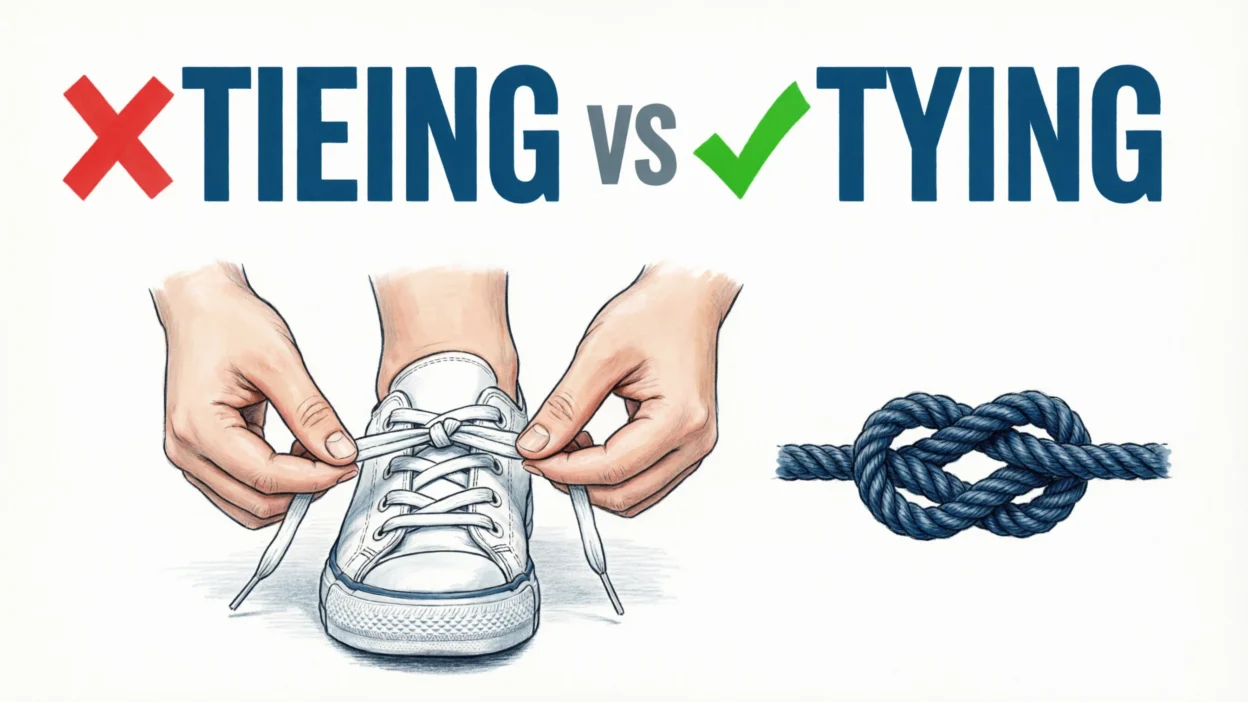
If you’ve ever paused while writing and wondered whether tieing or tying is correct, you’re not alone. This is one of the most common English spelling questions because the word “tie” follows a spelling pattern that looks unusual when changed into its present participle form.
Whether you’re writing an email, academic paper, blog post, or social media caption, using the correct spelling helps improve clarity and professionalism.
In this guide, you’ll learn the difference between tieing vs tying, why one spelling is preferred, common mistakes to avoid, and how to use the word correctly in everyday writing.
Quick Answer
Tying is the correct spelling in modern English.
❌ Tieing
✅ Tying
The verb tie becomes tying when used in the present participle or gerund form.
Examples:
- She is tying her shoelaces.
- Tying a necktie properly takes practice.
- He spent the afternoon tying fishing knots.
In standard English, tieing is generally considered a misspelling and should be avoided.
What Does “Tying” Mean?
The word tying comes from the verb tie, which means:
- To fasten something with a knot
- To connect or secure objects together
- To achieve an equal score in a competition
- To establish a relationship or connection
When we add -ing to “tie,” it becomes tying, which describes an ongoing action or can function as a noun.
Examples of Tying in Sentences
- She is tying the ribbon around the gift.
- The sailor is tying the boat to the dock.
- Tying your shoes correctly can prevent accidents.
- The teams are tying late in the game.
- He spent an hour tying decorative bows.
Why Is “Tying” Correct Instead of “Tieing”?
Many English learners assume that adding -ing to tie should create tieing, just as “see” becomes “seeing.” However, English spelling rules treat words ending in -ie differently.
When a verb ends in -ie, the ie usually changes to y before adding -ing.
Rule
ie → y + ing
Examples:
| Base Verb | Correct -ing Form |
|---|---|
| Tie | Tying |
| Lie | Lying |
| Die | Dying |
| Vie | Vying |
Because of this rule:
- Tie + ing = ❌ Tieing
- Tie → Ty + ing = ✅ Tying
This spelling makes the word easier to pronounce and aligns with standard English grammar conventions.
Tieing vs Tying: Side-by-Side Comparison
| Feature | Tieing | Tying |
|---|---|---|
| Standard English | No | Yes |
| Dictionary Approved | Rare/Generally Incorrect | Yes |
| Used in Formal Writing | No | Yes |
| Accepted in Academic Writing | No | Yes |
| Recommended for SEO Content | No | Yes |
| Common Modern Usage | Very Rare | Extremely Common |
The clear winner is tying, which is the spelling recognized by modern dictionaries, style guides, educators, and professional writers.
Common Examples of Tying
Here are some common situations where the word tying is used:
Tying Shoelaces
- The child is learning how to tie his shoes.
- She is tying her shoelaces before the race.
Tying Knots
- Fishermen spend years mastering the art of tying knots.
- Proper knot tying improves safety.
Tying a Tie
- He is tying his necktie before the interview.
- Tying a tie becomes easier with practice.
Tying Scores in Sports
- The teams are tying with only minutes remaining.
- They ended the match by tying the score.
Tying Things Together
- She is tying the packages with string.
- Workers are tying wires securely.
Common Mistakes People Make
Mistake 1: Writing “Tieing”
Many writers incorrectly assume that adding -ing to tie simply creates tieing.
Incorrect:
- She is tieing her shoes.
Correct:
- She is tying her shoes.
Mistake 2: Mixing Up Similar Words
Some people confuse:
- Tieing
- Tying
- Tie
- Tied
Examples:
- Present: I tie my shoes.
- Past: I tied my shoes.
- Present participle: I am tying my shoes.
Mistake 3: Following Sound Instead of Grammar
Because “tieing” may appear logical based on pronunciation, some writers use it accidentally. However, grammar rules override that assumption.
American vs British English: Is There Any Difference?
When comparing American English and British English, there is no significant difference regarding this word.
Both varieties use:
✅ Tying
Both varieties reject:
❌ Tieing
Unlike words such as:
- Color vs Colour
- Organize vs Organise
- Traveler vs Traveller
The spelling tying remains the standard form on both sides of the Atlantic.
Is “Tieing” Ever Used?
You may occasionally encounter tieing in:
- Old documents
- Historical texts
- Specialized technical contexts
- Typographical errors
However, modern dictionaries and style guides overwhelmingly recommend tying.
For everyday writing, blogging, business communication, academic work, and professional content, always choose tying.
Grammar Tip: Remember the IE Rule
A simple trick can help you remember the correct spelling.
When a verb ends in ie:
- Remove the ie
- Add y
- Add ing
Examples:
- Die → Dying
- Lie → Lying
- Tie → Tying
- Vie → Vying
This rule works consistently for many common English verbs.
Examples in Everyday Sentences
Here are additional examples showing correct usage.
- She is tying a ribbon around the bouquet.
- Tying fishing knots requires patience.
- They are tying the decorations to the fence.
- He enjoys tying flies for fly fishing.
- The athlete is tying his running shoes.
- We spent the afternoon tying up loose ends before the event.
- The game ended with both teams tying for first place.
- Tying cables neatly improves workplace safety.
Why Correct Spelling Matters
Using the correct spelling improves:
- Professional credibility
- Reader trust
- Grammar accuracy
- SEO performance
- Academic quality
Search engines and readers both expect standard English spelling. Choosing tying instead of tieing helps ensure your content appears polished and authoritative.
Frequently Asked Questions (FAQs)
Is tying the correct spelling?
Yes. Tying is the correct and widely accepted spelling of the present participle form of “tie.
Is tieing a real word?
While it may occasionally appear in older or specialized texts, tieing is generally considered incorrect in modern English.
Why does tie become tying?
English spelling rules change ie to y before adding -ing, resulting in tying.
How do you spell tying shoelaces?
The correct phrase is tying shoelaces.
Do Americans and British people spell it differently?
No. Both American English and British English use tying.
Is tying a verb or a noun?
It can be both. It acts as a verb in “She is tying a knot” and as a noun in “Tying knots is a useful skill.”
What is the past tense of tie?
The past tense of tie is tied.
What are similar words that follow the same rule?
Examples include:
- Dying
- Lying
- Vying
All change ie to y before adding -ing.
Summary
When comparing tieing vs tying, the correct choice is clear: tying is the standard spelling used in modern English. The confusion usually arises because the base word ends with ie, but English grammar requires changing ie to y before adding -ing. As a result, “tying” is accepted by dictionaries, educators, and professional writers, while “tieing” is generally viewed as a spelling mistake.
Whether you’re talking about tying shoelaces, tying knots, tying a necktie, or teams tying in a competition, the spelling remains the same. Using the correct form strengthens your writing, improves readability, and ensures your content appears professional and trustworthy.
Actionable Takeaway
Whenever you need the -ing form of tie, remember this simple formula:
Tie → Ty + ing = Tying
If you’re unsure while writing, ask yourself whether the word ends in -ie. If it does, replace ie with y before adding -ing. Following this rule will help you avoid one of the most common English spelling mistakes.

Here is a professional 30-word author biography including your site name Symboliy.com:
Martin Hood is a professional writer at Symboliy.com, creating clear, informative content focused on language, communication, and meaningful expressions for everyday and professional use.