
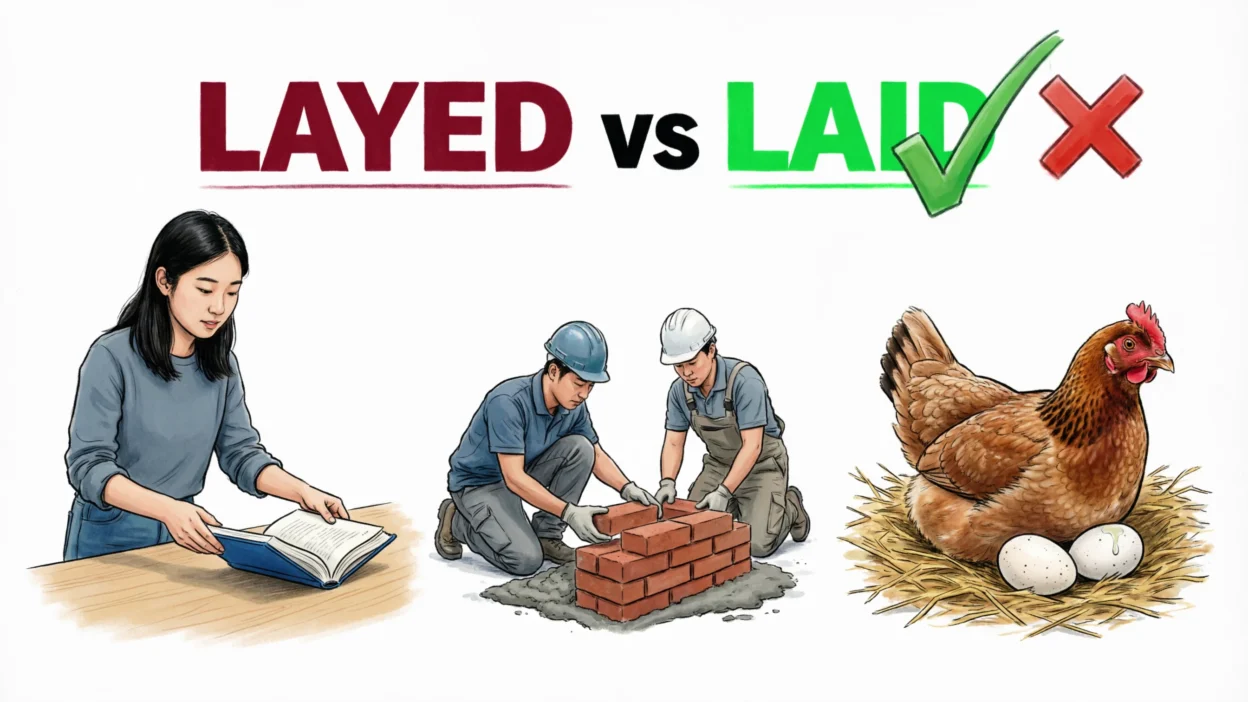
If you’ve ever found yourself wondering whether to write layed or laid, you’re not alone. This is one of the most common grammar mistakes in English because the verb lay has an irregular past tense that doesn’t follow the standard “-ed” pattern many writers expect.
Whether you’re writing an email, school assignment, blog post, or professional document, using the correct form can make your writing more polished and credible.
In this guide, you’ll learn the difference between layed vs laid, why one is correct, common mistakes to avoid, examples of proper usage, and a simple trick to remember the rule.
Quick Answer
✅ Laid is the correct past tense and past participle of lay.
❌ Layed is generally considered incorrect in standard English.
Examples:
- She laid the book on the table.
- The workers laid new flooring yesterday.
- He had laid the tools in the garage.
In almost all everyday writing situations, you should use laid, not layed.
What Do “Lay” and “Laid” Mean?
The verb lay means:
- To put or place something down
- To set something in a particular position
- To establish or prepare something
- For birds, to produce eggs
The word laid is the past tense and past participle form of lay.
Examples of Laid in Sentences
- She laid her keys on the counter.
- They laid a foundation for the new building.
- The hen laid three eggs this morning.
- He carefully laid the blanket over the child.
- We laid out the plans before starting the project.
Why Is “Laid” Correct Instead of “Layed”?
Many English verbs form their past tense by adding -ed.
Examples:
- Walk → Walked
- Jump → Jumped
- Clean → Cleaned
Because of this pattern, some writers mistakenly assume:
- Lay → Layed
However, lay is an irregular verb.
Correct Verb Forms
| Verb Form | Correct Word |
|---|---|
| Base Form | Lay |
| Present Participle | Laying |
| Past Tense | Laid |
| Past Participle | Laid |
Therefore:
- Yesterday, I laid the book down.
- I have laid the book on the shelf.
The form layed does not follow standard English grammar rules.
Layed vs Laid: Side-by-Side Comparison
| Feature | Layed | Laid |
|---|---|---|
| Standard English | No | Yes |
| Dictionary Approved | Generally No | Yes |
| Used in Formal Writing | No | Yes |
| Academic Writing | No | Yes |
| Common Modern Usage | Rare | Very Common |
| Recommended Usage | No | Yes |
For nearly all writing situations, laid is the correct choice.
Common Uses of “Laid”
Laying Objects Down
- She laid the phone on the desk.
- He laid the package by the door.
Construction and Building
- Workers laid bricks for the wall.
- The crew laid new pavement on the road.
Creating a Foundation
- The team laid the groundwork for future success.
- The company laid plans for expansion.
Egg Production
- The chicken laid an egg this morning.
- Several hens laid eggs overnight.
Common Mistakes People Make
Mistake 1: Using “Layed” as the Past Tense
Incorrect:
- She layed the book on the table.
Correct:
- She laid the book on the table.
Mistake 2: Confusing “Lay” and “Lie”
Many people mix up these verbs.
Lay = To place something.
Lie = To recline or rest.
Examples:
- I lay the blanket on the bed.
- I lie down to sleep.
Past tense forms:
- Lay → Laid
- Lie → Lay
This overlap creates a lot of confusion.
Mistake 3: Adding “-ed” to an Irregular Verb
Because many verbs follow regular patterns, writers often assume every verb does.
Incorrect:
- They layed new carpet yesterday.
Correct:
- They laid new carpet yesterday.
Lay vs Laid vs Laying
Understanding all three forms can help eliminate mistakes.
| Word | Function | Example |
|---|---|---|
| Lay | Present tense | I lay the book down. |
| Laid | Past tense | I laid the book down. |
| Laying | Present participle | I am laying the book down. |
These forms are commonly used in both spoken and written English.
American vs British English
Unlike some spelling differences between American and British English, there is no variation here.
Both American English and British English use:
✅ Laid
Both reject:
❌ Layed
Regardless of where you’re writing, laid remains the correct form.
Is “Layed” Ever Correct?
In standard English, layed is almost always considered incorrect.
However, there are rare specialized uses in certain technical industries, particularly involving specific nautical terms or old historical references. These usages are uncommon and rarely encountered in everyday writing.
For general communication, professional writing, academic work, and online content, always use laid.
Grammar Trick to Remember the Difference
A simple memory trick:
Think of these common irregular verbs:
- Pay → Paid
- Say → Said
- Lay → Laid
Notice that lay changes to laid, not layed.
Remember:
Lay → Laid
Just as:
Pay → Paid
This makes the correct spelling much easier to recall.
Real-Life Examples of Correct Usage
Here are more examples of laid in everyday writing:
- She laid the baby gently in the crib.
- They laid flowers at the memorial.
- We laid the documents on the conference table.
- The workers laid concrete throughout the afternoon.
- He laid his jacket over the chair.
- The company laid the foundation for growth.
- The hen laid several eggs this week.
- They had laid the pipes before winter arrived.
- She carefully laid the artwork on the floor.
- We laid out all the options before making a decision.
Why Correct Usage Matters
Using the correct word helps improve:
- Grammar accuracy
- Professional communication
- Academic writing quality
- Reader confidence
- Search engine optimization (SEO)
- Overall credibility
Mistakes such as using layed instead of laid can distract readers and reduce trust in your writing. Choosing the correct form ensures your message remains clear and professional.
Frequently Asked Questions (FAQs)
Is laid or layed correct?
Laid is correct. Layed is generally considered incorrect in standard English.
What is the past tense of lay?
The past tense of lay is laid.
Why isn’t it spelled layed?
Because lay is an irregular verb. Its past tense changes to laid rather than following the regular “-ed” pattern.
Is layed a real word?
It occasionally appears in specialized or historical contexts, but it is not accepted as the standard past tense of lay.
How do you use laid in a sentence?
Example: “She laid the book on the desk before leaving.”
What is the difference between lay and laid?
Lay is the present tense, while laid is the past tense and past participle.
Is laid used in both American and British English?
Yes. Both American and British English use laid.
What is the present participle of lay?
The present participle is laying.
Summary
When comparing layed vs laid, the correct choice in standard English is laid. It serves as both the past tense and past participle of the verb lay, which means to place or put something down. While many writers assume “layed” is correct because it follows the pattern of regular verbs, English grammar treats “lay” as an irregular verb.
Whether you’re talking about laying flooring, placing objects, building foundations, or describing a hen producing eggs, the correct past tense form is laid. Using the proper spelling strengthens your writing, improves readability, and helps maintain professional credibility.
Actionable Takeaway
Whenever you need the past tense of lay, remember this simple formula:
Lay → Laid
Avoid writing layed in general English. If you’re unsure, compare it to pay → paid and say → said. This quick memory trick will help you choose the correct spelling every time.

Mike Poop is a dedicated writer at Symboliy.com, creating clear, practical content about language, communication, and everyday expressions to help readers understand meaning and usage confidently in professional contexts worldwide.