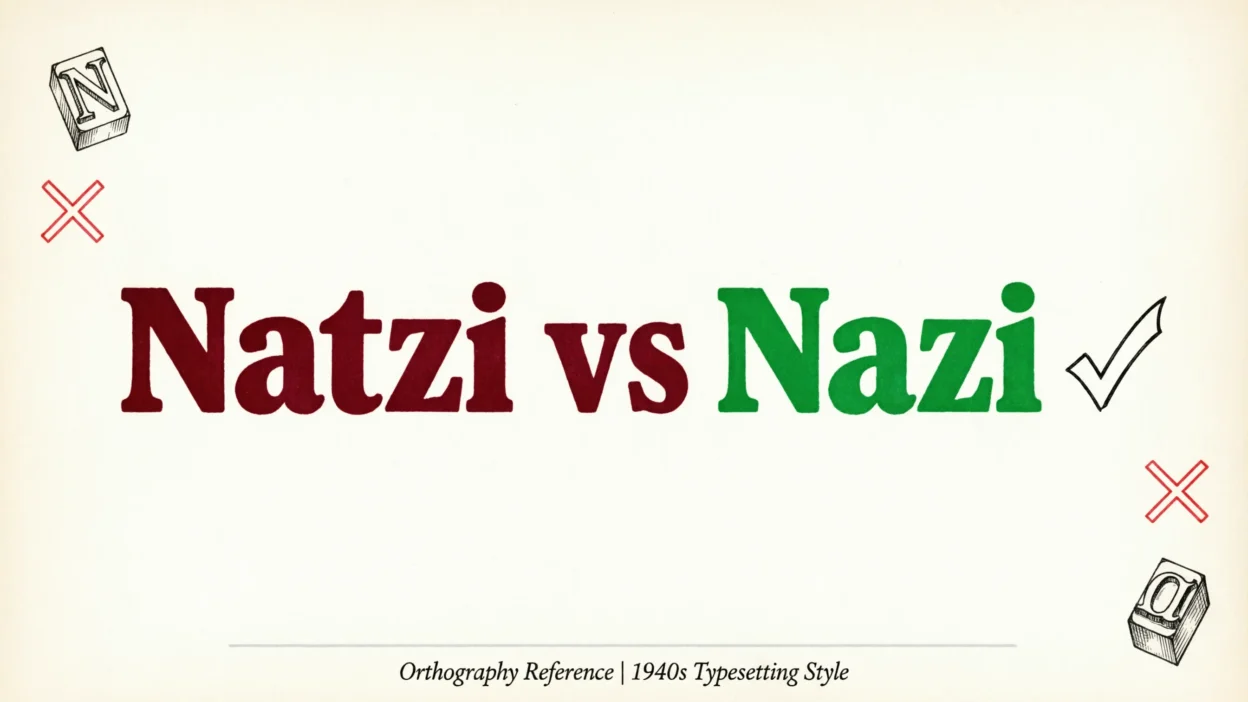
The confusion between natzi vs nazi is more common than many people realize. Because the words sound similar when spoken quickly, many people accidentally type natzi instead of nazi. However, only one of these spellings is correct in standard English.
The correct spelling is Nazi, a historically significant term connected to Germany’s National Socialist movement during the time of Adolf Hitler. The spelling natzi is simply a misspelling and is not recognized as a proper English word.
Understanding the correct form is important not only for grammar and spelling accuracy but also for historical clarity and respectful communication.
Quick Answer
- ✅ Nazi = Correct spelling
- ❌ Natzi = Incorrect spelling
The word Nazi refers to a member or supporter of the National Socialist German Workers’ Party led by Adolf Hitler in Germany during World War II.
Correct Example
- The Nazi regime played a major role in World War II.
Incorrect Example
- The Natzi regime played a major role in World War II.
What Does “Nazi” Mean?
The term Nazi historically refers to:
- A member of the National Socialist German Workers’ Party
- The political ideology associated with Adolf Hitler’s regime
- The government and movement that ruled Germany from 1933 to 1945
The word comes from the German pronunciation and abbreviation of Nationalsozialist.
Historical Background of the Word “Nazi”
The term became globally recognized during the rise of Adolf Hitler and the events surrounding World War II.
The Nazi Party was responsible for:
- Dictatorship in Germany
- Extreme nationalism
- Anti-Semitic policies
- The Holocaust
- Aggressive military expansion across Europe
Because of this history, the word carries strong historical and emotional significance.
Is “Natzi” a Real Word?
No. Natzi is not a correct English word.
It usually appears because of:
- Typing mistakes
- Pronunciation confusion
- Misspelling the word “Nazi”
- Keyboard errors
Standard dictionaries and grammar references do not recognize “natzi” as an accepted spelling.
Natzi vs Nazi: Comparison Table
| Feature | Nazi | Natzi |
|---|---|---|
| Correct Spelling | Yes | No |
| Dictionary Accepted | Yes | No |
| Historical Meaning | Yes | No |
| Used in Academic Writing | Yes | No |
| Grammatically Correct | Yes | No |
Why People Misspell “Nazi” as “Natzi”
Several factors contribute to this common spelling mistake.
1. Pronunciation Confusion
Some speakers pronounce the word with a slight “t” sound, leading writers to incorrectly insert the letter “t.”
2. Fast Typing Errors
Typing quickly often creates accidental extra letters.
3. Lack of Familiarity
People unfamiliar with German-origin words may guess the spelling incorrectly.
Correct Usage of “Nazi” in Sentences
Historical Context
- The Nazi government controlled Germany during World War II.
- Historians study the rise of the Nazi Party carefully.
Educational Context
- Students learn about Nazi Germany in history classes.
- Museums preserve evidence from the Nazi era.
Documentary and Research Context
- Many documentaries discuss Nazi propaganda.
- Scholars continue researching Nazi political strategies.
Common Mistakes Related to “Nazi”
1. Writing “Natzi” Instead of “Nazi”
Incorrect:
- The Natzi movement influenced Europe.
Correct:
- The Nazi movement influenced Europe.
2. Incorrect Capitalization
The word Nazi is typically capitalized because it refers to a specific political group.
Correct:
- Nazi Germany
Less Preferred:
- nazi Germany
3. Using the Word Casually
Because the term is historically sensitive, it should be used carefully and appropriately.
American vs British English Differences
There is no spelling difference between American and British English for the word Nazi.
Both use:
- ✅ Nazi
- ❌ Natzi
Pronunciation may vary slightly by accent, but the spelling remains identical.
Why Correct Spelling Matters Here
Correct spelling is especially important with historically significant terms like “Nazi.”
1. Historical Accuracy
Misspelling can weaken credibility in academic or educational writing.
2. Respectful Communication
Sensitive historical topics require careful and accurate language.
3. Professional Writing Standards
Correct spelling improves trustworthiness and readability.
4. Better Search and SEO Accuracy
Using the proper spelling ensures readers and search engines understand your content correctly.
Synonyms and Related Terms
While “Nazi” itself refers to a specific historical group, related historical and political terms include:
Related Terms
- Fascism
- Totalitarianism
- Dictatorship
- National Socialism
- Third Reich
- Axis powers
Related LSI Keywords
- Nazi meaning
- natzi spelling
- correct spelling of Nazi
- Nazi definition
- Nazi Germany
- World War II history
- Adolf Hitler
- common spelling mistakes
- historical terminology
- Nazi Party
How to Remember the Correct Spelling
Here’s a simple memory trick:
“Nazi” starts with “Na,” just like “National.”
Since the term comes from National Socialist, remembering “National” can help you avoid adding the unnecessary “t.”
FAQs About Natzi vs Nazi
Is “natzi” a real word?
No. “Natzi” is considered a misspelling of “Nazi.”
What does “Nazi” mean?
It refers to members or supporters of Germany’s National Socialist movement under Adolf Hitler.
Which spelling is correct: natzi or Nazi?
The correct spelling is “Nazi.”
Why do people spell Nazi as natzi?
Most errors happen because of pronunciation confusion or typing mistakes.
Is Nazi always capitalized?
Yes, it is generally capitalized because it refers to a specific political organization.
Is there a British spelling difference?
No. Both American and British English use “Nazi.”
Is the word offensive?
The term itself is historical, but because of its association with atrocities and genocide, it should be used carefully and respectfully.
Can “natzi” ever be acceptable?
No. Standard English dictionaries do not recognize “natzi.”
Final Summary
The confusion between natzi vs nazi comes down to a simple spelling mistake. Nazi is the only correct spelling and refers to the historical political movement associated with Germany under Adolf Hitler during World War II. The spelling natzi is incorrect and should be avoided in all formal, academic, and professional writing.
Using accurate spelling is especially important when discussing historical subjects. Correct terminology improves clarity, credibility, and respectful communication. Whether you are writing educational content, research papers, or general articles, always use the correct form: Nazi.
Actionable Takeaway
Whenever referring to the historical political movement or its members, remember:
- ✅ Nazi
- ❌ Natzi
A quick reminder is that “Nazi” connects to the word “National,” which helps reinforce the correct spelling without adding a “t.”

Mike Poop is a dedicated writer at Symboliy.com, creating clear, practical content about language, communication, and everyday expressions to help readers understand meaning and usage confidently in professional contexts worldwide.