Many English learners and even native speakers get confused about saw vs seen. Since both words come from the verb see, they look similar but are used in different grammatical situations.
Using the wrong one can make your writing or speech sound incorrect, especially in formal communication.
This guide explains the difference between saw vs seen in simple language. You’ll learn their meanings, when to use each one, common mistakes to avoid, helpful examples, and an easy trick to remember the difference forever.
Quick Answer
The difference between saw and seen is simple:
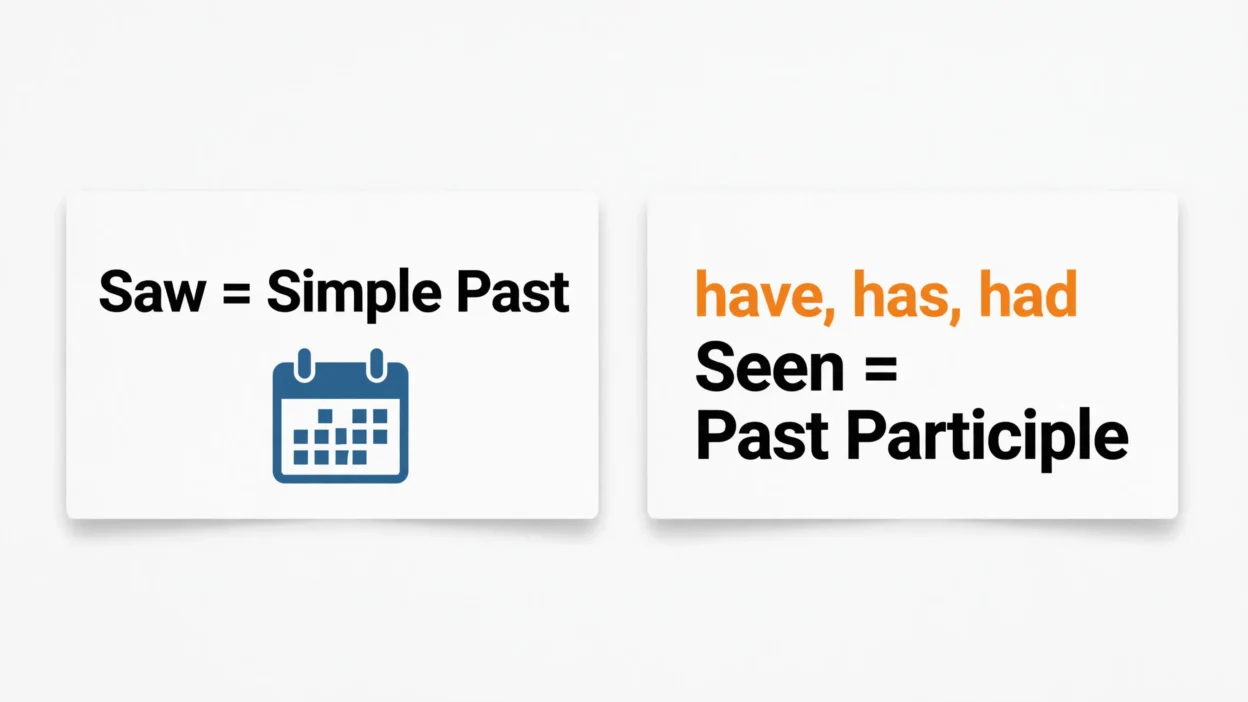
- Saw is the simple past tense of see and can be used by itself.
- Seen is the past participle of see and must be used with a helping verb such as have, has, had, is, was, or were.
Examples:
- ✅ I saw a rainbow yesterday.
- ✅ I have seen that movie before.
- ❌ I seen a rainbow yesterday.
- ❌ I have saw that movie before.
What Does “Saw” Mean?
Saw is the past tense of the verb see. It describes something that happened and was completed in the past.
Examples
- I saw my friend at the park.
- She saw a beautiful sunset.
- We saw dolphins during our vacation.
- They saw the accident from across the street.
In each sentence, the action happened in the past and does not need a helping verb.
When to Use Saw
Use saw when:
- Talking about a completed past action.
- There is no helping verb before it.
- The sentence refers to a specific time in the past.
LSI Keywords:
- past tense of see
- saw meaning
- simple past verb
- past action
- English grammar
What Does “Seen” Mean?
Seen is the past participle of see. It cannot stand alone as the main verb. It must always be used with a helping verb.
Examples
- I have seen this movie.
- She has seen the new restaurant.
- We had seen the forecast before leaving.
- The suspect was seen near the building.
Notice that every sentence includes a helping verb.
When to Use Seen
Choose seen when:
- Using the present perfect tense.
- Using the past perfect tense.
- Using the passive voice.
- A helping verb comes before it.
Related Keywords:
- past participle of see
- have seen
- has seen
- had seen
- English verb forms
Saw vs Seen: Comparison Table
| Feature | Saw | Seen |
|---|---|---|
| Verb Form | Simple past | Past participle |
| Can Stand Alone? | Yes | No |
| Needs a Helping Verb? | No | Yes |
| Common Helping Verbs | None | Have, Has, Had, Is, Was, Were |
| Example | I saw him yesterday. | I have seen him before. |
Easy Examples to Remember
Saw
- I saw a shooting star.
- She saw her teacher at the mall.
- They saw the fireworks.
- We saw an eagle flying overhead.
Seen
- I have seen that TV show.
- She has seen my message.
- They had seen the warning signs.
- The painting was seen by thousands of visitors.
Common Mistakes People Make
Many learners mix up these two verb forms.
Mistake 1
❌ I seen him yesterday.
✅ I saw him yesterday.
Since there is no helping verb, saw is correct.
Mistake 2
❌ I have saw that movie.
✅ I have seen that movie.
After have, always use seen.
Mistake 3
❌ She has saw the report.
✅ She has seen the report.
The present perfect tense always uses the past participle.
Mistake 4
❌ We seen the accident.
✅ We saw the accident.
Again, no helping verb means saw should be used.
Memory Trick
Here’s an easy way to remember the difference:
- Saw stands alone.
- Seen needs a helper.
If you see have, has, had, is, was, or were, you’ll usually need seen.
If there is no helping verb and you’re talking about the past, use saw.
Saw vs Seen in Everyday Writing
At School
- I saw the teacher this morning.
- I have seen this question before.
At Work
- We saw an increase in sales.
- The manager has seen your proposal.
At Home
- Mom saw the package arrive.
- Dad has seen the new furniture.
In Conversations
- Did you see the game?
- Yes, I saw it.
- I’ve seen every match this season.
American vs British English
There is no difference between American English and British English when using saw and seen.
Both varieties follow the same grammar rules:
- Saw is the simple past tense.
- Seen is the past participle used with helping verbs.
The usage remains identical in both forms of English.
Why Choosing the Right Word Matters
Using the correct verb form makes your communication clearer and more professional.
For example:
Incorrect:
I seen your email yesterday.
Correct:
I saw your email yesterday.
Or:
I have seen your email.
The correct choice depends on the sentence structure, not personal preference.
Related Words and Verb Forms
Understanding all forms of see makes the difference even easier.
| Verb Form | Word |
|---|---|
| Base Form | See |
| Present | See / Sees |
| Simple Past | Saw |
| Past Participle | Seen |
| Present Participle | Seeing |
Related Grammar Terms
- Irregular verbs
- Simple past tense
- Present perfect tense
- Past perfect tense
- Helping verbs
- Auxiliary verbs
Frequently Asked Questions
1. What is the difference between saw and seen?
Saw is the simple past tense, while seen is the past participle that requires a helping verb.
2. Can I say “I seen”?
Not in standard English. You should say I saw unless a helping verb comes before seen.
3. Is “have saw” correct?
No. The correct form is have seen.
4. Why does seen need a helping verb?
Because seen is a past participle, and past participles cannot function as the main verb by themselves.
5. Is “I have seen” correct?
Yes. This is the correct present perfect form.
6. Which is correct: “I saw him” or “I seen him”?
I saw him is correct because there is no helping verb.
7. Is “was seen” correct?
Yes. Was seen is correct because it uses seen in the passive voice with the helping verb was.
Summary
The difference between saw vs seen comes down to grammar. Saw is the simple past tense and works on its own to describe a completed action in the past. Seen, however, is the past participle and always needs a helping verb such as have, has, had, is, was, or were.
Whenever you’re unsure, first check whether your sentence contains a helping verb. If it does, seen is usually the correct choice. If you’re simply talking about something that happened in the past without a helping verb, use saw. Mastering this rule will make your English more accurate and natural.
Actionable Takeaway
Remember this simple rule: Saw stands alone, while seen needs a helper. Before choosing between the two, look for a helping verb in your sentence. With regular practice, using saw and seen correctly will become second nature.

Mike Poop is a dedicated writer at Symboliy.com, creating clear, practical content about language, communication, and everyday expressions to help readers understand meaning and usage confidently in professional contexts worldwide.