Confused about past vs passed? You’re not alone. These two words sound exactly the same, making them one of the most commonly confused pairs in English.
Whether you’re writing an email, an academic paper, or a social media post, using the wrong word can make your writing look less polished.
The good news is that the difference between past and passed is easy to understand once you know their meanings and how they function in a sentence.
In this guide, you’ll learn what each word means, see practical examples, avoid common mistakes, and discover simple memory tricks that will help you choose the correct word every time.
Quick Answer
The difference between past vs passed is simple:
- Past usually refers to time that has already happened or a position beyond something. It can be a noun, adjective, adverb, or preposition.
- The past cannot be changed.
- Walk past the library.
- Passed is the past tense and past participle of the verb “pass.” It means went by, moved beyond, succeeded, or completed.
- She passed the exam.
- The car passed us on the highway.
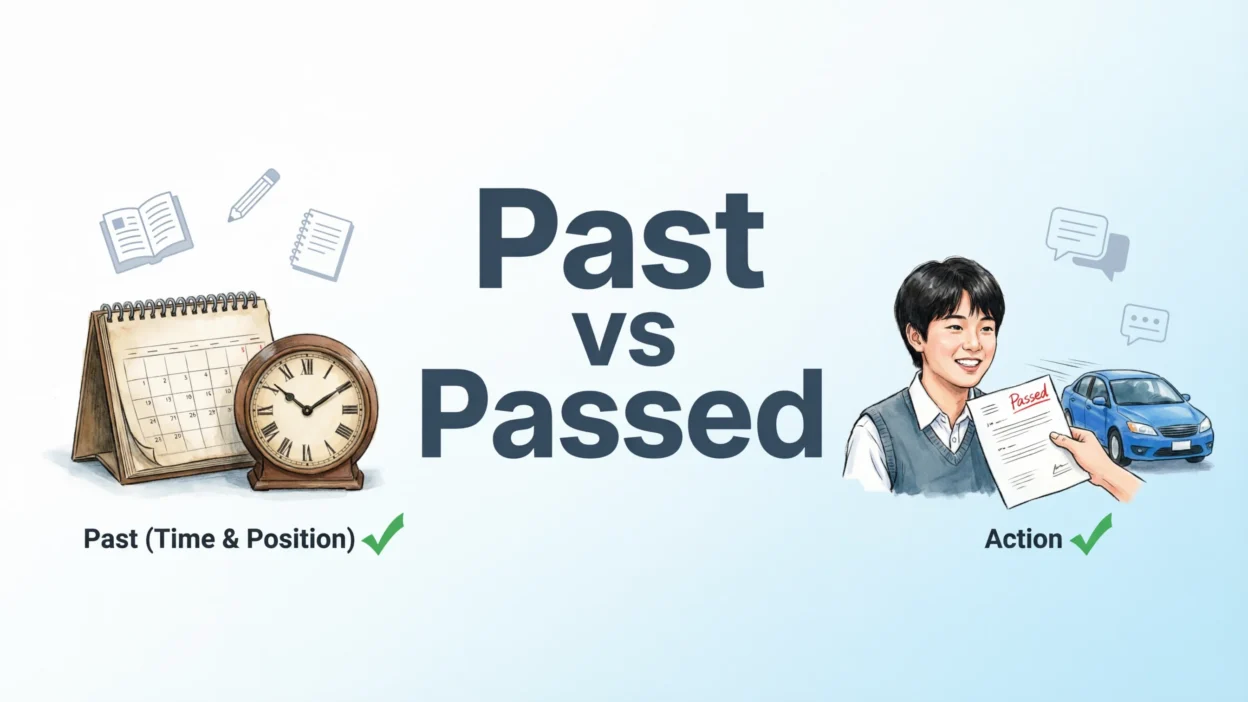
Easy rule: If you’re talking about an action, use passed. If you’re referring to time or location, use past.
What Does “Past” Mean?
Past refers to something that has already happened, existed before the present, or is beyond a particular point. Unlike passed, it is not a verb.
Depending on the sentence, past can function as a noun, adjective, adverb, or preposition.
Examples of “Past”
- We should learn from the past.
- That’s all in the past now.
- Drive past the school and turn left.
- The meeting lasted past midnight.
- Her past experiences made her stronger.
In each sentence, past refers to time or position rather than an action.
What Does “Passed” Mean?
Passed is the past tense of the verb pass. It describes an action that has already happened, such as moving by something, succeeding, handing something to someone, or the passage of time.
Examples of “Passed”
- She passed the driving test.
- He passed me the remote.
- The train passed the station quickly.
- Several years have passed since we met.
- Time passed faster than expected.
Notice that passed always describes an action.
Past vs Passed Comparison Table
| Feature | Past | Passed |
|---|---|---|
| Part of Speech | Noun, adjective, adverb, or preposition | Verb (past tense of “pass”) |
| Meaning | Earlier time or beyond a point | Moved by, completed, succeeded, handed over |
| Indicates | Time or position | Action |
| Example | We walked past the museum. | We passed the museum. |
| Easy Test | Not an action | Always an action |
Understanding the Difference with Simple Examples
These examples make the distinction clear.
- We walked past the bakery.
- We passed the bakery.
In the first sentence, past shows direction or position.
In the second sentence, passed describes the action of moving by the bakery.
Another example:
- Forget about the past.
- The years passed quickly.
The first refers to time, while the second describes an action.
Common Mistakes People Make
Because past and passed are homophones, they’re easy to confuse in writing.
Mistake 1
❌ She past the exam.
✅ She passed the exam.
Reason: Passing an exam is an action.
Mistake 2
❌ We drove passed the park.
✅ We drove past the park.
Reason: The sentence describes direction or location.
Mistake 3
❌ Many years past before we met again.
✅ Many years passed before we met again.
Reason: Time performed the action of passing.
Mistake 4
❌ Leave the past behind you has passed.
✅ Leave the past behind you.
Reason: Past refers to previous time, not an action.
Easy Memory Trick
A simple trick makes choosing the correct word much easier.
Look for an Action
Ask yourself:
Is something happening or being done?
- Yes → Use passed.
- No → Use past.
For example:
- He passed the ball.
- The ball rolled past the goal.
In the first sentence, passing is the action. In the second, past tells you where the ball went.
Real-Life Example Sentences
Using “Past”
- The past teaches valuable lessons.
- Walk past the supermarket.
- It’s already past bedtime.
- We talked about past events.
- The river flows past the village.
Using “Passed”
- She passed her final exams.
- He passed the salt across the table.
- The ambulance passed us quickly.
- Three weeks have passed already.
- The bill passed through Parliament.
Past vs Passed in Everyday Conversation
You’ll hear these words often in daily life.
Correct examples include:
- We drove past the stadium.
- She passed her interview.
- It’s half past seven.
- Time has passed so quickly.
- Leave the past where it belongs.
Whenever you’re unsure, decide whether the sentence describes an action or refers to time or location.
American vs British English
There is no grammatical difference between American English and British English when it comes to past and passed.
Both varieties of English follow the same rules:
- Past refers to previous time or movement beyond a point.
- Passed is the past tense of pass and describes an action.
One small vocabulary difference is that British English often uses expressions like “half past seven”, while American English more commonly says “seven-thirty.” However, the grammar of past and passed remains exactly the same.
Related Grammar Terms (LSI Keywords)
Understanding past vs passed becomes easier when you also know these related grammar topics:
- Passed or past
- Homophones in English
- Common grammar mistakes
- English verb forms
- Parts of speech
- English vocabulary
- Grammar rules
- Correct English usage
- Writing tips
- English punctuation
- Time expressions
- Movement and direction words
These related concepts help strengthen your grammar and improve your writing accuracy.
FAQs
1. What is the difference between past and passed?
Past refers to time or position, while passed is the past tense of the verb pass and describes an action.
2. Is it “walked past” or “walked passed”?
The correct phrase is walked past because past indicates movement beyond a place.
3. Is it “passed the exam” or “past the exam”?
The correct phrase is passed the exam because passing is an action.
4. Can “past” be used as a verb?
No. Past is never used as a verb in standard English.
5. Why are past and passed confusing?
They are pronounced the same but have different meanings and grammatical functions.
6. Do American and British English use these words differently?
No. Both follow the same grammar rules for past and passed.
7. How do I quickly remember the difference?
If the sentence contains an action, choose passed. If it refers to time or location, choose past.
8. Is “half past five” correct?
Yes. Half past five is a correct expression, especially in British English, meaning 5:30.
Summary
Understanding past vs passed becomes much easier once you remember their primary roles. Past refers to previous time or movement beyond a point, while passed is the past tense of pass and always describes an action. Although they sound identical, recognizing whether your sentence involves an action or simply refers to time or position will help you choose the correct word with confidence.
By practicing with everyday examples and applying a simple grammar check before you write, you’ll quickly avoid this common mistake. Whether you’re writing professionally, academically, or casually, using past and passed correctly improves clarity, accuracy, and overall writing quality.
Actionable Takeaway
Before using past or passed, ask yourself these quick questions:
- Is the sentence describing an action? → Use passed.
- Is it referring to time, direction, or location? → Use past.
- Replace the word with moved, completed, or handed. If it still makes sense, passed is likely correct.
- Proofread your writing to catch this common homophone error before publishing.

Mike Poop is a dedicated writer at Symboliy.com, creating clear, practical content about language, communication, and everyday expressions to help readers understand meaning and usage confidently in professional contexts worldwide.