If you’ve ever been unsure whether to write discrete vs discreet, you’re not alone. These two words are among the most commonly confused in English because they differ by just one letter and are pronounced almost the same.
However, their meanings are completely different, and using the wrong one can change the meaning of your sentence.
The good news is that distinguishing discrete from discreet is easier than it looks. Once you understand what each word means and when to use it, you’ll be able to write with greater confidence.
This guide explains their meanings, provides real-world examples, highlights common mistakes, and shares simple memory tricks to help you remember the difference.
Quick Answer
The difference between discrete vs discreet is simple:
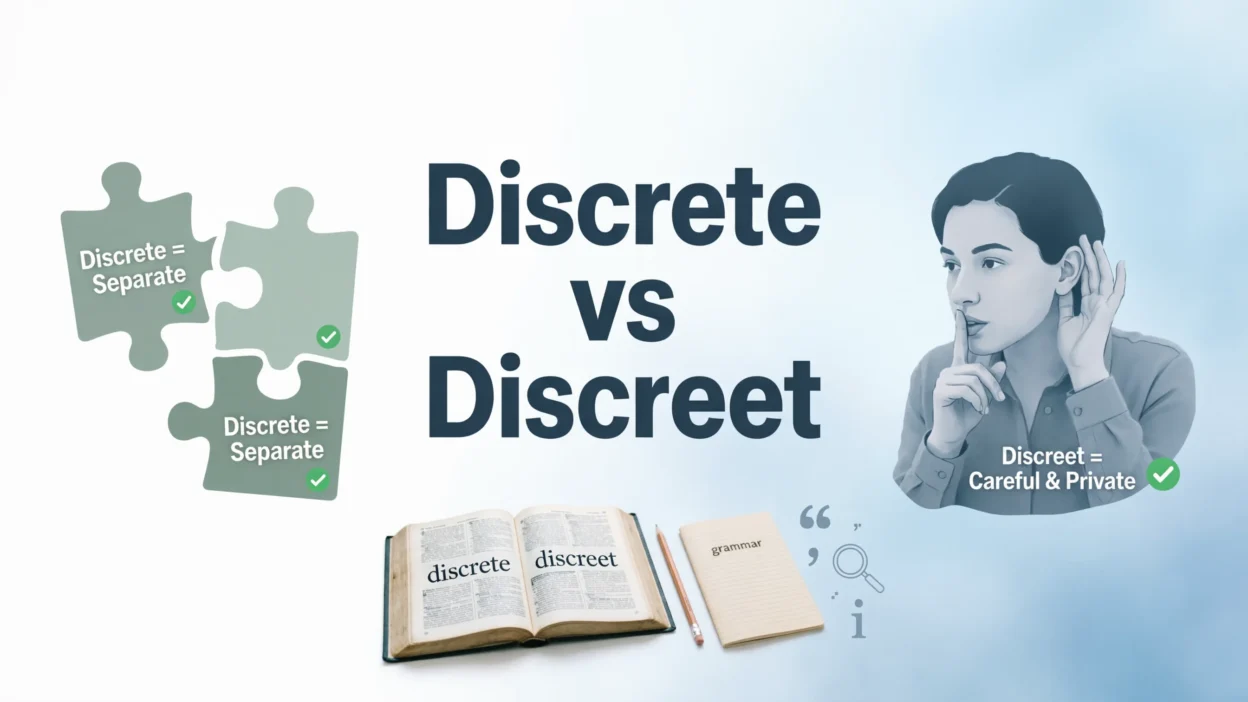
- Discrete means separate, distinct, or individually separate from other things.
- The report is divided into three discrete sections.
- Each task is treated as a discrete project.
- Discreet means careful, tactful, or intentionally avoiding attention or embarrassment.
- She was discreet about sharing the confidential information.
- Please be discreet when discussing the matter.
Easy rule: If you’re talking about separate things, use discrete. If you’re talking about being careful or private, use discreet.
What Does “Discrete” Mean?
Discrete describes something that is separate, distinct, or individually identifiable. It is commonly used in mathematics, science, technology, business, and everyday English when discussing items that are not connected or continuous.
Examples of “Discrete”
- The project consists of several discrete stages.
- Each department performs a discrete function.
- The data is divided into discrete categories.
- These are two discrete issues that require different solutions.
- The software treats every file as a discrete object.
In each sentence, discrete refers to things that are separate from one another.
What Does “Discreet” Mean?
Discreet describes someone who is careful, tactful, respectful of privacy, or avoids attracting unnecessary attention. It often refers to behavior, communication, or actions involving confidentiality and good judgment.
Examples of “Discreet”
- She was discreet during the private meeting.
- Please be discreet with sensitive information.
- The doctor handled the situation in a discreet manner.
- They arranged a discreet entrance for the celebrity.
- He gave me a discreet smile across the room.
Here, discreet relates to careful or private behavior.
Discrete vs Discreet Comparison Table
| Feature | Discrete | Discreet |
|---|---|---|
| Meaning | Separate or distinct | Careful, private, tactful |
| Part of Speech | Adjective | Adjective |
| Used For | Objects, categories, systems, ideas | People, behavior, communication |
| Easy Reminder | Separate | Secretive or careful |
| Example | The data is stored in discrete files. | She remained discreet about the news. |
Understanding the Difference with Simple Examples
These examples make the distinction easier to understand.
- The report contains discrete sections.
- She remained discreet during the investigation.
In the first sentence, the sections are separate.
In the second sentence, the person behaved carefully and respectfully.
Another example:
- Each apartment is a discrete unit.
- The receptionist was discreet with customer information.
One refers to separate units, while the other describes careful behavior.
Common Mistakes People Make
Since the words look and sound similar, they’re often confused in writing.
Mistake 1
❌ Please be discrete about this conversation.
✅ Please be discreet about this conversation.
Reason: The sentence refers to keeping information private.
Mistake 2
❌ The experiment has three discreet phases.
✅ The experiment has three discrete phases.
Reason: The phases are separate from one another.
Mistake 3
❌ He handled the situation in a discrete manner.
✅ He handled the situation in a discreet manner.
Reason: The sentence describes careful behavior.
Mistake 4
❌ The software uses discreet components.
✅ The software uses discrete components.
Reason: The components are separate parts.
Easy Memory Trick
A simple memory trick makes these words much easier to remember.
Look at the Letter “E”
Discrete contains the word “separate” in meaning.
Think:
Discrete = Distinct = Separate
Now notice Discreet ends with “eet.”
Think:
Discreet = Keep a Secret
Both discreet and secret relate to privacy and careful communication.
Real-Life Example Sentences
Using “Discrete”
- The university offers discrete courses in different subjects.
- Each chapter covers a discrete topic.
- Scientists studied several discrete populations.
- The presentation included discrete sections for each department.
- The machine consists of discrete components.
Using “Discreet”
- The lawyer remained discreet about the case.
- Our conversation should remain discreet.
- Hotel staff provide discreet service to guests.
- She made a discreet phone call.
- He asked a discreet question during the interview.
Discrete vs Discreet in Everyday Writing
These words appear in very different contexts.
You’ll commonly see discrete in:
- Mathematics
- Computer science
- Engineering
- Research
- Business reports
- Data analysis
You’ll commonly see discreet in:
- Professional communication
- Customer service
- Healthcare
- Legal writing
- Hospitality
- Personal conversations
Recognizing the context often helps you choose the correct spelling.
American vs British English
There is no difference between American English and British English in the use of discrete and discreet.
Both varieties of English use the words in exactly the same way:
- Discrete means separate or distinct.
- Discreet means careful, tactful, or private.
Whether you’re writing for readers in the United States, the United Kingdom, Canada, Australia, or elsewhere, the meanings and spellings remain identical.
Related Grammar Terms (LSI Keywords)
If you’re learning discrete vs discreet, these related grammar and vocabulary topics may also be helpful:
- Commonly confused words
- English homophones
- Similar English words
- Word choice
- Correct English usage
- English vocabulary
- Grammar mistakes
- Frequently confused words
- Business English
- Academic writing
- English language learning
- Writing tips
Learning these related concepts will improve your vocabulary and writing accuracy.
FAQs
1. What is the difference between discrete and discreet?
Discrete means separate or distinct, while discreet means careful, tactful, or respectful of privacy.
2. Is it “discrete” or “discreet” information?
If you mean confidential or private information, the correct word is discreet.
3. What does discrete mean in mathematics?
In mathematics, discrete refers to separate, distinct values rather than continuous ones.
4. Why do people confuse discrete and discreet?
They have similar spellings and nearly identical pronunciations but completely different meanings.
5. Can discrete describe a person?
Generally, no. Discrete describes separate things or categories, while discreet describes a person’s behavior.
6. Do American and British English use these words differently?
No. Both use discrete and discreet according to the same grammar and vocabulary rules.
7. How can I quickly remember the difference?
Remember: Discrete = Distinct = Separate. Discreet = Secret = Careful.
8. Which word should I use in professional writing?
Use discrete for separate items, systems, or categories, and discreet when referring to privacy, tact, or careful behavior.
Summary
Understanding discrete vs discreet is simple once you focus on their meanings. Discrete describes things that are separate, distinct, or independent, while discreet refers to careful, tactful, and private behavior. Although the words are almost identical in spelling and pronunciation, they are never interchangeable because they serve different purposes in English.
By learning a simple memory trick and practicing with everyday examples, you’ll quickly become confident in choosing the correct word. Whether you’re writing a business report, academic paper, email, or social media post, using discrete and discreet correctly improves clarity, professionalism, and credibility.
Actionable Takeaway
Before using discrete or discreet, ask yourself these quick questions:
- Are you talking about separate or distinct things? → Use discrete.
- Are you describing careful, private, or tactful behavior? → Use discreet.
- Remember: Discrete = Distinct, Discreet = Secret.
- Proofread your writing to catch this commonly confused word pair before publishing.

Here is a professional 30-word author biography including your site name Symboliy.com:
Martin Hood is a professional writer at Symboliy.com, creating clear, informative content focused on language, communication, and meaningful expressions for everyday and professional use.