If you’ve ever wondered whether to write deep-seeded vs deep-seated, you’re not alone. These two phrases sound almost identical, which is why they’re frequently confused in everyday writing and speech.
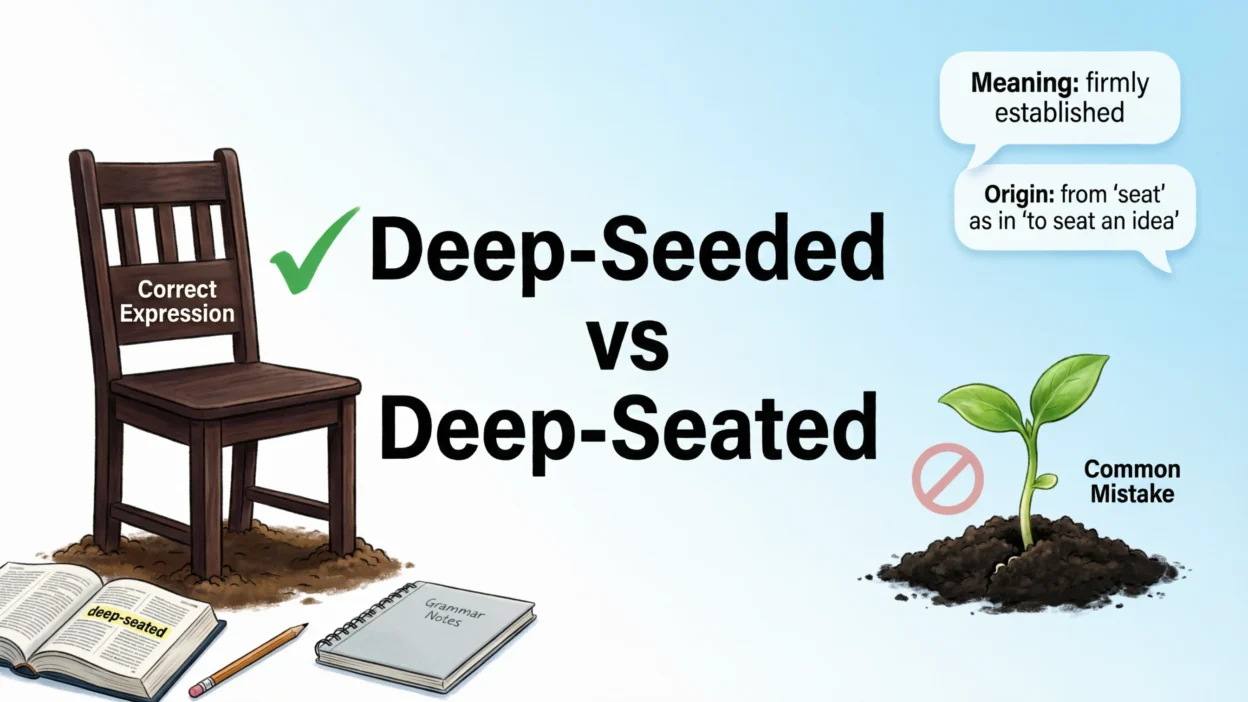
Many people mistakenly use deep-seeded, assuming it makes sense because of the word seed, but the correct expression is actually deep-seated.
In this guide, you’ll learn the difference between deep-seeded and deep-seated, understand why one is considered standard English, see practical examples, avoid common mistakes, and discover an easy trick to remember the correct phrase every time.
Quick Answer
The difference between deep-seeded vs deep-seated is straightforward:
- Deep-seated is the correct and standard English expression. It describes something that is firmly established, deeply rooted, or difficult to change.
- She has a deep-seated fear of heights.
- The conflict is caused by deep-seated political differences.
- Deep-seeded is generally considered an incorrect or mistaken version of deep-seated in modern English.
- ❌ He has a deep-seeded belief…
- ✅ He has a deep-seated belief…
Easy rule: If you mean firmly established or deeply ingrained, always use deep-seated.
What Does “Deep-Seated” Mean?
Deep-seated means something is firmly fixed, strongly established, or deeply ingrained. It often describes emotions, beliefs, habits, fears, prejudices, or problems that have existed for a long time and are not easy to change.
The phrase comes from the idea of something being firmly seated or fixed deep inside.
Examples of “Deep-Seated”
- She has a deep-seated fear of public speaking.
- Their disagreement comes from deep-seated political beliefs.
- The company faced deep-seated cultural issues.
- His deep-seated resentment affected their friendship.
- The therapist helped her address deep-seated anxiety.
In each example, the feeling or issue is firmly established.
What Does “Deep-Seeded” Mean?
In standard English, deep-seeded is not considered the correct expression when referring to firmly established beliefs or emotions.
Many people mistakenly replace seated with seeded because they associate ideas or emotions with seeds growing over time. While that interpretation seems logical, dictionaries and style guides recognize deep-seated as the accepted phrase.
Example
❌ She has a deep-seeded fear of failure.
✅ She has a deep-seated fear of failure.
Although deep-seeded occasionally appears in informal writing, editors generally treat it as an error.
Deep-Seeded vs Deep-Seated Comparison Table
| Feature | Deep-Seated | Deep-Seeded |
|---|---|---|
| Standard English | ✔ Yes | ✘ No (usually considered incorrect) |
| Meaning | Firmly established or ingrained | Common mistaken version |
| Common Usage | Formal and informal writing | Informal error or misspelling |
| Recommended in Professional Writing | ✔ Yes | ✘ No |
| Example | Deep-seated beliefs | Deep-seeded beliefs ❌ |
Why Do People Say “Deep-Seeded”?
The confusion happens because seeded sounds meaningful. People naturally connect the word seed with ideas, beliefs, or emotions that grow over time.
For example:
- A seed grows into a tree.
- An idea grows over time.
Because of this mental connection, many speakers accidentally say deep-seeded instead of deep-seated.
However, the accepted English idiom has always been deep-seated, meaning something firmly fixed beneath the surface.
Common Mistakes People Make
Since the phrases are pronounced similarly, writers often substitute the wrong one.
Mistake 1
❌ He has a deep-seeded distrust of strangers.
✅ He has a deep-seated distrust of strangers.
Mistake 2
❌ The country faces deep-seeded economic problems.
✅ The country faces deep-seated economic problems.
Mistake 3
❌ Her deep-seeded habits are difficult to change.
✅ Her deep-seated habits are difficult to change.
Mistake 4
❌ They discussed deep-seeded social issues.
✅ They discussed deep-seated social issues.
In all these cases, deep-seated is the correct phrase.
Easy Memory Trick
A simple trick makes this phrase easy to remember.
Think “Firmly Seated”
Imagine a chair firmly attached to the floor.
Something that is deep-seated is firmly seated in place and difficult to remove.
Avoid thinking about planting seeds. Although it sounds logical, deep-seeded is not the standard expression.
Real-Life Example Sentences
Using “Deep-Seated”
- She has a deep-seated passion for helping others.
- His deep-seated fear prevented him from flying.
- The debate revealed deep-seated differences between the two groups.
- Deep-seated traditions continue to shape the community.
- They worked to overcome deep-seated prejudice.
Incorrect Use of “Deep-Seeded”
- ❌ A deep-seeded belief influenced his decisions.
- ❌ Their deep-seeded conflict lasted for years.
- ❌ She struggled with deep-seeded anxiety.
These should all use deep-seated instead.
Deep-Seated in Everyday Writing
You’ll often encounter deep-seated in news articles, books, academic writing, and professional communication.
Common expressions include:
- Deep-seated fear
- Deep-seated resentment
- Deep-seated beliefs
- Deep-seated prejudice
- Deep-seated mistrust
- Deep-seated problems
- Deep-seated emotions
- Deep-seated cultural differences
These collocations are widely accepted and commonly used by professional writers.
American vs British English
There is no difference between American English and British English regarding deep-seated.
Both varieties of English recognize:
- Deep-seated as the correct idiomatic expression.
- Deep-seeded as a common mistake or nonstandard variation.
Whether you’re writing for readers in the United States, the United Kingdom, Canada, Australia, or elsewhere, deep-seated is the preferred form.
Related Grammar Terms (LSI Keywords)
If you’re learning deep-seeded vs deep-seated, these related terms may also be helpful:
- Commonly confused words
- English idioms
- Correct English phrases
- Deep-rooted meaning
- Frequently misused expressions
- English vocabulary
- Grammar mistakes
- Idiomatic expressions
- Word choice
- Proper English usage
- Writing tips
- English language learning
Understanding these related topics will improve your vocabulary and writing accuracy.
FAQs
1. Which is correct: deep-seated or deep-seeded?
Deep-seated is the correct and standard English expression.
2. Is deep-seeded ever correct?
In modern standard English, deep-seeded is generally considered an error when referring to firmly established beliefs, emotions, or problems.
3. Why do people say deep-seeded?
People often associate ideas and emotions with seeds growing over time, leading them to mistakenly replace seated with seeded.
4. What does deep-seated mean?
It means firmly established, deeply ingrained, or difficult to change.
5. Can I use deep-seeded in formal writing?
No. Professional writing, academic papers, and style guides recommend using deep-seated.
6. Do American and British English use different versions?
No. Both American and British English use deep-seated as the standard expression.
7. Is deep-seated an idiom?
Yes. Deep-seated is an established English idiomatic expression used to describe deeply ingrained feelings, beliefs, or problems.
8. How can I remember the correct phrase?
Think of something being firmly seated in place. If it’s difficult to remove or change, it’s deep-seated, not deep-seeded.
Summary
Understanding deep-seeded vs deep-seated is simple once you know that deep-seated is the correct and widely accepted English expression. It describes beliefs, emotions, traditions, fears, or problems that are firmly established and difficult to change. Although deep-seeded may sound logical because of its connection to seeds and growth, it is considered a common mistake in standard English.
Whether you’re writing a professional report, an academic essay, or everyday content, choosing deep-seated demonstrates strong language skills and helps your writing appear more polished. Remember that dictionaries, editors, and style guides consistently recommend deep-seated, making it the safest and most accurate choice.
Actionable Takeaway
Before using this phrase, ask yourself these quick questions:
- Are you describing something firmly established or deeply ingrained? → Use deep-seated.
- Avoid writing deep-seeded in professional or academic work.
- Remember the phrase “firmly seated” to reinforce the correct form.
- Proofread your writing to catch this commonly confused expression before publishing.

Shan Waston is a skilled writer at Symboliy.com, producing clear, engaging content on language, communication, and everyday expressions to help readers understand meaning and usage confidently in modern digital contexts.