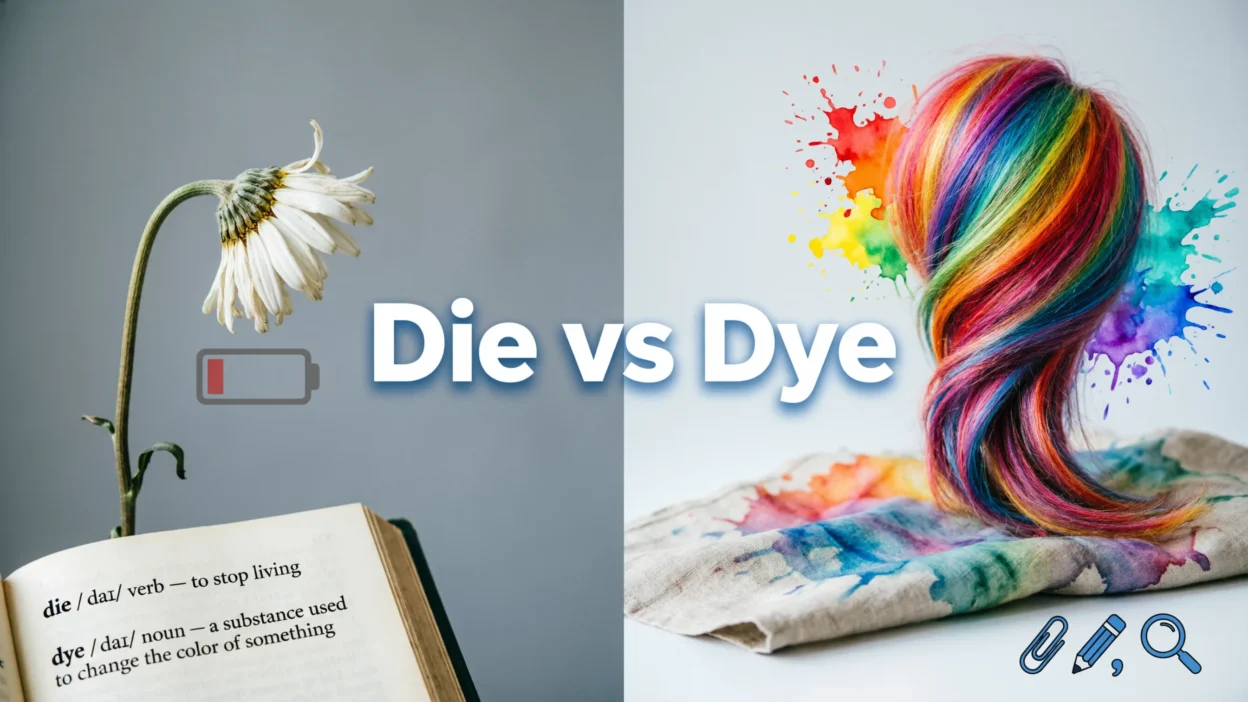
The words die and dye are among the most commonly confused words in English. They sound exactly alike, making them perfect examples of homophones—words with the same pronunciation but different meanings and spellings.
Although they differ by just one letter, using the wrong one can completely change the meaning of your sentence.
In this guide, you’ll learn the difference between die vs dye, their meanings, correct usage, practical examples, common mistakes to avoid, and simple tips to remember which word to use.
Whether you’re writing an essay, an email, or a social media post, you’ll be able to choose the correct word with confidence.
Quick Answer
The difference between die and dye is simple:
- Die is a verb that means to stop living or to cease functioning.
- Dye can be a verb meaning to change the color of something or a noun referring to the coloring substance itself.
- Although they are pronounced the same, they have completely different meanings and should never be used interchangeably.
What Do “Die” and “Dye” Mean?
While die and dye sound identical, they describe entirely different actions.
Die means to stop living, to come to an end, or for something to stop working.
Examples:
- Plants die without water.
- My phone suddenly died.
- Many traditions never die.
Dye means to color or stain something using a coloring substance. It can also refer to the coloring material itself.
Examples:
- She wants to dye her hair brown.
- They dyed the fabric blue.
- This natural dye is made from plants.
Understanding this distinction is essential because the wrong spelling can dramatically alter the meaning of a sentence.
Die vs Dye: The Main Difference
| Feature | Die | Dye |
|---|---|---|
| Part of Speech | Verb (also noun in manufacturing) | Verb and Noun |
| Main Meaning | To stop living or stop functioning | To color something |
| Pronunciation | /daɪ/ | /daɪ/ |
| Common Contexts | Life, death, machines, batteries | Hair, clothing, fabric, crafts |
| Interchangeable? | No | No |
The pronunciation is identical, but the meanings are completely unrelated.
When to Use “Die”
Use die whenever you’re talking about death, the end of life, or something stopping completely.
Examples:
- Flowers die without sunlight.
- His laptop died during the presentation.
- Old traditions sometimes die over time.
- The battery died after several hours.
- Fish can die if the water becomes polluted.
In addition to living things, die is often used for machines, batteries, phones, engines, and electronic devices that stop working.
When to Use “Dye”
Use dye when referring to changing the color of something.
Examples:
- She decided to dye her hair black.
- They dyed the curtains green.
- We used natural dye to color the fabric.
- He wants to dye his beard.
- The artist dyed the cloth using plant-based colors.
As a noun:
- This blue dye is environmentally friendly.
- The fabric absorbed the dye evenly.
Examples of Die vs Dye in Sentences
Here are side-by-side examples showing the difference.
| Die | Dye |
|---|---|
| The flowers will die without water. | She wants to dye her hair blonde. |
| My phone died overnight. | They dyed the shirt red. |
| Batteries eventually die. | This dye works well on cotton. |
| Some traditions never die. | He learned how to dye leather. |
| The engine suddenly died. | The scarf was dyed by hand. |
Notice how one relates to life or function, while the other relates to color.
Can “Die” and “Dye” Ever Be Interchangeable?
No.
Although they are pronounced exactly the same, die and dye have completely different meanings and grammatical uses.
For example:
Incorrect:
- I want to die my hair.
Correct:
- I want to dye my hair.
Another example:
Incorrect:
- My phone dyed yesterday.
Correct:
- My phone died yesterday.
Using the wrong spelling can completely change—or even confuse—the intended meaning.
American vs British English
Unlike some English word pairs, die and dye have the same spelling, meaning, and usage in both American and British English.
Whether you’re writing for readers in the United States, the United Kingdom, Canada, Australia, or elsewhere, the rules remain exactly the same.
- Die always refers to death or something stopping.
- Dye always refers to coloring.
There are no regional spelling differences between these words.
Common Mistakes to Avoid
Because die and dye sound identical, they’re easy to confuse when writing.
Using “die” when talking about coloring
Incorrect:
- I’m going to die my hair tomorrow.
Correct:
- I’m going to dye my hair tomorrow.
Using “dye” for something stopping
Incorrect:
- My computer dyed during the meeting.
Correct:
- My computer died during the meeting.
Forgetting They Are Homophones
Remember that hearing the word isn’t enough to determine the correct spelling. Always consider the meaning of the sentence.
Easy Memory Trick
Here’s a simple way to remember the difference.
- Dye contains the letter “Y”, which you can associate with “Your hair” or “Yellow,” both related to color.
- Die does not contain a Y and refers to life ending or something stopping.
This small memory trick helps many learners choose the correct spelling instantly.
Related Homophones You Should Know
If you’re learning commonly confused English words, you may also find these helpful:
- To vs Too vs Two
- There vs Their vs They’re
- Break vs Brake
- Hear vs Here
- Weather vs Whether
- Principal vs Principle
- Complement vs Compliment
Learning these word pairs improves both your writing accuracy and your confidence.
FAQs
What is the difference between die and dye?
Die means to stop living or stop functioning, while dye means to color something or refers to the coloring substance.
Are die and dye pronounced the same?
Yes. They are homophones and are pronounced exactly the same.
Is “dye” a noun or a verb?
Both. Dye can be a verb meaning to color something and a noun referring to the coloring material.
Can I say “my phone dyed”?
No. The correct sentence is “My phone died.”
Is “die your hair” correct?
No. The correct phrase is “dye your hair.”
Do American and British English use these words differently?
No. Both varieties of English use die and dye in the same way.
Why are die and dye confusing?
They are confusing because they sound identical but have different spellings, meanings, and uses.
Summary
Understanding die vs dye is straightforward once you focus on their meanings. Die refers to death or something stopping, such as a person, plant, battery, or machine. Dye, on the other hand, refers to adding color to hair, fabric, clothing, or other materials, or to the coloring substance itself.
A simple way to avoid mistakes is to think about the context. If the sentence is about life ending or something no longer working, choose die. If it’s about changing color, choose dye. Keeping this distinction in mind will help you write more accurately and confidently.
Actionable Takeaway: Before writing die or dye, ask yourself whether you’re talking about stopping or coloring. That quick check will help you choose the correct word every time.

Shan Waston is a skilled writer at Symboliy.com, producing clear, engaging content on language, communication, and everyday expressions to help readers understand meaning and usage confidently in modern digital contexts.