Have you ever paused while writing and wondered whether dreamed or dreamt is the correct word?
You’re not alone. Many English learners, students, writers, and even native speakers often hesitate when choosing between these two forms.
The good news is that both are correct—but the best choice depends on your audience and the type of English you’re using.
In this guide, you’ll learn the difference between dreamed vs dreamt, when to use each one, examples in real sentences, common mistakes to avoid, and whether American or British English prefers one over the other. By the end, you’ll confidently know which form fits your writing.
Quick Answer
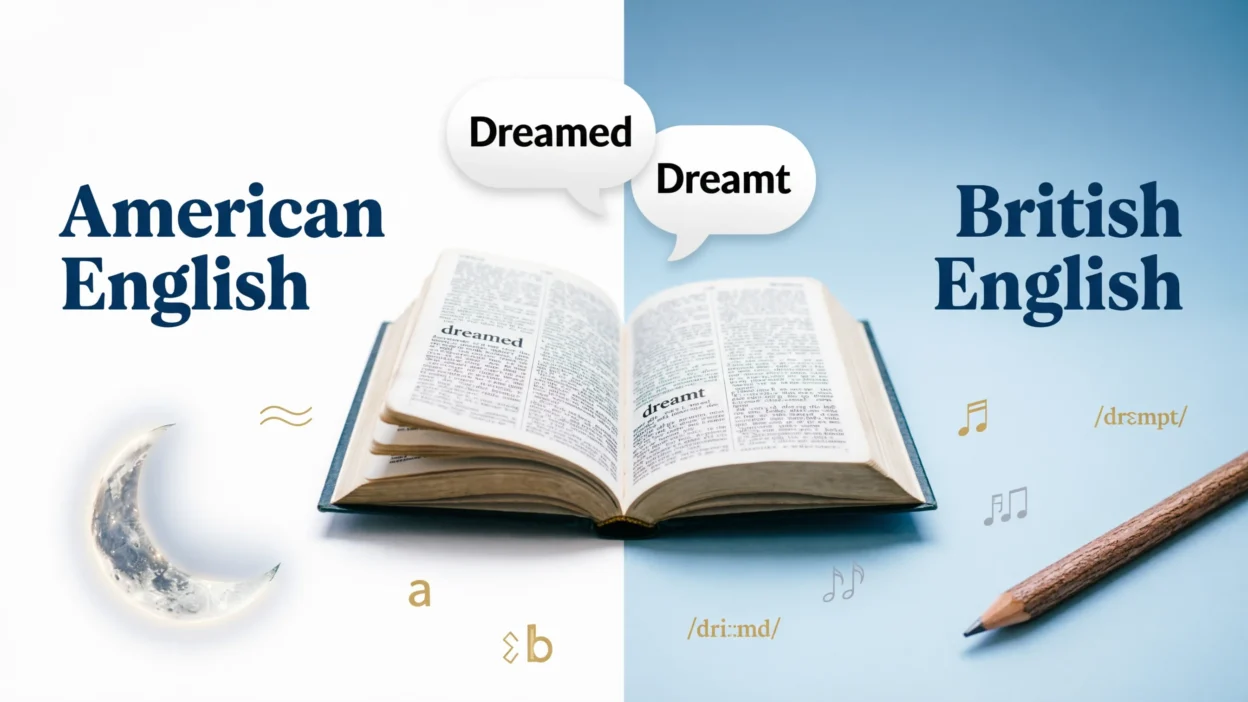
Both dreamed and dreamt are correct past tense and past participle forms of the verb dream.
- Dreamed is more common in American English.
- Dreamt is more common in British English.
- Both words have the same meaning and are grammatically correct.
- Choose the form that matches your audience and remain consistent throughout your writing.
What Does “Dreamed” and “Dreamt” Mean?
The words dreamed and dreamt both refer to the past tense or past participle of the verb dream. They describe experiencing dreams while sleeping or imagining, hoping, or wishing for something.
For example:
- I dreamed about visiting Japan last night.
- She dreamt of becoming a famous artist.
In both examples, the meaning remains exactly the same. The only difference is the preferred regional spelling.
Dreamed vs Dreamt: The Main Difference
The difference between dreamed vs dreamt is not about meaning or grammar. It is simply a matter of language preference.
| Feature | Dreamed | Dreamt |
|---|---|---|
| Meaning | Past tense of “dream” | Past tense of “dream” |
| American English | Preferred | Less common |
| British English | Correct but less common | Preferred |
| Formal Writing | Very common | Common in UK publications |
| Pronunciation | DREEMD | DREMT |
If you’re writing for an American audience, dreamed usually sounds more natural. If you’re writing for readers in the UK, Australia, or New Zealand, dreamt often feels more familiar.
Is Dreamed or Dreamt Grammatically Correct?
Yes. Both words are grammatically correct.
English contains several verbs that have both regular and irregular past tense forms.
Examples include:
- Learned / Learnt
- Burned / Burnt
- Spoiled / Spoilt
- Dreamed / Dreamt
Over time, American English has generally favored the regular -ed endings, while British English has preserved many of the traditional -t endings.
American English vs British English
Understanding regional differences helps you choose the right word for your audience.
American English
In the United States, dreamed is the standard choice.
Examples:
- I dreamed about my childhood.
- She dreamed of starting her own company.
- They dreamed of traveling around the world.
Most American books, newspapers, universities, and style guides prefer dreamed.
British English
In British English, dreamt is commonly used, although dreamed is also accepted.
Examples:
- I dreamt about my grandparents.
- He dreamt of becoming a pilot.
- We dreamt of a peaceful future.
British novels and newspapers often use dreamt, giving it a slightly more traditional feel.
Examples of Dreamed vs Dreamt in Sentences
Here are practical examples showing that both words work perfectly.
Using Dreamed
- Last night, I dreamed about flying over the mountains.
- She dreamed of opening her own café.
- We dreamed that everything would work out.
- He dreamed about winning the championship.
- I have always dreamed of writing a novel.
Using Dreamt
- Last night, I dreamt about my old school.
- She dreamt of living near the sea.
- They dreamt of a better future.
- He dreamt about meeting his favorite actor.
- I had dreamt of this moment for years.
Notice that changing dreamed to dreamt does not change the meaning of any sentence.
When Should You Use Dreamed?
Choose dreamed if:
- You are writing for an American audience.
- Your content follows American spelling rules.
- Your school, workplace, or publication uses US English.
- You want the more commonly used international form.
This makes dreamed an excellent choice for most online content targeting readers in the United States.
When Should You Use Dreamt?
Choose dreamt if:
- Your audience is primarily British.
- You follow UK spelling conventions.
- You’re writing for British publishers or educational institutions.
- You want a slightly traditional or literary tone.
For British readers, dreamt often feels completely natural.
Common Mistakes to Avoid
Even though both forms are correct, writers sometimes make avoidable mistakes.
Mixing American and British English
Incorrect:
- I dreamed about London yesterday, and later I dreamt about Paris.
Correct:
- I dreamed about London yesterday, and later I dreamed about Paris.
OR
- I dreamt about London yesterday, and later I dreamt about Paris.
Consistency improves readability.
Thinking One Form Is Wrong
Many learners mistakenly believe dreamt is incorrect.
It is not.
Likewise, dreamed is also fully correct.
Using the Wrong Style Guide
If you’re writing academic papers or professional documents, always follow your required style guide and keep your spelling consistent throughout the document.
Why Does English Have Both Forms?
English has evolved through centuries of language change.
Many older English verbs originally ended with -t in their past tense. As English became more standardized, especially in North America, regular -ed endings became increasingly common.
Today, both forms survive because English continues to preserve historical variations alongside modern usage.
Similar Word Pairs
If you’re learning English grammar, you’ll likely encounter other words with similar regional differences.
Examples include:
- Learned vs Learnt
- Burned vs Burnt
- Spoiled vs Spoilt
- Smelled vs Smelt
- Spelled vs Spelt
These pairs follow a similar pattern:
- American English generally prefers -ed.
- British English often accepts or prefers -t.
Tips for Choosing the Right Form
If you’re unsure which version to use, these tips can help.
- Know your target audience.
- Follow either American or British English consistently.
- Don’t switch spellings within the same article.
- Remember that both forms are grammatically correct.
- Use the style preferred by your employer, school, or publisher.
Consistency is more important than choosing one form over the other.
FAQs
Is dreamed or dreamt correct?
Both are correct. Dreamed is more common in American English, while dreamt is preferred more often in British English.
Is dreamt old-fashioned?
Not at all. Although dreamt has a more traditional feel, it remains widely used in British English today.
Which word should I use in the United States?
Use dreamed, as it is the standard form in American English.
Which form is more common in the United Kingdom?
Dreamt is generally more common in British English, though dreamed is also accepted.
Do dreamed and dreamt have different meanings?
No. Both words have exactly the same meaning. They simply represent different regional preferences.
Can I use dreamt in American writing?
Yes, you can. However, dreamed will usually sound more natural to American readers.
Is dreamed more modern than dreamt?
Many people consider dreamed to be the more modern and regular form, especially in American English. However, dreamt remains perfectly correct and actively used.
Summary
Understanding dreamed vs dreamt is much simpler than it first appears. Both are correct past tense forms of the verb dream, and neither changes the meaning of your sentence. The primary distinction lies in regional usage: dreamed is the preferred form in American English, while dreamt is more commonly used in British English.
The best approach is to choose the version that matches your audience and use it consistently throughout your writing. Whether you’re preparing academic work, publishing blog content, or improving your English skills, maintaining a consistent style helps your writing appear polished, professional, and easy to read.
Actionable Takeaway: If you’re writing for American readers, use dreamed. If your audience is British, dreamt is often the better choice. Whichever form you select, stay consistent from beginning to end for clear and natural communication.

Here is a professional 30-word author biography including your site name Symboliy.com:
Martin Hood is a professional writer at Symboliy.com, creating clear, informative content focused on language, communication, and meaningful expressions for everyday and professional use.