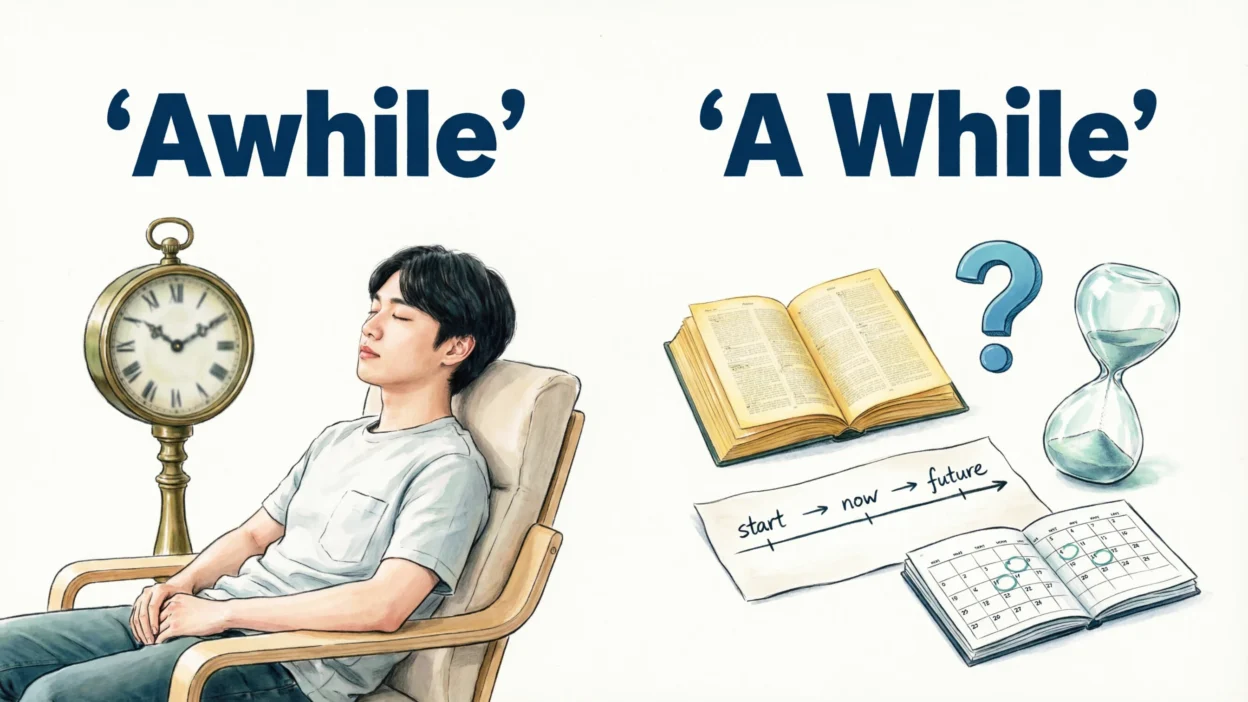
The words awhile and a while often confuse English learners because they look almost identical and relate to time.
Many people use them interchangeably, but they actually have different grammatical roles. Knowing when to write awhile as one word or a while as two words will make your writing more accurate and natural.
In this guide, you’ll learn the difference between awhile vs a while, their meanings, when to use each one, practical examples, common mistakes to avoid, and easy memory tricks. By the end, you’ll know exactly which form belongs in every sentence.
Quick Answer
The difference between awhile and a while is grammatical.
- Awhile is an adverb that means for a short time.
- A while is a noun phrase meaning a period of time.
- Use awhile when no preposition comes before it.
- Use a while after prepositions such as for, after, in, before, and quite.
What Do “Awhile” and “A While” Mean?
Although both expressions refer to time, they function differently in a sentence.
Awhile is an adverb that means for a short period.
Examples:
- Stay awhile.
- Sit awhile and relax.
A while is a noun phrase referring to a length of time.
Examples:
- Stay for a while.
- It has been a while since we met.
The meaning is similar, but the grammar determines which form you should choose.
Awhile vs A While: The Main Difference
| Feature | Awhile | A While |
|---|---|---|
| Word Type | Adverb | Noun Phrase |
| Meaning | For a short time | A period of time |
| Usually Follows | Verbs directly | Prepositions like for, after, in, before |
| Example | Wait awhile. | Wait for a while. |
| Interchangeable? | Not always | Not always |
The easiest way to tell them apart is to identify whether the sentence needs an adverb or a noun phrase.
When to Use “Awhile”
Use awhile when it directly modifies a verb and means for a short time.
Examples:
- Please stay awhile.
- Sit awhile before leaving.
- Rest awhile after your workout.
- Let’s chat awhile.
- The children played awhile before dinner.
Notice that no preposition comes before awhile.
When to Use “A While”
Use a while whenever you need a noun phrase, especially after a preposition.
Examples:
- Wait for a while.
- We talked for a while.
- It has been a while since I visited.
- After a while, everyone relaxed.
- In a while, we’ll start the meeting.
In these sentences, a while acts as the object of a preposition or functions as a noun phrase.
Easy Memory Trick
A simple trick can help you remember the difference.
If the sentence includes a preposition like:
- for
- after
- before
- in
use a while.
Examples:
- Wait for a while.
- After a while, it stopped raining.
- In a while, we’ll leave.
If there is no preposition and the word simply modifies the verb, use awhile.
Example:
- Stay awhile.
This rule works in the vast majority of situations.
Examples of Awhile vs A While
Here are side-by-side examples.
| Awhile | A While |
|---|---|
| Stay awhile. | Stay for a while. |
| Sit awhile. | It has been a while. |
| Rest awhile before driving. | After a while, we left. |
| Wait awhile. | We talked for a while. |
| Relax awhile. | I’ll see you in a while. |
Notice how a while usually follows a preposition, while awhile stands on its own.
Can “Awhile” and “A While” Ever Mean the Same Thing?
In some situations, both expressions communicate nearly the same idea, but the sentence structure changes.
For example:
- Stay awhile.
- Stay for a while.
Both sentences mean that someone should remain for a short period. However, the first uses an adverb, while the second uses a prepositional phrase with a noun.
Because of this grammatical difference, they cannot always replace one another.
American vs British English
There is no significant difference between American and British English in the use of awhile and a while.
Both varieties follow the same grammatical rules.
Whether you’re writing in American or British English:
- Use awhile as an adverb.
- Use a while as a noun phrase.
The choice depends on grammar rather than regional preference.
Common Mistakes to Avoid
These expressions are frequently confused because they have similar meanings.
Using “awhile” after a preposition
Incorrect:
- Wait for awhile.
Correct:
- Wait for a while.
Using “a while” without a needed preposition
Less natural:
- Stay a while.
Better:
- Stay awhile.
or
- Stay for a while.
Assuming They Are Always Interchangeable
Although some sentences allow both forms with slight restructuring, they are not interchangeable word for word. Always check whether your sentence requires an adverb or a noun phrase.
Tips for Using Awhile and A While Correctly
Keep these tips in mind:
- Use awhile after a verb without a preposition.
- Use a while after prepositions like for, after, before, and in.
- Identify whether the sentence needs an adverb or a noun phrase.
- Read the sentence aloud to check whether it sounds natural.
- If you’re unsure, look for the word for. If it’s there, you’ll almost always need a while.
Related Grammar Topics
If you’re learning commonly confused English words, you may also enjoy these grammar guides:
- Everyday vs Every Day
- Onto vs On To
- Into vs In To
- Apart vs A Part
- Maybe vs May Be
- Sometime vs Some Time
- Anytime vs Any Time
Mastering these pairs will make your English more polished and professional.
FAQs
What is the difference between awhile and a while?
Awhile is an adverb meaning for a short time, while a while is a noun phrase meaning a period of time.
Is “wait awhile” correct?
Yes. Wait awhile is grammatically correct because awhile modifies the verb wait.
Is “wait for awhile” correct?
No. The preferred form is wait for a while because for requires the noun phrase a while.
Can I say “it’s been awhile”?
In formal grammar, It’s been a while is preferred because a while functions as a noun phrase after been.
Do American and British English use these words differently?
No. Both follow the same grammatical distinction between awhile and a while.
Which is more common in everyday writing?
A while is generally more common because it appears in many everyday expressions like for a while, after a while, and it’s been a while.
How can I remember the difference?
If there’s a preposition such as for or after, use a while. Otherwise, awhile is often the correct choice.
Summary
Understanding awhile vs a while is mainly a matter of grammar. Awhile is an adverb that means for a short time and is used directly after a verb. A while is a noun phrase meaning a period of time, commonly used after prepositions like for, after, before, and in.
The easiest way to choose the correct form is to look for a preposition. If one appears before the expression, use a while. If the word directly modifies the verb without a preposition, use awhile. Following this simple rule will help you write with greater accuracy and confidence.
Actionable Takeaway: Before writing awhile or a while, check whether a preposition comes before the phrase. If it does, choose a while. If not, awhile is usually the correct option.

Here is a professional 30-word author biography including your site name Symboliy.com:
Martin Hood is a professional writer at Symboliy.com, creating clear, informative content focused on language, communication, and meaningful expressions for everyday and professional use.