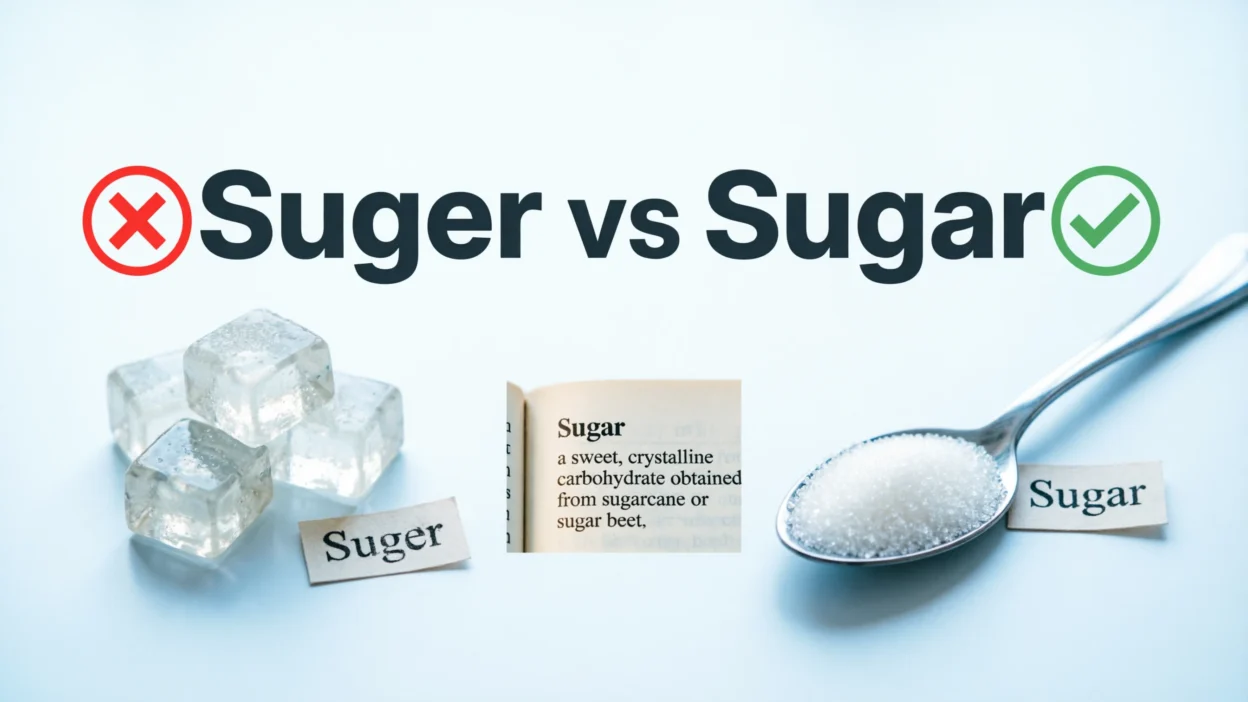
Have you ever typed suger instead of sugar and wondered whether both spellings are correct? You’re not alone.
This is one of the most common spelling mistakes in English because the pronunciation of the word doesn’t clearly match its spelling. As a result, many writers, students, and English learners often confuse suger vs sugar.
Understanding the difference is important for clear communication, professional writing, and improving your English skills.
In this guide, you’ll learn the meaning of each term, discover why the confusion happens, see practical examples, avoid common mistakes, and find out which spelling is correct in American and British English.
Quick Answer
Sugar is the correct spelling in both American and British English. Suger is a misspelling and is not recognized as a standard English word. Whenever you’re referring to the sweet substance used in food and drinks, you should always write sugar.
What Does “Sugar” Mean?
Sugar is a sweet-tasting substance commonly used in cooking, baking, and beverages. It occurs naturally in fruits, vegetables, and milk, and it can also be refined from sources such as sugarcane and sugar beets.
The word is often used both literally and figuratively. Besides referring to the food ingredient, it can also serve as a term of affection.
Examples
- I like a little sugar in my coffee.
- The recipe calls for two cups of sugar.
- Good morning, sugar. How are you today?
- Excess sugar consumption may affect health.
- She baked a cake using brown sugar.
What Does “Suger” Mean?
Suger is generally considered a spelling mistake of sugar. It does not have a recognized meaning in modern standard English.
People usually write suger because they spell the word based on how they think it sounds rather than memorizing its correct spelling.
Examples of Incorrect Usage
- Please pass the suger. ❌
- I need more suger in my tea. ❌
- The cake contains too much suger. ❌
Correct Versions
- Please pass the sugar. ✔️
- I need more sugar in my tea. ✔️
- The cake contains too much sugar. ✔️
Suger vs Sugar: Key Differences
Although these words look similar, only one is correct.
| Feature | Suger | Sugar |
|---|---|---|
| Correct English Word | No | Yes |
| Dictionary Recognition | No | Yes |
| Meaning | None in standard English | Sweet food substance |
| Accepted in Writing | No | Yes |
| Used in Schools and Publications | No | Yes |
| Spelling Status | Misspelling | Correct spelling |
The simple answer is that sugar is always correct, while suger should be avoided.
Which Spelling Is Correct?
The correct spelling is sugar.
This spelling has been used in English for centuries and appears in dictionaries, textbooks, recipes, scientific publications, and everyday communication.
Use “Sugar” When:
- Writing recipes
- Discussing nutrition
- Talking about food and beverages
- Referring to sweeteners
- Using it as a nickname or term of affection
Avoid “Suger” Because:
- It is a spelling error.
- It may reduce credibility in writing.
- Spell-checkers often flag it as incorrect.
- It is not recognized in standard English.
Why Do People Confuse Suger and Sugar?
Several factors contribute to this common spelling mistake.
Pronunciation Confusion
The word sugar is pronounced roughly as:
SHUG-er
Many learners assume the word should contain an “e” because of how it sounds.
English Spelling Rules
English spelling often differs from pronunciation. Similar examples include:
- Enough
- Colonel
- Wednesday
- Business
Like these words, sugar must simply be memorized.
Typing Errors
Fast typing can easily result in:
- Suger
- Surgar
- Sugerr
These are all incorrect spellings.
American vs British English Differences
Unlike some English words that have different spellings across regions, sugar remains the same in both American and British English.
American English
Americans write:
- Sugar ✔️
Examples:
- Add sugar to the recipe.
- This drink contains too much sugar.
British English
British speakers also write:
- Sugar ✔️
Examples:
- The tea needs more sugar.
- Brown sugar is commonly used in baking.
There is no regional spelling variation. Sugar is universally correct.
Common Situations Where Sugar Is Used
Cooking and Baking
Sugar is a key ingredient in countless recipes.
Examples:
- Cookies
- Cakes
- Muffins
- Desserts
Beverages
Many drinks contain sugar.
Examples:
- Tea
- Coffee
- Soft drinks
- Fruit juices
Health and Nutrition
Healthcare professionals often discuss sugar intake.
Examples:
- Added sugar
- Natural sugar
- Blood sugar
- Sugar consumption
Affectionate Nickname
People sometimes use sugar as a loving nickname.
Examples:
- Thanks, sugar.
- You’re so kind, sugar.
Common Mistakes to Avoid
Mistake 1: Writing “Suger”
Incorrect:
- I need some suger.
Correct:
- I need some sugar.
Mistake 2: Assuming It Has Alternative Spellings
Some words have accepted variants, but sugar does not.
Incorrect:
- Sugar and suger are both correct.
Correct:
- Sugar is the only standard spelling.
Mistake 3: Ignoring Spell Check
Many spelling tools identify “suger” as incorrect.
Always review your writing before publishing.
Mistake 4: Teaching the Wrong Spelling
Students and English learners should memorize:
- Sugar ✔️
- Suger ❌
Synonyms and Related Terms
Depending on context, these related words may be useful:
- Sweetener
- Sucrose
- Glucose
- Fructose
- Brown sugar
- Cane sugar
- Powdered sugar
- Granulated sugar
- Sweet substance
- Natural sweetener
These terms are often associated with discussions about sugar and nutrition.
When Should You Use Sugar?
You should use sugar whenever referring to:
- The sweet ingredient used in food
- Nutrition discussions
- Baking and cooking
- Scientific or medical topics
- Everyday conversations
Because it is the standard spelling, it works in every context.
When Should You Use Suger?
In standard English writing, you generally should not use suger.
The only exception might be:
- Quoting someone’s original typo
- Discussing common spelling mistakes
- Educational examples comparing correct and incorrect spellings
Otherwise, always choose sugar.
FAQs About Suger vs Sugar
Is suger a real word?
No. Suger is generally considered a misspelling of sugar.
What is the correct spelling, sugar or suger?
Sugar is the correct spelling.
Why do people write suger instead of sugar?
Most people spell it incorrectly because the pronunciation can be misleading.
Is suger accepted in dictionaries?
No major English dictionaries recognize suger as a standard word.
Is sugar spelled differently in British English?
No. Both American and British English use sugar.
Can sugar be used as a nickname?
Yes. Many people use sugar as an affectionate term.
Is sugar difficult to spell for English learners?
Yes. The spelling does not closely match the pronunciation, making it a common source of confusion.
How can I remember the correct spelling?
Remember that sugar always contains an “a” after the “g.” Practice writing it regularly until it becomes familiar.
Summary
When comparing suger vs sugar, the answer is straightforward: sugar is the correct spelling, while suger is a common spelling mistake. Whether you’re discussing cooking, nutrition, health, beverages, or using the word as a nickname, the accepted form is always sugar.
Because the pronunciation can be misleading, many people accidentally write suger, especially when learning English. However, using the correct spelling improves clarity, professionalism, and credibility in both personal and professional writing. Remember that there is no American or British variation for this word—sugar is correct everywhere.
Actionable Takeaway
Whenever you’re unsure, choose sugar. If you frequently type suger, add the correct spelling to your study notes or writing checklist and let spell-check tools help reinforce the habit.

Mike Poop is a dedicated writer at Symboliy.com, creating clear, practical content about language, communication, and everyday expressions to help readers understand meaning and usage confidently in professional contexts worldwide.