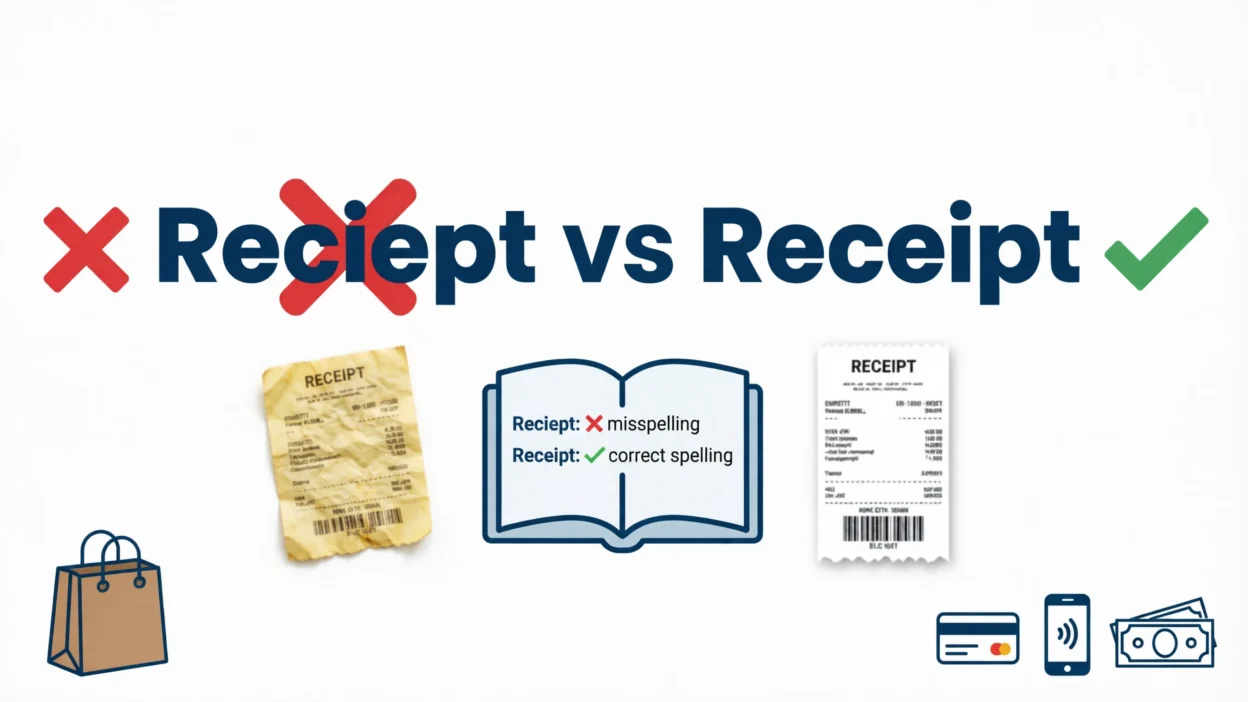
Have you ever typed reciept instead of receipt and wondered whether both spellings are acceptable? If so, you’re not alone.
The word receipt is one of the most commonly misspelled words in English because its spelling doesn’t match how most people expect it to look.
As a result, many students, professionals, and English learners often confuse reciept vs receipt.
Understanding the correct spelling is important for business communication, academic writing, financial records, and everyday English.
In this guide, you’ll learn the difference between reciept and receipt, discover why the confusion happens, see practical examples, avoid common mistakes, and understand how the word is used in American and British English.
Quick Answer
Receipt is the correct spelling in both American and British English. Reciept is a misspelling and is not recognized as a standard English word. Whenever you’re referring to a document that confirms a payment or the act of receiving something, you should always use receipt.
What Does “Receipt” Mean?
Receipt is a noun that typically refers to a written or digital record showing that money has been paid or goods have been received.
The word is commonly used in:
- Retail stores
- Banking
- Accounting
- Business transactions
- Online shopping
- Tax documentation
It can also refer to the act of receiving something, although this usage is less common in everyday conversation.
Examples
- Please keep your receipt for returns.
- I received an email receipt after making the purchase.
- The accountant organized all the receipts for tax season.
- Can you send me a copy of the receipt?
- The receipt confirmed that payment had been processed.
What Does “Reciept” Mean?
Reciept is a spelling mistake of receipt. It is not recognized as a valid English word and should not be used in formal or informal writing.
People commonly write reciept because they mistakenly apply the wrong order of the letters “i” and “e.”
Examples of Incorrect Usage
- I lost my reciept. ❌
- Please save the reciept for reimbursement. ❌
- The store emailed my reciept. ❌
Correct Versions
- I lost my receipt. ✔️
- Please save the receipt for reimbursement. ✔️
- The store emailed my receipt. ✔️
Reciept vs Receipt: Key Differences
Although the two spellings look similar, only one is correct.
| Feature | Reciept | Receipt |
|---|---|---|
| Correct English Word | No | Yes |
| Dictionary Recognition | No | Yes |
| Accepted in Professional Writing | No | Yes |
| Meaning | None in standard English | Proof of payment or receiving goods |
| Business Usage | No | Yes |
| Academic Usage | No | Yes |
The conclusion is simple: receipt is correct, while reciept is a misspelling.
Which Spelling Is Correct?
The correct spelling is receipt.
This spelling appears in dictionaries, legal documents, business records, invoices, financial reports, and everyday communication.
Use “Receipt” When:
- Referring to proof of purchase
- Discussing payments
- Managing business expenses
- Filing taxes
- Talking about financial records
Avoid “Reciept” Because:
- It is a spelling error.
- It looks unprofessional.
- It may cause confusion.
- It is not accepted in standard English.
Why Do People Confuse Reciept and Receipt?
The confusion is largely caused by English spelling patterns.
The “I Before E” Rule
Many people learn the rule:
“I before E except after C.”
Since the word contains the letter “c,” the correct spelling follows the pattern:
- Receipt ✔️
However, people often forget the rule or apply it incorrectly.
Silent Letters
The “p” in receipt is silent, making the spelling harder to remember.
Pronunciation:
ri-SEET
Because the “p” isn’t heard, many people struggle to visualize the correct spelling.
Common Typing Habits
Fast typing can lead to:
- Reciept
- Recepit
- Receit
These are all incorrect spellings.
American vs British English Differences
Unlike words such as color/colour or center/centre, receipt is spelled the same in both American and British English.
American English
Americans use:
- Receipt ✔️
Examples:
- Keep the receipt for your records.
- I need a receipt for reimbursement.
British English
British speakers also use:
- Receipt ✔️
Examples:
- Please retain your receipt.
- The receipt shows the transaction details.
There is no regional spelling difference.
Common Situations Where Receipt Is Used
Retail Purchases
Stores provide receipts after purchases.
Example:
- The cashier handed me the receipt.
Online Shopping
Digital receipts are sent by email.
Example:
- I received the receipt immediately after checkout.
Business Expenses
Employees often submit receipts for reimbursement.
Example:
- Attach all receipts to your expense report.
Tax Preparation
Receipts help verify deductions and expenses.
Example:
- Keep receipts for at least several years.
Banking and Financial Records
Receipts provide proof of transactions.
Example:
- The bank issued a receipt for the deposit.
Common Mistakes to Avoid
Mistake 1: Writing “Reciept”
Incorrect:
- Do you have the reciept?
Correct:
- Do you have the receipt?
Mistake 2: Reversing the “I” and “E”
Incorrect:
- Reciept
Correct:
- Receipt
Remember:
“I before E except after C.”
Mistake 3: Forgetting the Silent “P”
Some writers mistakenly omit or misplace the letter “p.”
- Receipt
Mistake 4: Not Proofreading Financial Documents
Misspelling common business terms can appear unprofessional.
Always double-check important documents.
Synonyms and Related Terms
Depending on the context, these related words may be useful:
- Invoice
- Proof of purchase
- Sales slip
- Transaction record
- Bill
- Voucher
- Payment confirmation
- Financial record
- Purchase record
- Acknowledgment
These terms are often associated with receipts in business and financial settings.
When Should You Use Receipt?
You should use receipt whenever referring to:
- Proof of payment
- Store purchases
- Financial records
- Expense documentation
- Online transactions
- Business accounting
Because it is the standard spelling, it is appropriate in every context.
When Should You Use Reciept?
In standard English writing, you should not use reciept.
The only situations where it may appear are:
- Discussing spelling mistakes
- Teaching English spelling
- Quoting an original typo
Otherwise, always choose receipt.
FAQs About Reciept vs Receipt
Is reciept a real word?
No. Reciept is a common misspelling of receipt.
What is the correct spelling, reciept or receipt?
Receipt is the correct spelling.
Why do people misspell receipt?
Many people reverse the positions of the letters “i” and “e” or forget the spelling rule associated with the letter “c.”
Is receipt spelled differently in British English?
No. Both American and British English use receipt.
What does receipt mean?
A receipt is proof that a payment was made or goods were received.
Why is the “p” silent in receipt?
The spelling comes from historical language origins, but modern pronunciation no longer emphasizes the “p.”
Can receipt be used digitally?
Yes. Digital receipts are commonly sent by email after online purchases.
How can I remember the correct spelling?
Remember the phrase:
“I before E except after C.”
Since receipt contains the letter “c,” the correct order is e-i.
Summary
When comparing reciept vs receipt, the correct spelling is receipt, while reciept is a common spelling mistake. The confusion usually occurs because writers reverse the letters “i” and “e” or struggle with the silent “p.” However, standard English dictionaries, businesses, schools, and professional organizations all recognize receipt as the only correct form.
Whether you’re managing finances, shopping online, filing taxes, or writing professional documents, using the correct spelling helps maintain clarity and credibility. Since the word is identical in both American and British English, you can confidently use receipt in any situation.
Actionable Takeaway
Whenever you’re unsure, remember the rule “I before E except after C.” Since receipt contains a “c,” the correct spelling uses e-i.
Proofread financial and business documents carefully to avoid this common mistake.Learn the difference between reciept vs receipt, discover the correct spelling, examples, common mistakes, and proper English usage.

Here is a professional 30-word author biography including your site name Symboliy.com:
Martin Hood is a professional writer at Symboliy.com, creating clear, informative content focused on language, communication, and meaningful expressions for everyday and professional use.