Have you ever found yourself wondering whether undecisive or indecisive is the correct word? You’re not alone.
Many English speakers use these terms interchangeably, especially in casual conversations, because they seem to carry the same meaning. However, when it comes to proper English usage, there is an important distinction.
Understanding the difference between undecisive vs indecisive can improve your writing, strengthen your communication skills, and help you avoid common language mistakes.
In this guide, you’ll learn which word is correct, what each term means, examples of proper usage, common errors, and simple tricks to remember the difference.
Quick Answer
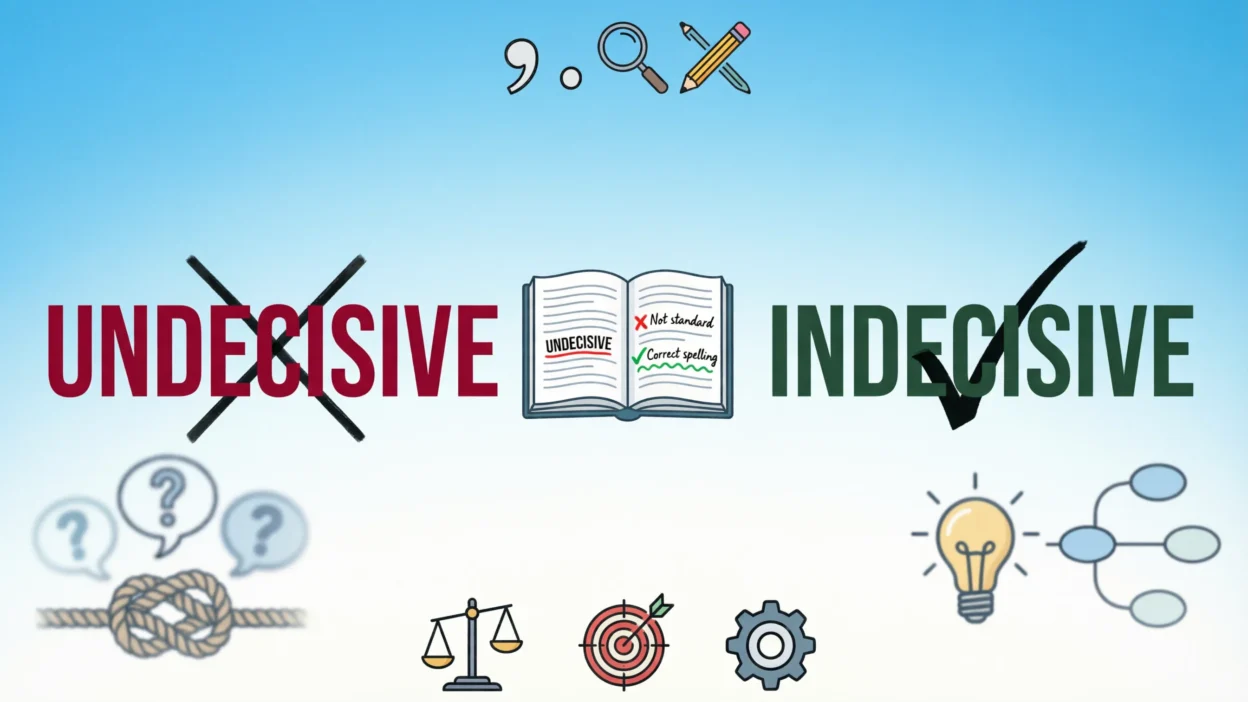
✅ Indecisive – Correct and widely accepted word
⚠️ Undecisive – Rarely used and generally considered nonstandard or incorrect in modern English
If you’re writing for school, work, business, or professional communication, always use indecisive.
What Does Indecisive Mean?
The word indecisive is an adjective used to describe someone who struggles to make decisions or has difficulty choosing between options.
Definition
Indecisive (adjective):
- Unable to make decisions quickly or confidently.
- Hesitant when faced with choices.
- Lacking determination in selecting a course of action.
Synonyms of Indecisive
- Hesitant
- Uncertain
- Undetermined
- Wavering
- Doubtful
- Vacillating
- Reluctant
- Ambivalent
Antonyms of Indecisive
- Decisive
- Determined
- Certain
- Confident
- Resolute
- Firm
What Does Undecisive Mean?
The word undecisive occasionally appears in informal speech and online writing, but it is generally considered a nonstandard variation of indecisive.
Most major dictionaries either do not recognize undecisive as a standard English word or label it as uncommon. In modern writing, professional editors, teachers, and style guides overwhelmingly recommend using indecisive instead.
Example
❌ She is very undecisive when choosing a restaurant.
✅ She is very indecisive when choosing a restaurant.
Why Do People Confuse Undecisive and Indecisive?
The confusion comes from common English word-building patterns.
Many adjectives use the prefix un-, such as:
- Unhappy
- Uncertain
- Unclear
- Uncomfortable
Because of this pattern, many people naturally assume that the opposite of “decisive” should be undecisive.
However, English already has the established word indecisive, which uses the prefix in-, meaning “not.”
As a result, indecisive became the accepted standard form.
Undecisive vs Indecisive: Comparison Table
| Feature | Undecisive | Indecisive |
|---|---|---|
| Standard English | ❌ No | ✅ Yes |
| Accepted in formal writing | ❌ No | ✅ Yes |
| Found in major dictionaries | Rarely | ✅ Yes |
| Academic use | ❌ Not recommended | ✅ Recommended |
| Business communication | ❌ Avoid | ✅ Use |
| Meaning | Similar intended meaning | Unable to make decisions |
The safest choice is always indecisive.
How to Use Indecisive Correctly
The word indecisive can describe people, actions, leadership styles, behaviors, and even outcomes.
Everyday Examples
- I’m too indecisive to choose between the two movies.
- She remained indecisive about which phone to buy.
- His indecisive nature often frustrates his friends.
- They were indecisive when selecting a vacation destination.
Professional Examples
- The manager appeared indecisive during the meeting.
- Investors became concerned about the company’s indecisive leadership.
- An indecisive response can delay important projects.
Academic Examples
- Researchers noted the participant’s indecisive behavior.
- The committee remained indecisive regarding policy changes.
Common Mistakes with Indecisive
Many writers unintentionally misuse the word.
Mistake #1: Using Undecisive in Formal Writing
❌ The candidate seemed undecisive during the debate.
✅ The candidate seemed indecisive during the debate.
Mistake #2: Assuming Both Words Are Equally Correct
While people may understand what undecisive means, it is not considered the preferred standard form.
❌ Undecisive
✅ Indecisive
Mistake #3: Mixing Up Decisive and Indecisive
Some writers accidentally use the opposite word.
❌ She was decisive about choosing a college. (when hesitation is intended)
✅ She was indecisive about choosing a college.
Easy Trick to Remember the Correct Word
A simple memory trick can help:
Think of these pairs:
- Active → Inactive
- Accurate → Inaccurate
- Complete → Incomplete
- Decisive → Indecisive
Notice the pattern?
Many English adjectives use the prefix in- to indicate the opposite meaning.
So:
Decisive → Indecisive
This makes it easy to remember that indecisive is the correct choice.
American vs British English
There is no significant difference between American and British English regarding this word.
American English
✅ Indecisive
British English
✅ Indecisive
Generally Avoided in Both
❌ Undecisive
Whether you’re writing in the United States, the United Kingdom, Canada, Australia, or elsewhere, indecisive remains the preferred spelling.
Origin and Etymology of Indecisive
The word indecisive originates from:
- Latin: indecisus
- Prefix: in- meaning “not”
- Root: related to “decide” or “determine”
The word entered English to describe someone who lacks certainty or firmness in making decisions.
This historical development is one reason why indecisive became the accepted form rather than undecisive.
Similar Word Pairs That Cause Confusion
English contains many word pairs that create similar uncertainty.
Common Examples
| Incorrect or Confusing Form | Correct Form |
|---|---|
| Undecisive | Indecisive |
| Irregardless | Regardless |
| Conversate | Converse |
| Supposably | Supposedly |
| Visable | Visible |
| Definately | Definitely |
Learning these commonly confused words can make your writing appear more polished and professional.
When Does Being Indecisive Matter?
Being indecisive can affect many areas of life.
In Personal Life
Indecisiveness can make everyday choices stressful, from selecting meals to making major life decisions.
In Business
Leaders who are consistently indecisive may struggle to gain trust and maintain momentum.
In Education
Students can become indecisive when choosing courses, careers, or research topics.
In Relationships
Being overly indecisive may sometimes create frustration when decisions need to be made together.
The word indecisive accurately describes these situations and is widely understood across contexts.
Frequently Asked Questions (FAQs)
1. Is undecisive a real word?
It occasionally appears in informal usage, but it is generally considered nonstandard. Most writers should use indecisive instead.
2. Which is correct: undecisive or indecisive?
Indecisive is the correct and accepted word in modern English.
3. Why do people say undecisive?
People often assume the opposite of “decisive” should follow the common un- prefix pattern used in many English words.
4. Is undecisive grammatically wrong?
In formal writing, it is generally viewed as incorrect or nonstandard. Indecisive is the recommended choice.
5. What does indecisive mean?
Indecisive means having difficulty making decisions or choosing between options.
6. Is indecisive a negative trait?
Not necessarily. While it can create challenges, indecisiveness may also reflect careful consideration and thoughtfulness.
7. What is the opposite of indecisive?
The opposite of indecisive is decisive, meaning able to make decisions confidently and quickly.
8. Can indecisive describe situations as well as people?
Yes. It can describe people, actions, leadership styles, discussions, and outcomes that lack a clear decision.
Summary
When comparing undecisive vs indecisive, the clear winner is indecisive. It is the standard, dictionary-recognized word used to describe someone who struggles to make decisions. Although undecisive occasionally appears in informal language, it is generally considered nonstandard and should be avoided in professional, academic, and formal writing.
Remember that the correct opposite of decisive is indecisive, not undecisive. Using the accepted form will make your writing more accurate, credible, and polished regardless of whether you’re writing an email, article, report, or social media post.
Actionable Takeaway
Whenever you’re tempted to write undecisive, replace it with indecisive. A quick proofreading check can help ensure your writing follows standard English conventions and leaves a professional impression.

Mike Poop is a dedicated writer at Symboliy.com, creating clear, practical content about language, communication, and everyday expressions to help readers understand meaning and usage confidently in professional contexts worldwide.