Have you ever typed a sentence and paused because you weren’t sure whether to use vary or very? You’re not alone.
These two words look similar, but they have completely different meanings and grammatical roles. Mixing them up is a common mistake among English learners and even native speakers when typing quickly.
In this guide, you’ll learn the difference between vary vs very, when to use each word, common mistakes to avoid, practical examples, and simple memory tricks. By the end, you’ll be confident using both words correctly in everyday writing and conversation.
Quick Answer
Vary is a verb that means to change, differ, or become different.
Very is an adverb that means to a high degree or extremely. It is used to strengthen adjectives and other adverbs.
Example:
- ✅ Prices vary depending on the season.
- ✅ The weather is very hot today.
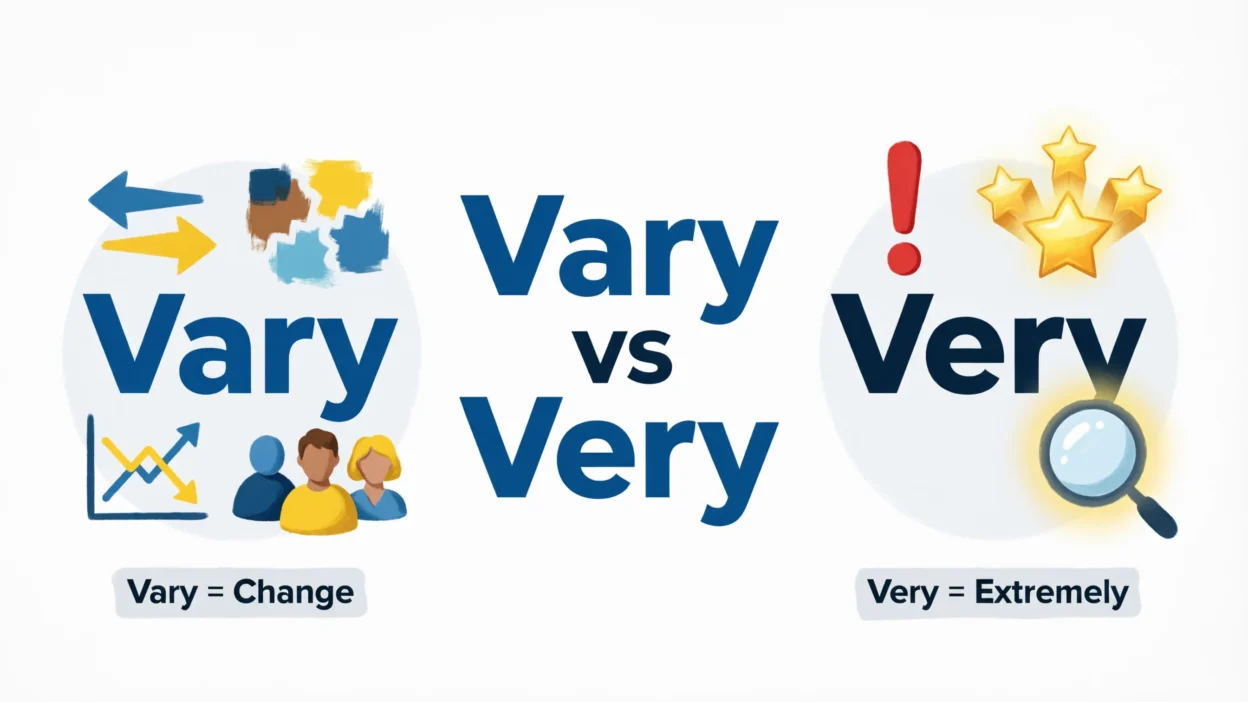
The easiest way to remember the difference is:
- Vary = Change
- Very = Extremely
What Does “Vary” Mean?
Vary is a verb that describes change or difference. It is used when something is not always the same.
Examples of “Vary”
- Prices vary from store to store.
- Results may vary depending on experience.
- Temperatures vary throughout the year.
- Opinions vary among experts.
- The color of the flowers can vary naturally.
In each sentence, vary refers to something changing or being different.
Common Uses of “Vary”
You will often see vary used with phrases such as:
- vary by
- vary depending on
- vary from…to…
- vary greatly
- vary widely
- may vary
Examples:
- Costs vary by location.
- Your experience may vary.
- The schedule varies from week to week.
What Does “Very” Mean?
Very is an adverb that adds emphasis. It makes adjectives and adverbs stronger.
Examples of “Very”
- She is very kind.
- The movie was very interesting.
- They worked very hard.
- It is very cold outside.
- The test was very easy.
In every example, very intensifies the word that follows it.
Common Uses of “Very”
You can use very before:
- Adjectives
- Adverbs
- Certain participles
Examples:
- very happy
- very fast
- very carefully
- very excited
- very important
Avoid using very before verbs in standard English.
Incorrect:
- ❌ I very like this book.
Correct:
- ✅ I really like this book.
Vary vs Very: Comparison Table
| Feature | Vary | Very |
|---|---|---|
| Part of speech | Verb | Adverb |
| Meaning | To change or differ | Extremely or to a high degree |
| Function | Shows change | Adds emphasis |
| Example | Prices vary daily. | Prices are very high. |
| Can replace with | Change, differ | Extremely, really, highly |
| Common phrases | vary by, vary from, may vary | very good, very fast, very happy |
Key Differences Between Vary and Very
Although vary and very differ by only one letter, they serve completely different purposes.
Vary
- Expresses change
- Functions as a verb
- Indicates differences over time, place, or condition
Example:
- Weather conditions vary throughout the year.
Very
- Expresses intensity
- Functions as an adverb
- Strengthens adjectives and adverbs
Example:
- The weather is very pleasant today.
Examples of Vary vs Very in Sentences
Here are side-by-side examples that make the distinction easy.
| Vary | Very |
|---|---|
| Prices vary by region. | Prices are very high. |
| Results vary depending on effort. | She is very motivated. |
| Opinions vary among teachers. | The lesson was very useful. |
| Colors vary naturally. | The colors are very bright. |
| Performance may vary. | He speaks very clearly. |
Common Mistakes People Make
Many writers accidentally replace one word with the other because they sound somewhat similar while typing quickly.
Mistake 1
❌ Prices are very depending on demand.
✅ Prices vary depending on demand.
Mistake 2
❌ She is vary happy.
✅ She is very happy.
Mistake 3
❌ The weather very from city to city.
✅ The weather varies from city to city.
Mistake 4
❌ Results are vary different.
✅ Results are very different.
Easy Memory Trick
A simple trick can help you remember these words forever.
Vary contains the idea of variation, which means change.
Very is used to give extra emphasis.
Think of it like this:
- Variation = Vary
- Emphasis = Very
Whenever you’re talking about something changing, choose vary.
Whenever you’re making something stronger or more intense, choose very.
Synonyms of Vary
Depending on the context, you can replace vary with:
- Differ
- Change
- Fluctuate
- Shift
- Alter
- Modify
- Diversify
- Adjust
Example:
- Prices fluctuate throughout the year.
- Opinions differ widely.
Synonyms of Very
Instead of repeating very, you can often choose stronger words.
Examples:
| Instead of | Try |
|---|---|
| very big | enormous |
| very small | tiny |
| very happy | delighted |
| very tired | exhausted |
| very angry | furious |
| very good | excellent |
| very cold | freezing |
| very fast | rapid |
Using stronger vocabulary often makes your writing more engaging and natural.
American vs British English
There is no spelling or meaning difference between vary and very in American English and British English.
Both varieties use these words in exactly the same way.
Examples accepted in both:
- Prices vary by location.
- She is very talented.
- Opinions vary widely.
- The coffee is very hot.
The only differences you may notice involve surrounding vocabulary or punctuation styles, not the words vary or very themselves.
Tips to Avoid Confusing Vary and Very
Remember these practical tips:
- If the sentence talks about change, use vary.
- If the sentence adds emphasis, use very.
- Check whether the word is acting as a verb or an adverb.
- Read your sentence aloud.
- Replace vary with change. If it still makes sense, you’ve chosen correctly.
- Replace very with extremely. If it works naturally, it’s probably correct.
Practice Sentences
Choose the correct word.
- Prices _____ throughout the year.
- ✅ vary
- The soup is _____ hot.
- ✅ very
- Results may _____ depending on experience.
- ✅ vary
- She is _____ friendly.
- ✅ very
- Weather conditions _____ from region to region.
- ✅ vary
FAQs
Is “vary” the same as “very”?
No. Vary means to change or differ, while very means extremely or to a high degree.
Is “vary” a verb?
Yes. Vary is always used as a verb because it describes change or difference.
Is “very” an adjective?
No. Very is an adverb that modifies adjectives, adverbs, and sometimes participles.
Can I replace “very” with “really”?
Often, yes. In many informal situations, really and very have similar meanings, although very is generally considered more formal.
Why do people confuse vary and very?
They have similar spellings and are often typed quickly. However, their meanings and grammar are completely different.
Is “results may vary” grammatically correct?
Yes. It is a standard English expression meaning that outcomes may differ depending on circumstances.
Can “very” come before a verb?
Usually no. Instead, use words like really, truly, or greatly, depending on the context.
Are “vary” and “very” pronounced differently?
Yes. Although they look similar, they have different pronunciations, which helps distinguish them in spoken English.
Summary
Understanding vary vs very is easier once you remember their roles. Vary is a verb that describes change, difference, or fluctuation, while very is an adverb that adds emphasis to adjectives and adverbs. Even though they differ by only one letter, they cannot replace each other because they serve entirely different grammatical functions.
Whenever you write, ask yourself whether you’re describing change or intensity. If you’re talking about something changing, use vary. If you’re strengthening a description, use very. Practicing with real-life examples and checking your sentences before publishing will help you avoid this common mistake and write with greater clarity and confidence.
Actionable Takeaway: Before using vary or very, substitute change for vary or extremely for very. If the sentence still sounds natural, you’ve chosen the correct word.

Here is a professional 30-word author biography including your site name Symboliy.com:
Martin Hood is a professional writer at Symboliy.com, creating clear, informative content focused on language, communication, and meaningful expressions for everyday and professional use.