The difference between either vs whether can be confusing because both words are often used when talking about choices or alternatives.
Although they may appear in similar types of sentences, they have different grammatical roles and cannot always replace one another.
If you’ve ever wondered whether to use either or whether, this guide will make the distinction clear.
You’ll learn the meaning of each word, understand when to use them, see practical examples, avoid common mistakes, and discover simple memory tricks to help you choose the correct word every time.
Quick Answer
Both either and whether are correct English words, but they serve different purposes.
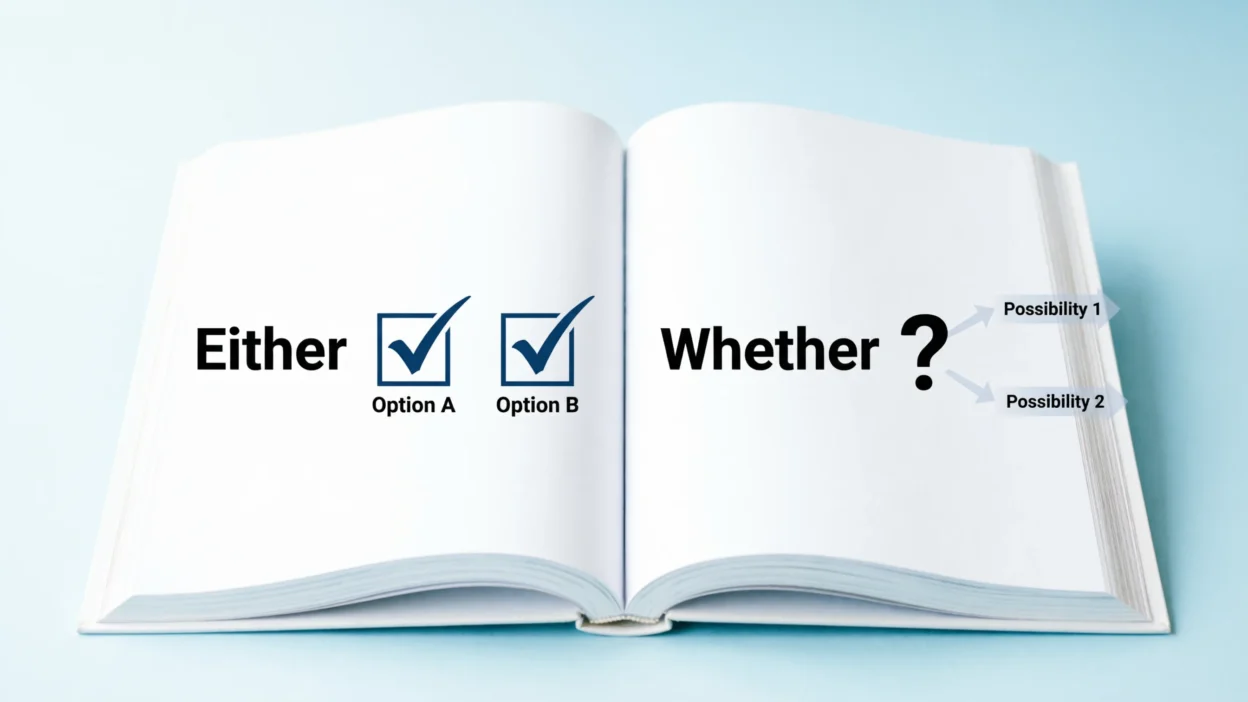
- ✅ Either = Refers to one of two choices or alternatives.
- ✅ Whether = Introduces a choice, possibility, or uncertainty between alternatives.
- ❌ They are not interchangeable in most sentences.
A simple rule to remember is: Use “either” to refer to a choice, and use “whether” to introduce a question or uncertainty about a choice.
What Does “Either” Mean?
Either is a determiner, pronoun, adverb, or conjunction depending on how it is used. It generally refers to one of two people, things, or options.
You can use either to indicate that one of two choices is acceptable or possible.
Examples:
- You can choose either dress.
- Either answer is correct.
- We can leave on Monday or Tuesday; either day works for me.
- There are trees on either side of the road.
In each example, either refers to one of two alternatives.
What Does “Whether” Mean?
Whether is a conjunction used to introduce alternatives, possibilities, or uncertainty. It often means if when presenting two or more options.
Examples:
- I don’t know whether he will come.
- She asked whether we were ready.
- We need to decide whether to stay or leave.
- Tell me whether you agree.
Unlike either, whether introduces a clause rather than referring directly to one of the options.
Either vs Whether: The Key Difference
| Feature | Either | Whether |
|---|---|---|
| Meaning | One of two choices | Introduces alternatives or uncertainty |
| Part of Speech | Determiner, pronoun, adverb, conjunction | Conjunction |
| Refers to a Choice | ✅ Yes | ✅ Yes |
| Introduces a Clause | ❌ Usually No | ✅ Yes |
| Can Mean “One or the Other” | ✅ Yes | ❌ No |
| Grammatically Correct | ✅ Yes | ✅ Yes |
The main difference is that either points to one of the choices, while whether introduces the choice itself.
Why Do People Confuse Either and Whether?
These words are often confused because they frequently appear in sentences involving two options.
Common reasons include:
- Both relate to alternatives.
- Both often appear with the word or.
- Learners sometimes assume they perform the same grammatical function.
- Some expressions contain both words, making the distinction less obvious.
Understanding the sentence structure helps you choose the correct word.
Examples of “Either” in Sentences
Use either when referring to one of two options.
- You may sit in either chair.
- Either solution will solve the problem.
- I don’t like either movie.
- She can take either route.
- Either candidate would do an excellent job.
Each sentence refers directly to one of two choices.
Examples of “Whether” in Sentences
Use whether when introducing uncertainty or alternatives.
- I’m not sure whether it will rain.
- He asked whether dinner was ready.
- We haven’t decided whether to buy the house.
- Please let me know whether you’ll attend.
- She wondered whether the train had already left.
In each example, whether introduces a clause expressing uncertainty or alternatives.
Common Mistakes to Avoid
Many writers mistakenly replace one word with the other.
Avoid these common errors:
- ❌ I don’t know either he is coming.
- ✅ I don’t know whether he is coming.
- ❌ You may choose whether option.
- ✅ You may choose either option.
- ❌ We need to decide either to stay or leave.
- ✅ We need to decide whether to stay or leave.
- ❌ Whether answer is acceptable.
- ✅ Either answer is acceptable.
Always ask yourself whether you’re introducing a choice or referring to one of the choices.
A Simple Memory Trick
Here’s an easy way to remember the difference.
- Either = One of two options.
- Whether = Introduces uncertainty or a decision.
Memory tip:
Choose one? Use either.
Wondering which? Use whether.
Either vs Whether in Everyday Writing
You’ll commonly see either in:
- Everyday conversations
- Instructions
- Choices and options
- Recommendations
- Decision-making
You’ll commonly see whether in:
- Questions
- Formal writing
- Academic essays
- Business communication
- Conditional statements
Recognizing the sentence’s purpose makes the correct choice much easier.
American vs British English
There is no grammatical difference between American English and British English in the use of either and whether.
However, pronunciation of either varies.
- In American English, both EE-ther and EYE-ther are common.
- In British English, EYE-ther is traditionally more common, although both pronunciations are widely accepted.
The grammar and meanings remain the same in both varieties of English.
Related Words and Synonyms
Depending on the context, you may also use these related words.
For either:
- One
- Any one
- One or the other
- Each (in some contexts)
- Both (in contrasting constructions)
For whether:
- If (in some situations)
- Regardless of whether
- Whether or not
- In case (context-dependent)
Keep in mind that these alternatives are not always interchangeable.
Frequently Asked Questions
Are “either” and “whether” interchangeable?
No. Either refers to one of two choices, while whether introduces alternatives or uncertainty.
When should I use “either”?
Use either when referring to one of two people, things, or options.
When should I use “whether”?
Use whether when introducing a clause about alternatives, decisions, or uncertainty.
Is “whether or not” correct?
Yes. Whether or not is a common expression used to emphasize that both possibilities are included.
Can “whether” be replaced with “if”?
Sometimes. In informal contexts, if can replace whether, but whether is preferred in many formal and specific grammatical situations.
Is “either of” grammatically correct?
Yes. Phrases such as either of the books and either of us are perfectly correct.
Do American and British English use these words differently?
No. The grammar is the same. The main difference is the common pronunciation of either.
How can I remember the difference?
Think of either as choosing one of two options and whether as introducing a decision or uncertainty.
Summary
Understanding the difference between either vs whether is essential for clear and accurate writing. Either refers to one of two choices or alternatives, while whether introduces a clause expressing uncertainty, possibility, or a decision between options. Although they often appear in similar contexts, they perform different grammatical functions and cannot usually replace one another.
Whenever you write, consider what your sentence is doing. If you’re pointing to one of two options, choose either. If you’re introducing a question, decision, or uncertainty, choose whether. Using the correct word will make your writing more precise, natural, and grammatically correct.
Actionable Takeaway: Before choosing between either and whether, ask yourself one question: Am I referring to a choice or introducing a decision? If you’re referring to one of two options, use either. If you’re introducing uncertainty or alternatives, use whether.

Here is a professional 30-word author biography including your site name Symboliy.com:
Martin Hood is a professional writer at Symboliy.com, creating clear, informative content focused on language, communication, and meaningful expressions for everyday and professional use.